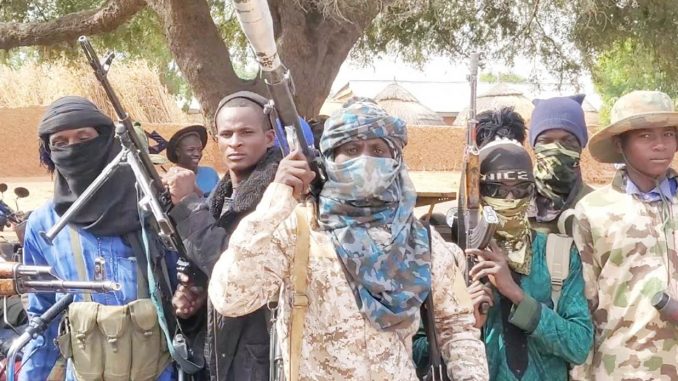
Bello Turji is a Fulani warlord commanding more than 1,000 fighters across northwestern Nigeria. For nearly a decade, he has carried out mass kidnappings, extortion, and massacres while evading Nigerian military operations, U.S. airstrikes, and multiple Defence Headquarters manhunts. As of June 2026, he is reportedly rearming, conducting large-scale weapons training, and allegedly collaborating with Boko Haram to expand his network. Photo courtesy of Parallel Facts News via X.
Published June 22, 2026
Rise of a Notorious Bandit Leader
On February 2, an armed group leader appeared in a short video clip and issued a chilling threat: he would invite terrorists and criminal armed groups from neighboring African countries to help destabilize Nigeria. The footage was recorded during a reconciliation meeting held in a forest and facilitated by self-appointed negotiator and prominent Islamic cleric Dr. Ahmad Gumi. The man making the threat was Turji Kachalla, widely known as Bello Turji or Muhammad Bello (HumAngle, February 4).
At just 27 years old, Turji had already become one of the most feared figures in northwestern Nigeria. Born and raised in the Fulani pastoral settlements of Shinkafi in Zamfara State, he earned admiration among some Fulani youths for his fierce defense of Fulani communities and their cattle against perceived discrimination and hostility. Before entering organized banditry, Turji reportedly engaged in numerous local conflicts with farming communities around Shinkafi.
His path into armed violence began when he joined a Fulani militia led by the notorious bandit Buharin Daji. Initially a low-ranking member with limited influence, Turji gradually learned the dynamics of criminal operations under Daji’s leadership (Militant Leadership Monitor, March 2021).
From 2011 to 2018, Buharin Daji dominated the banditry landscape in Zamfara and neighboring states. Despite participating in peace negotiations with then-Governor Abdulaziz Yari in 2016, Daji later resumed violent attacks. His reign ended in 2018 when he was killed by his lieutenant, Dogo Gide, during an internal power struggle at a camp in Madada Forest, Zamfara (Daily Trust, March 15, 2018). Following Daji’s death, Turji emerged as one of the most influential bandit leaders in the region.
Turji’s Leadership Style and Expansion
Turji’s criminal career was shaped by mentorship from notorious bandit leaders Halilu Sububu and Shehu Rekeb, both known for their extensive networks and connections with armed groups operating across the Sahel. Inspired by their organizational skills, Turji began building his own network, recruiting heavily from among close relatives and young men from Fulani communities.

Notorious bandits kingpin, Bello Turji, has released a new video message confirming that negotiations are ongoing with him to end violence and insecurity in parts of Zamfara and neighbouring states.
During discussions with Dr. Gumi, Turji claimed that many of his fighters were victims of injustice whose livelihoods had been destroyed by government security operations and the activities of civilian vigilante groups known as Yan Sakai. According to Turji, these grievances pushed many young men into armed criminality. He admitted that his group initially financed its operations through cattle rustling, using stolen livestock to purchase weapons and sustain its activities (TheCable.ng, February 13).
Turji’s youth and extensive local connections enabled him to attract recruits from multiple bandit camps across Zamfara State, including Zurmi, Anka, and Sabon Birni. Although the exact size of his force remains unclear, security analysts estimate that he commands at least 200 fighters operating around Shinkafi and Zurmi, while subordinate commanders oversee operations in Isa and Sabon Birni in neighboring Sokoto State.
A striking characteristic of Turji’s organization is the age of many of its members. Numerous fighters are reportedly under 20 years old and are locally referred to as “Yan Shabakwai,” a Hausa term meaning “seventeen years,” reflecting the youthfulness of his combatants (Leadership.ng, February 5).
Campaign of Violence Against Civilians
Turji’s notoriety stems largely from a series of brutal attacks against civilian populations across northwestern Nigeria.
In July, he orchestrated one of his most infamous operations after Nigerian authorities detained his father due to concerns over Turji’s criminal activities. Seeking leverage, Turji launched attacks across Shinkafi, taking more than 200 people hostage, killing 63 residents, and burning over 338 homes. He publicly declared that the captives would only be released if his father was freed.
Turji accused local residents of providing intelligence to security agencies regarding his father’s whereabouts after the elder Turji had relocated to Jigawa State in an attempt to distance himself from his son’s activities. The crisis eventually forced government intervention, culminating in a negotiated exchange in which Turji’s father was released and more than 200 abductees regained their freedom (Daily Trust, July 19).
The attack demonstrated Turji’s willingness to target entire communities in pursuit of personal and strategic objectives. It also highlighted the difficulties Nigerian authorities face when confronting heavily armed groups capable of carrying out mass kidnappings and collective punishment against civilians.
Escalating Regional Insecurity
Violence linked to Turji continued to spread across northwestern Nigeria. Just days before authorities imposed a telecommunications shutdown in Zamfara State in September, Turji’s fighters launched a major assault on Sabon Birni in Sokoto State.
The attack forced residents from more than 14 villages to flee their homes.
Approximately 1,000 cattle were stolen, while countless civilians were displaced as armed men swept through the affected communities. The assault reinforced Turji’s reputation as one of the region’s most dangerous bandit commanders and underscored the growing reach of armed groups operating across state boundaries.
For many residents of Zamfara, Sokoto, and neighboring states, Bello Turji has become a symbol of the broader security crisis gripping northwestern Nigeria—a conflict fueled by weak governance, rural poverty, ethnic tensions, and the proliferation of armed criminal networks. Despite repeated military operations and peace initiatives, Turji’s ability to recruit, organize, and launch attacks continues to challenge efforts to restore stability in the region.
Today, his name remains synonymous with banditry, kidnapping, and terror, illustrating how local grievances and criminal enterprise can evolve into a persistent threat to national security.
 Bottom Line
The rise of Bello Turji reflects the complex and evolving security crisis in northwestern Nigeria. Emerging from local conflicts involving pastoralist communities, Turji transformed from a little-known militia member into one of the region’s most feared bandit leaders. Through strategic recruitment, exploitation of local grievances, and the use of extreme violence, he built a criminal network capable of challenging state authority and terrorizing entire communities.
His involvement in mass kidnappings, village attacks, cattle rustling, and retaliatory violence has left thousands displaced and deepened insecurity across Zamfara, Sokoto, and neighboring states. At the same time, his ability to attract young recruits and maintain influence despite repeated military operations highlights the broader challenges facing Nigerian authorities in addressing armed banditry.
Ultimately, Bello Turji’s story is not only about one warlord but also about the conditions that enable such figures to emerge. Lasting peace in northwestern Nigeria will require more than security operations alone. It will depend on strengthening governance, improving economic opportunities, addressing community grievances, and restoring public trust in state institutions. Without tackling these underlying factors, the cycle of violence that gave rise to Turji may continue to produce new generations of armed leaders, threatening the stability and development of the region for years to come.
SOURCES: THE GATEWAY PUNDIT – Bello Turji: The Fulani Warlord Terrorizing Northwestern Nigeria
JAMESTOWN FOUNDATION – The Rise of Turji: The Notorious Bandit Leader Terrorizing Northwestern Nigeria