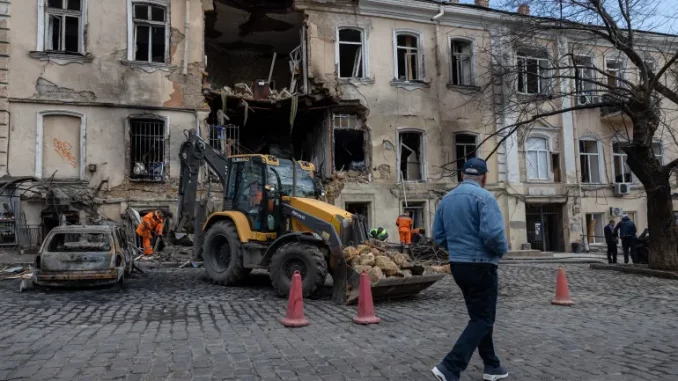
Municipal workers clear the rubble of a residential building damaged after a Russian drone attack in Odesa, Ukraine, on March 19, 2026 [Oleg Grekov/AP Photo]
Published March 25, 2026
The Ukraine war entered a difficult new phase this week as a renewed Russian offensive takes shape along the eastern front while diplomatic efforts to reach a ceasefire have stalled. At the same time, power outages caused by Russian attacks have plunged hundreds of thousands of civilians in both Ukraine and adjacent regions into darkness, underscoring the war’s widening impact.
Renewed Russian Offensive on Eastern Front
Russian forces have launched a spring offensive aimed at strategic targets in Ukraine’s eastern Donetsk region — including near Sloviansk, Pokrovsk, and Kostiantynivka — pressing against well‑defended Ukrainian positions known as the “Fortress Belt.” The advance is seen as an attempt to exploit openings created by shifting global attention and the slow pace of international diplomacy.
Ukrainian troops, while outnumbered, have used drone strikes and mid‑range weapons to blunt some Russian moves, reclaiming limited territory in recent weeks. Military analysts suggest Russia may achieve tactical gains but is unlikely to produce a decisive breakthrough along heavily fortified lines.
Diplomacy Stalls Amid Battlefield Pressure
Efforts backed by the United States to revive peace negotiations have stalled, leaving Ukraine and Russia without a clear diplomatic path forward. The lack of progress in talks has added pressure on Kyiv, as military supply lines are strained and focus shifts to front‑line capabilities.
Ukrainian commanders have emphasized adapting battlefield tactics, especially leveraging drone technologies against Russian logistics, even as political dialogue remains stalled.
Power Outages Disrupt Lives and Services
In addition to the intensifying ground offensive, Russia’s campaign against infrastructure has knocked out electricity for hundreds of thousands of residents on both sides of the conflict. In Russia’s Belgorod region, about 450,000 consumers lost electricity, while another 150,000 people were left without power in Ukraine’s Chernihiv area following repeated missile and drone strikes targeting energy grids.
The deliberate targeting of power infrastructure adds a civilian hardship dimension to the conflict, affecting everyday life, business activity, and public services. These outages also reflect the broader strategy of infrastructure disruption that has marked years of hostilities.
Humanitarian and Economic Impact
The cascading effects of battlefield escalation and energy disruption are now felt far beyond the front lines. Power outages complicate heating, healthcare, and basic services, particularly in the face of colder seasons. Energy experts warn that repeated damage to electricity grids can have long‑lasting economic consequences unless repaired and protected.
Outlook: Uncertain Path Ahead
With diplomacy stalled and military operations intensifying, the trajectory of the Ukraine conflict remains uncertain. Both sides appear committed to solidifying their positions — Kyiv defending its territory and Russia seeking incremental advantages — while the civilian population continues to bear the brunt of strategic decisions made far from their homes.
As the war enters another spring campaign, the need for renewed diplomatic impetus — backed by credible security guarantees — remains critical, even as the battlefield reality grows more complex.
🧩 The Core Analysis: Strength, Deterrence, and the Limits of Diplomacy
The renewed Russian offensive and widespread attacks on energy infrastructure in Ukraine reveal a stark reality: diplomacy alone cannot deter aggression without credible defensive capabilities. While international efforts at negotiations continue, the battlefield demonstrates that real leverage is derived from strength and preparedness, not solely from dialogue.
Battlefield Pressure Exposes Vulnerabilities
Russia’s spring offensive highlights how momentum on the ground can dictate the terms of engagement. Ukrainian forces, despite tactical successes, face sustained attacks that strain resources, infrastructure, and civilian resilience. This underscores that a nation’s negotiating position is inseparable from its ability to protect territory and sustain operations under fire.
Infrastructure as a Strategic Target
The deliberate targeting of power grids and civilian utilities illustrates how conflict extends beyond troop movements. When electricity, heating, and essential services are disrupted, the consequences ripple into the economy and public morale. Effective defense, therefore, is not limited to the front lines; it must encompass the protection of critical infrastructure.
Diplomacy Without Credible Backing Falls Short
Repeated stalemates in peace talks show that adversaries are unlikely to compromise unless facing a credible threat to their objectives. Negotiations that are not grounded in enforceable consequences are perceived as weakness, emboldening continued aggression.
🔗 The Synthesis: Strength Shapes Negotiation
The latest developments in Ukraine demonstrate that the interplay between military capability and diplomacy is decisive. Russia’s renewed offensive, combined with attacks on civilian power infrastructure, underscores that negotiations cannot succeed without credible leverage. Words alone are insufficient when an adversary can act unimpeded on the battlefield.
Defense Underpins Diplomacy
Ukraine’s ability to hold strategic positions, execute counter-strikes, and protect its infrastructure directly affects its bargaining power. Diplomacy is most effective when backed by the tangible capability to enforce terms and defend national interests. Without this foundation, proposals for ceasefires or peace agreements risk being ignored.
Civilian and Economic Stakes Highlight Urgency
The attacks on electricity grids and essential services illustrate how military action extends beyond the front lines, creating pressure on civilian populations and economies. These realities demonstrate that strategic resilience and protection of critical systems are as crucial as troop deployments in shaping the outcome of negotiations.
A Framework for Lasting Stability
The situation highlights a broader principle: lasting security and effective diplomacy require preparation, credible deterrence, and resilience. Nations must combine clear defensive capabilities with negotiation efforts, ensuring that adversaries recognize the consequences of noncompliance.
🏁 The Final Word: Strength First, Diplomacy Second
The latest phase of the Russia‑Ukraine conflict demonstrates a critical lesson: effective negotiation depends on credible power and resilience. Battlefield gains, infrastructure protection, and strategic readiness directly shape a nation’s ability to influence outcomes.
Diplomacy alone cannot halt aggression when adversaries perceive weakness or unchallenged freedom of action. Only when negotiation is paired with enforceable consequences and a firm defensive posture can stability be achieved.
For Ukraine and its partners, the path forward is clear: maintain strength, secure critical systems, and let capability underpin every diplomatic initiative. Without this foundation, agreements remain fragile, and civilian populations bear the cost of unmitigated conflict.