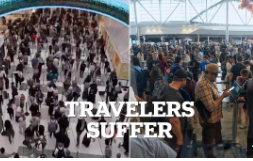
Claustrophobic fliers suffering panic attacks while waiting in dank underground tunnel at Houston Airport, as TSA wait times came close to FIVE HOURS
Published March 25, 2026
Travelers at George Bush Intercontinental Airport (IAH) reported panic attacks, long security lines, and extreme delays as Transportation Security Administration (TSA) screening lanes became overwhelmed, leaving passengers stranded and anxious.
According to passenger accounts, what should have been routine security checks turned into hours‑long ordeals, with some flyers describing the experience as “claustrophobic” and “stress‑inducing.” Many reported standing for long stretches in crowded lines under bright lights, with minimal space and increasing tension as flight departure times loomed.
TSA Lines Stretch as Staffing and Process Issues Strain Screenings
The chaotic scenes have been linked to a convergence of factors that has stretched TSA resources thin:
- Staffing shortages — TSA personnel numbers have not kept pace with post‑pandemic travel volumes at IAH, a major international hub.
- Increased passenger counts — Airports nationwide are seeing a resurgence of travel demand, putting pressure on screening checkpoints.
- Operational bottlenecks — Fewer open lanes than needed has compounded long wait times, causing frustration among travelers.
Passengers reported waits of two to three hours or more just to reach the x‑ray and body‑scanner stages, with some saying they feared missing flights and others describing full‑blown panic attacks amid the jammed queues.

The lines was three-floors long and seemingly endless as passengers waited at least two hours

Houston airports, like George W. Bush, are facing the highest wait times in the country as both airports have a high number of callouts
Traveler Reactions: Stress, Panic, and Missed Flights
One traveler described the experience as “claustrophobia on a grand scale,” saying that long waits, close crowds, and the perception that nothing was moving triggered intense anxiety. Another passenger said they watched others become so overwhelmed they became physically ill in line.
Several passengers said they received few updates from TSA agents while they waited, adding to the frustration and uncertainty.

Passengers were still waiting in at least two-hours line on Wednesday at George W. Bush
Airport and TSA Response
In response to mounting customer complaints, airport officials acknowledged that security wait times have been significantly higher than normal at several checkpoints. TSA spokespeople have said that they are working to open additional lanes and redirect staff where possible to relieve congestion. However, no immediate timeline has been offered for when wait times might return to normal.
A TSA representative reminded flyers to arrive well in advance of departure times, especially during peak travel hours, and stressed that security procedures must be completed carefully for passenger safety.
Broader Implications for Air Travel
The problems at Houston’s busiest airport highlight a broader trend affecting U.S. air travelers: as passenger numbers continue to recover and exceed pre‑pandemic levels, security operations and staffing are struggling to keep pace. Long TSA lines have become a recurring complaint at several major airports, prompting calls for improved staffing, better technology, and more efficient screening protocols.
🧩 The Core Analysis: Efficiency and Security Under Pressure
The chaos at George Bush Intercontinental Airport highlights a fundamental challenge in balancing passenger convenience with effective security enforcement. While TSA procedures are designed to protect travelers and prevent threats, long wait times and overwhelmed checkpoints demonstrate the operational limits of the current system.
Security Procedures vs. Operational Capacity
Screening operations are intended to detect prohibited items, maintain safety, and enforce federal travel regulations. However, when staffing levels and lane availability cannot match passenger volumes, the system becomes a source of stress rather than protection. Claustrophobia and panic attacks among passengers reflect how procedural safeguards can unintentionally create public hazards when operational efficiency is compromised.
Systemic Strain on National Security Resources
The congestion at TSA checkpoints is not merely an inconvenience—it exposes vulnerabilities in national security logistics. Excessive wait times increase the risk of missed flights, disrupted travel schedules, and public frustration, which can indirectly affect compliance and safety. Ensuring that TSA personnel and infrastructure can handle peak travel demands is essential to maintain both security integrity and public confidence.
🔗 The Synthesis: Security Coupled With Operational Readiness
The chaos at Houston’s George Bush Intercontinental Airport underscores a fundamental principle: security measures alone cannot guarantee safe and efficient travel without the operational capacity to implement them effectively. TSA procedures are designed to protect passengers, but long lines, staffing shortages, and procedural bottlenecks reveal that enforcement without preparedness can create risk and public frustration.
Capacity Determines Effectiveness
The incidents of panic attacks and stress among travelers demonstrate that maintaining public confidence requires more than rules; it requires adequate personnel, functional infrastructure, and efficient processes. Without these elements, even well-intentioned safety protocols can inadvertently compromise both safety and order.
Implications for National Security and Public Confidence
Airports are critical points of national security. When operational gaps slow enforcement, they not only inconvenience travelers but also reduce the overall effectiveness of federal security measures. Preparedness and resource allocation are therefore as essential as the procedures themselves.
🏁 The Final Word: Preparedness Ensures Security and Efficiency
The situation at George Bush Intercontinental Airport highlights a key lesson: security measures are only as effective as the systems supporting them. TSA procedures are vital for maintaining safe air travel, but without sufficient staffing, operational capacity, and infrastructure, these safeguards can create unnecessary stress and inefficiency for passengers.
Ensuring that security operations are fully resourced and well-managed is essential not only for public safety but also for maintaining confidence in national travel systems. A balance between rigorous enforcement and practical execution is critical to prevent disruptions while protecting travelers and national security.