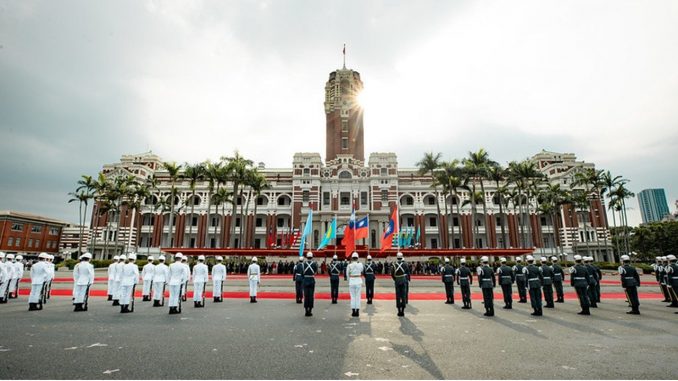
Taiwan is a high-functioning democracy with its own legal system, freedoms, government, military, and currency. Maintaining the nation’s sovereignty depends on sustaining a strong military and coordinating closely with its strongest ally, the United States. Photo courtesy of the Office of the President of Taiwan.
Published January 24, 2026
2026 is shaping up to be one of the most consequential years yet in the ongoing strategic contest between Taiwan and the People’s Republic of China (PRC). Multiple military, political, and socioeconomic pressures are converging in ways that analysts say could heighten the risk of escalation across the Taiwan Strait — even if a full-scale invasion remains uncertain.
1. The Strategic Countdown: The “Davidson Window”
The notion of a “Davidson Window” — named after former U.S. INDOPACOM commander Admiral Philip Davidson — refers to a period between roughly 2021 and 2027 in which China is expected to reach decisive military capability to potentially take Taiwan by force.
Because Chinese leader Xi Jinping set 2027 as a milestone for the People’s Liberation Army (PLA) to complete its modernization, 2026 is widely viewed as the final flexible year before major political constraints and leadership transitions tighten Beijing’s options.
This has made 2026 a focal point for both heightened military activity and intense diplomatic signaling.
2. PLA Military Build-Up and Exercises
China’s military modernization continues at a rapid clip:
-
The PLA’s missile arsenal and launchers have more than doubled over the last half decade, expanding the range and lethality of potential strikes.
-
Naval and amphibious transport capabilities have grown, alongside a third aircraft carrier, increasing China’s ability to project force across the Taiwan Strait.
-
Large-scale military drills — including the Justice Mission 2025 exercises — have been conducted repeatedly near Taiwanese airspace and waters, seen by analysts as both demonstrations of strength and rehearsals for future campaigns.
Experts in Taipei and Washington warn that these exercises could be used as cover for real operational deployments, making it harder to distinguish routine training from preparations for conflict.
3. Taiwan’s Defense Challenges
Despite bolstered weapon deliveries from the U.S., such as Harpoon coastal defense systems and newer F-16V fighters, Taiwan’s military is still transitioning to a fully integrated asymmetric defense model.
Compounding this are demographic pressures — Taiwan officially becomes a “super-aged society” in 2026, with over 20% of the population aged 65 and older. This shrinking pool of young recruits puts additional strain on Taiwan’s defense manpower just as strategic threats rise.
Energy security is another vulnerability: Taiwan’s shift away from coal and nuclear power has led to a heavy dependence on imported Liquefied Natural Gas (LNG), with only about 11–14 days of reserves on hand, which could cripple the grid in the event of a blockade or conflict.
4. Political Dynamics on the Island
Taiwan’s internal politics also feed into Beijing’s calculations. President Lai Ching-te’s government lacks a legislative majority as of January 2026, and opponents have blocked key defense budget measures.
With local elections slated for late 2026, China is expected to intensify “gray-zone” pressure — diplomatic, economic, and information operations aimed at shaping Taiwanese public opinion and weakening resistance to unification.
5. Cyber and Hybrid Warfare Pressures
Beyond traditional military postures, Taiwan faces rising cyber pressure from Beijing. In 2025, daily cyberattacks on critical infrastructure — from energy grids to hospitals — averaged 2.63 million attacks a day, a notable increase over prior years.
These operations often coincide with military drills and are part of broader “hybrid warfare” tactics designed to erode resilience and sow disruption without crossing the threshold into kinetic conflict.
6. The Wider Strategic Context and U.S. Role
How Washington responds remains central to Taiwan’s security outlook. Some analysts believe muted U.S. responses to Chinese military actions — especially amid domestic political shifts like U.S. midterm election cycles — could embolden Beijing’s decision-making calculus.
Yet it’s also clear that Taiwan is backed by longstanding ties with the U.S. and other regional partners, whose policies continue to evolve in response to PRC threats and wider Indo-Pacific geopolitical dynamics.
 Implications of Rising Cross-Strait Tensions in 2026
1. Global Economic Shock Risks
Any serious escalation around Taiwan would have immediate global consequences. Taiwan dominates advanced semiconductor manufacturing, and even a limited blockade or prolonged military standoff could disrupt supply chains worldwide—impacting electronics, automobiles, defense systems, and critical infrastructure. Markets would likely react sharply, triggering inflationary pressures and capital flight across Asia and beyond.
2. Increased Risk of Miscalculation
With frequent PLA drills, gray-zone operations, and heightened air and naval activity, the margin for error is shrinking. An accidental collision, misread military movement, or cyber disruption could rapidly spiral into a broader crisis—even if neither side intends to initiate open conflict.
3. Strain on U.S. and Allied Credibility
How the United States and its regional partners respond in 2026 will shape future deterrence. A weak or inconsistent response to Chinese pressure could embolden Beijing not only regarding Taiwan, but also in the South China Sea and beyond. Conversely, stronger signaling may deter aggression but raises the risk of escalation.
4. Taiwan’s Internal Pressure Test
Taiwan faces a decisive stress test of its political unity and civil resilience. Legislative gridlock, demographic decline, and energy vulnerability could be exploited through psychological and economic pressure campaigns. Public confidence in governance and defense preparedness will be as critical as military hardware.
5. Normalization of Hybrid Warfare
Cyberattacks, disinformation, economic coercion, and legal warfare are likely to become more frequent and more normalized. This blurs the line between peace and conflict, making it harder for governments to justify decisive responses while gradually eroding Taiwan’s strategic position.
6. Regional Militarization Acceleration
Neighboring states—Japan, the Philippines, South Korea, and Australia—may accelerate defense spending and strategic alignment in response to instability. This could reshape the Indo-Pacific security architecture, increasing long-term polarization between blocs led by Washington and Beijing.
7. Long-Term Strategic Precedent
How 2026 unfolds may set a precedent for future territorial disputes worldwide. If coercion succeeds without consequence, it could encourage similar strategies elsewhere. If deterrence holds, it reinforces the principle that forceful revision of borders carries unacceptable costs.
 Overall Takeaway: A Defining Moment, Not a Foregone War
The growing sense of danger surrounding Taiwan in 2026 does not stem from a single trigger, but from the convergence of military readiness, political timing, economic vulnerability, and strategic uncertainty. This alignment makes the year uniquely sensitive — not because conflict is inevitable, but because the cost of miscalculation has never been higher.
For Beijing, the pressure to demonstrate momentum toward unification collides with economic headwinds, internal legitimacy concerns, and the reality that a failed or protracted campaign would be catastrophic. For Taiwan, the challenge lies in sustaining public confidence, strengthening resilience, and closing critical gaps in energy security, manpower, and civil defense under constant psychological pressure. For the United States and its allies, 2026 represents a credibility test: deterrence must be strong enough to prevent aggression without tipping the region into a self-fulfilling crisis.
What makes this moment especially dangerous is the normalization of coercion. Gray-zone tactics, cyber operations, and military signaling have become routine, blurring the line between peace and conflict. Over time, this erodes strategic clarity and increases the likelihood that a crisis could begin not with a declaration, but with a misunderstanding — an exercise mistaken for an invasion, a cyberattack triggering kinetic retaliation, or a blockade framed as law enforcement.
Yet restraint remains rational. Taiwan’s central role in global semiconductor production, the interdependence of the world economy, and the unpredictable consequences of major-power conflict continue to impose powerful constraints on all sides. These realities suggest that 2026 is less a countdown to war than a stress test of deterrence, diplomacy, and crisis management.
How this year unfolds will shape more than the future of Taiwan. It will influence global norms on sovereignty, coercion, and the use of force in an era defined by great-power competition. If pressure succeeds without resistance, it may encourage similar strategies elsewhere. If deterrence holds, it reinforces the principle that stability is preserved not by escalation, but by resilience, clarity, and credible resolve.
In that sense, 2026 may be remembered not for the conflict that occurred — but for whether the international system proved capable of preventing one.
SOURCES: THE GATEWAY PUNDIT – A Dangerous Year for Taiwan: Converging Pressures Raise the Risk of Chinese Invasion
TAIPEI TIMES – Taiwan conflict ‘catastrophic’ for China: US report