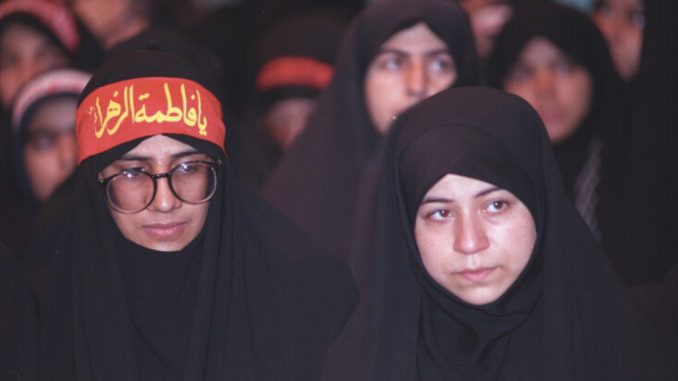
Photo: Khamenei.ir, CC BY 4.0, via Wikimedia Commons
Published March 14, 2025
Iran’s legal framework contains some of the most restrictive measures in the world regulating the lives of women and girls. These laws are rooted in the Islamic Republic’s interpretation of Sharia (Islamic law) and have shaped Iranian society’s gender roles ever since the 1979 revolution.
Mandatory Dress Code: Compulsory Hijab and Morality Laws
One of the most visible and controversial restrictions is Iran’s compulsory dress code requiring women and girls to cover their hair and bodies in public. Mandatory hijab rules were written into law in the early 1980s and have been enforced ever since.
In 2024, a new “hijab and chastity” law—officially known as the Law on Protecting the Family through the Promotion of the Culture of Chastity and Hijab—escalated these requirements. This sweeping law contains dozens of punitive articles that:
-
Impose heavy fines, prison terms, and even the death penalty for violations of hijab and morality standards.
-
Criminalize broad notions such as “nudity,” “indecency,” “unveiling,” and “bad dressing,” with undefined terms giving authorities wide discretion.
-
Penalize peaceful activism—including sharing videos or messages abroad—by labeling it as “corruption on Earth,” a charge punishable by death under Iran’s penal code.
These measures have been widely condemned by international human rights groups as a severe escalation in gender‑based repression and have sparked ongoing resistance from women in Iran.
Enforcement and Surveillance
Enforcement of these laws goes far beyond moral policing on the streets:
-
A United Nations fact‑finding report found that Iranian authorities use electronic surveillance, drones, facial recognition cameras, and mobile reporting apps to monitor women’s compliance with hijab codes.
-
Citizens can be encouraged or legally empowered to report women who allegedly violate dress codes, essentially deputizing public informants.
-
Businesses and institutions can face fines or closure if they are seen to “promote” indecency or fail to enforce hijab compliance.
Despite these controls, compliance varies in practice. In some urban areas, enforcement has weakened due to social resistance, economic crisis, and political division within the regime.
Legal Discrimination Beyond Dress Codes
Iran’s legal restrictions on women extend into many other areas of life:
-
Family and civil law: Women often require male permission for travel, and their testimony in certain court cases is unequal to that of men.
-
Political participation: Legal provisions and political practices have routinely barred women from high office, including the roles of Supreme Leader or membership on the powerful Guardian Council.
-
Social life and segregation: Laws separate men and women in public transport, sporting events, schools, and even airport queues.
-
Reproductive and family rights: Separate legislation restricts access to contraception and reproductive health services, reinforcing traditional gender roles.
Resistance and Criticism
Iranian women have pushed back against these laws for decades, most visibly after the 2022 death of Mahsa Amini in the custody of the morality police—a case that ignited nationwide protests under the slogan “Woman, Life, Freedom.”
Activists, international legal bodies, and human rights organizations have characterized many of these practices as systemic gender discrimination or even gender apartheid, arguing that they violate fundamental rights to equality, freedom of expression, and bodily autonomy.
 Public / Political Reactions
Iran’s restrictive laws on women’s rights have triggered widespread public outrage, both domestically and internationally, highlighting the deep societal tensions between state-enforced religious norms and calls for gender equality.
Domestic Public Response
-
Protests and activism: Following high-profile incidents like the 2022 death of Mahsa Amini, widespread protests erupted across Iran, involving women, students, and ordinary citizens demanding freedom of dress, equal rights, and an end to morality policing. These protests often involve mass demonstrations, social media campaigns, and symbolic acts of defiance, such as women publicly removing their hijabs.
-
Civil society engagement: Grassroots organizations and women’s rights groups have used digital platforms to organize awareness campaigns, document abuses, and provide legal support to arrested activists. Despite heavy censorship, Iranians continue to find creative ways to resist restrictive laws.
Political Reactions Within Iran
-
Government stance: The Iranian government, particularly hardline factions, defend these laws as essential to preserving Islamic values and national morality. Officials often frame protests as influenced by “foreign enemies” attempting to undermine Iran’s culture.
-
Parliament and judiciary: Hardline lawmakers have passed stricter enforcement measures, increasing fines, prison sentences, and other punitive measures for violations of dress codes and morality laws. The judiciary frequently interprets infractions as “corruption on Earth,” a charge carrying severe consequences.
International Political Response
-
United Nations and human rights bodies: The UN has repeatedly condemned Iran’s treatment of women as systematic discrimination and has urged Tehran to repeal laws that violate international human rights conventions.
-
Foreign governments: Western nations, including the United States, EU member states, Canada, and Australia, have issued sanctions targeting Iran’s morality police and top officials responsible for enforcing restrictive laws. Diplomatic statements frequently highlight gender oppression as a violation of human rights and call for accountability.
-
Global advocacy and solidarity: International NGOs, feminist networks, and diaspora communities actively support Iranian women through campaigns, petitions, and fundraising for legal defense, amplifying the voices of Iranian activists globally.
 Resulting Effects:
The implementation of Iran’s restrictive laws on women has produced far-reaching social, cultural, and legal consequences that are often viewed through a lens of maintaining societal order and traditional values.
Preservation of Cultural Norms
-
Many supporters argue that these laws reinforce family structures and moral standards, emphasizing modesty, respect, and clearly defined gender roles.
-
By codifying dress codes and behavioral expectations, the legal framework is seen as a mechanism to protect cultural identity in the face of rapid globalization and foreign influences.
Impact on Daily Life and Behavior
-
Women navigating public spaces must adapt their clothing, behavior, and interactions according to legal requirements, which some see as encouraging personal discipline and societal responsibility.
-
Segregation in schools, workplaces, and public transport shapes social interactions, aiming to minimize conflict and maintain order between genders.
Legal and Institutional Effects
-
The laws provide authorities with clear guidelines to enforce public morality, which supporters claim contributes to a more predictable and controlled social environment.
-
Families and communities are indirectly reinforced as the primary social units, with laws emphasizing traditional family roles, child-rearing responsibilities, and marital obligations.
Economic and Social Trade-offs
-
While restrictions may limit certain career opportunities or freedoms, proponents argue that they also prioritize societal stability over individual expression, suggesting that cohesion and moral alignment are essential for national well-being.
-
Compliance with the laws can reduce legal uncertainty for women and businesses, offering a framework that clearly defines expectations and consequences.
Public Perception
-
Within segments of Iranian society, these laws are regarded as necessary to safeguard moral values and protect younger generations from perceived negative influences.
-
Some believe that strict adherence to social codes fosters a sense of communal responsibility, with individuals encouraged to contribute positively to family and society.
 Future Outlook:
Looking ahead, Iran’s laws restricting women’s rights are likely to continue shaping the nation’s social and cultural trajectory, reinforcing long-standing moral frameworks while navigating modern challenges.
Continuation of Traditional Social Structures
-
These laws are expected to maintain established family and community roles, emphasizing moral guidance and the centrality of familial responsibility.
-
Supporters see the legal framework as a means to ensure stability and cohesion, preventing rapid social change from undermining cultural values.
Gradual Adaptation Within Boundaries
-
While societal pressures and technological developments may influence behaviors, any adaptation is likely to occur within the existing legal and moral framework.
-
Families and institutions are expected to balance modern conveniences with traditional expectations, creating incremental adjustments rather than wholesale societal shifts.
Institutional Enforcement and Civic Responsibility
-
Law enforcement and civic institutions will likely continue to promote compliance, with supporters viewing this as essential for preserving public order and moral standards.
-
By embedding moral expectations into public life, authorities aim to encourage personal discipline and communal responsibility, fostering a predictable and orderly society.
Cultural Resilience
-
Advocates anticipate that adherence to these laws will strengthen cultural identity and continuity, particularly in the face of external influences and globalization.
-
Traditional values are seen as a guiding force for younger generations, shaping their worldview, social interactions, and responsibilities within the family and community.
Potential Challenges
-
Balancing modern economic demands and international pressures with traditional social norms will remain an ongoing challenge.
-
Nevertheless, the prevailing view among supporters is that preserving core moral and cultural principles will provide a stable foundation for the country’s long-term development.
 Bottom Line:
Iran’s laws restricting women’s rights reflect a broader effort to preserve cultural identity, moral standards, and social order in a rapidly changing world. While these regulations impose significant responsibilities on women and shape daily life, they are seen by supporters as essential for upholding family structures, promoting communal responsibility, and maintaining societal cohesion.
Looking forward, adherence to these laws is expected to continue guiding behavior, reinforcing established norms, and fostering a sense of moral accountability across society. From this perspective, the legal framework serves not only as a set of rules but as a foundation for continuity, stability, and cultural resilience, ensuring that traditional values endure for future generations while navigating the pressures of modern life.