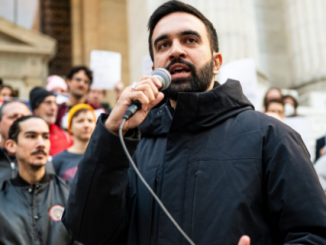
Screencap of Twitter/X video.
Published March 22, 2026
Tensions are rising in Staten Island after the administration of Mayor Zohran Mamdani approved plans to construct a 160-bed all-male homeless shelter in a quiet residential section of the borough’s South Shore.
The proposed facility, slated for the Charleston area, is intended to house single adult men—both employed and unemployed—while providing support services aimed at helping them stabilize their lives and find work.
However, instead of easing concerns about homelessness, the decision has triggered a wave of backlash from local residents and officials.

Local businesses have been circulating a petition against the shelter.Leonardo Munoz for NY Post
Public Outrage and Community Concerns
Residents say the shelter is being placed in the middle of a residential neighborhood, close to homes and small businesses. Many fear the project could bring:
- Increased crime and safety risks
- Drug activity and loitering
- Declining property values
- Disruption to family-oriented communities
Some locals have expressed frustration over what they see as a lack of transparency, claiming the project was initially filed under a different classification—such as a hotel or community facility—before being revealed as a shelter.
Others argue the location itself is unsuitable, pointing out that the area lacks access to mass transit, hospitals, and essential social services needed to support vulnerable populations.

The approved shelter site is next to small businesses and minutes away from homes.Google Maps
Political and Local Pushback
Local leaders, including Frank Morano, have strongly opposed the plan—not necessarily rejecting the idea of shelters, but questioning the placement and planning process.
A group of lawmakers formally urged city officials to reconsider the site, citing:
- Limited infrastructure
- Insufficient community consultation
- Concerns about long-term impact on residents
Community protests have already taken place, with residents demanding public hearings and greater accountability from City Hall.
Broader Policy Context
The controversy comes as Mayor Mamdani pushes a broader overhaul of New York City’s homelessness strategy. His administration has:
- Closed aging shelter facilities due to poor conditions
- Shifted toward a “housing-first” and service-based model
- Resumed encampment clearances with a more outreach-focused approach
Supporters argue these efforts aim to create a more humane and effective system. Critics, however, say implementation has been uneven and disconnected from neighborhood realities.
The Bigger Debate
At the heart of the issue is a larger national question:
How do cities balance compassion for the homeless with the safety and stability of established communities?
Opponents of the Staten Island shelter argue that forcing residential neighborhoods to absorb large-scale facilities—without proper planning or input—undermines public trust and quality of life.
Supporters counter that every community must share responsibility in addressing homelessness, especially in a city legally required to provide shelter.
🧩 The Core Analysis:
The controversy surrounding Zohran Mamdani’s plan to establish an all-male homeless shelter in a residential section of Staten Island exposes a deeper governance problem that extends far beyond a single project.
At the surface level, the policy is framed as a humanitarian response to homelessness. But the intensity of the backlash suggests that the real issue lies in how decisions are made and who bears the consequences. Residents are not simply reacting to the presence of a shelter—they are responding to what they perceive as a top-down mandate that alters the character of their neighborhood without their meaningful input.
This creates a credibility gap. When local communities feel bypassed, even well-intentioned programs begin to look like imposed burdens rather than shared solutions.
There is also a risk concentration factor that cannot be ignored. Placing a large, single-gender population—particularly one facing economic or social instability—into a quiet residential environment raises legitimate concerns about:
- Strain on local infrastructure
- Public safety uncertainties
- Lack of immediate access to support systems
- Increased pressure on already limited community resources
Whether all fears are justified or not, the perception alone is powerful enough to reshape community behavior, property decisions, and trust in public institutions.
Another key issue is policy sequencing. Effective homelessness strategies typically require a foundation of services—mental health care, job placement, addiction support, and transit access—before large-scale housing placements occur. When housing is introduced without these supports firmly in place, it risks becoming a temporary containment measure rather than a pathway to stability.
In this case, critics argue that the shelter appears less like a carefully integrated solution and more like a relocation of an existing problem into a new neighborhood.
🔗 The Synthesis:
What is unfolding in Staten Island reflects a broader national pattern: the gap between policy ambition and operational reality.
Addressing homelessness requires more than allocating beds—it demands a system that aligns human dignity with public order. That balance is difficult, but not impossible. The key lies in execution.
A more effective framework would include:
1. Distributed Responsibility
Instead of concentrating large shelters in specific neighborhoods, cities should adopt a decentralized model where smaller, well-managed facilities are spread across multiple districts. This reduces localized impact and fosters a sense of shared civic responsibility.
2. Infrastructure First, Placement Second
Shelters should be located where services already exist or can be easily expanded—near transit hubs, healthcare facilities, and employment opportunities. Without these, residents of the shelter face greater difficulty reintegrating, and surrounding communities absorb unintended strain.
3. Community Integration, Not Isolation
Programs should be designed to integrate individuals into society, not isolate them in clusters. Workforce development, skills training, and structured reintegration plans are essential to preventing long-term dependency.
4. Transparent Governance
Public trust hinges on process. Early disclosure, open forums, and genuine community engagement are not optional—they are foundational. When residents feel heard, opposition often becomes more constructive rather than purely resistant.
5. Measurable Outcomes
Success should not be defined by how many shelters are built, but by how many individuals transition out of homelessness permanently. Without accountability metrics, policies risk becoming cyclical rather than transformative.
At its best, public policy aligns moral responsibility with practical execution. At its worst, it creates friction between those it aims to help and those expected to absorb the impact.
🏁 The Final Word:
The Staten Island dispute is not just about a shelter—it is about the limits of governance that prioritizes intent over implementation.
Communities are more willing to support difficult solutions when they are confident those solutions are fair, balanced, and competently managed. But when decisions appear rushed, unevenly distributed, or disconnected from on-the-ground realities, resistance becomes inevitable.
Moving forward, leadership will be judged not by how aggressively it pursues policy goals, but by how effectively it harmonizes those goals with the stability of the communities involved.
If solutions to homelessness are to succeed, they must be built on more than urgency—they must rest on discipline, accountability, and respect for the people expected to live alongside them.
SOURCES: THE GATWAY PUNDIT – Zohran Mamdani Angers People of Staten Island With Plans to Build All-Male Homeless Shelter in Residential Area
AOL – Mamdani’s plan to boost housing helps homeowners build ADUs, small apartments on their property
THE NEW YORK POST – Staten Islanders rage at Mamdani as NYC approves homeless shelter: ‘He wants to screw us’
GOTHAMIST – Staten Island elected officials voice disapproval for a planned homeless shelter