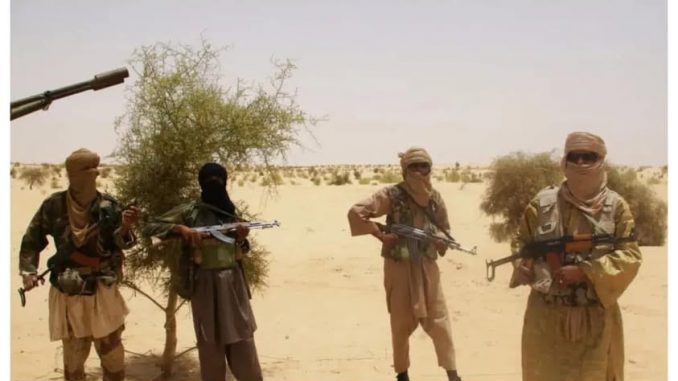
Jama’at Nusrat al-Islam wal-Muslimin (JNIM), one of the Islamist groups slaughtering Christians in Burkina Faso. Photo courtesy of Radio Biafra London via Facebook.
Published December 22, 2025
Ouagadougou, Burkina Faso — In the heart of West Africa, a country once celebrated for its religious harmony is now experiencing one of the most intense waves of violent extremism in the world. Burkina Faso — a nation where Muslims and Christians peacefully worshipped side by side — has become an epicenter of jihadist terror. In recent years, communities of believers have found themselves increasingly in the crosshairs of armed groups linked to Al-Qaeda and the Islamic State, who are spreading death and fear across the Sahel.
A Spiraling Crisis
Since jihadist insurgencies began spreading across the Sahel in the mid-2010s, Burkina Faso has seen a dramatic deterioration in security. These groups, including Jama’at Nasr al-Islam wal-Muslimin and Islamic State in the Greater Sahara, have exploited weak governance, porous borders, and local grievances to establish footholds in large swathes of territory. According to recent global terrorism reports, Burkina Faso remains among the most terror-affected countries on Earth, with extreme violence against civilians continuing unabated.
Christian communities — though a minority — have faced disproportionately brutal attacks. From indiscriminate shootings to targeted ambushes and kidnappings, jihadists have repeatedly struck places of worship, homes, and roadways where Christians travel.
Stories of Violence and Loss
In late 2025, a string of violent attacks shook the Christian population:
-
In Madouba Commune, armed terrorists stopped buses carrying returning students and passengers, pulling teenagers off and shooting them dead, a stark example of how civilians, including young Christians, are being deliberately targeted.
-
On roads across the Diocese of Nouna, gunmen opened fire on vehicles, killing at least 15 people and leaving families devastated.
-
In other recent incidents, catechists and pastoral workers have been kidnapped or killed after attending church services, reflecting a chilling campaign meant to intimidate and uproot believers.
These are not isolated incidents but part of a broader pattern of terror that has driven millions from their homes and forced numerous parishes to close. Reports estimate that nearly half of Burkina Faso’s territory is under the control of armed groups, leaving ordinary citizens to fend for themselves or flee.
A War Beyond Religion?
While many headlines highlight the targeting of Christians, analysts emphasize that the violence is complex. Extremist groups claim religious motives, but deeper forces — political instability, marginalization, and competition for resources — also fuel the conflict. Some observers caution against framing the crisis solely as religious persecution, pointing out that Muslims and other civilians have also suffered from attacks, displacement, and abuses by all sides.
Nevertheless, Christian leaders and relief agencies on the ground say that believers feel particularly vulnerable. Churches have been burned, community leaders have been killed, and worshippers have faced direct threats unless they leave or change their faith.
Humanitarian Toll and Displacement
The human cost of this conflict is staggering. According to international charity reports:
-
More than 20,000 people have been killed in jihadist violence across the Sahel, and millions have been displaced from their homes.
-
In 2024 alone, Burkina Faso accounted for about one in five terrorism-related deaths worldwide, underscoring the intensity of the crisis.
Relief organizations, including Catholic charities, are struggling to provide food, shelter, and medical care for those uprooted by fear and violence. Thousands of Christians now live in displacement camps, relying on aid as they wait — often with uncertainty — for safe conditions to return home.
Faith in the Midst of Fear
Despite the unprecedented challenges, many believers remain steadfast. Christian leaders report that — even under threat — some congregants refuse to abandon their faith. In northern parishes, people continue to meet for prayer when and where it is safe, holding onto hope amid hardship.
The International Response
International attention has been uneven. While human rights groups and some governments have condemned the violence, effective solutions remain elusive as regional forces struggle to contain well-armed extremist groups. Burkina Faso’s own political instability, including coups and shifting alliances, has further complicated coordinated security efforts.
 Implications of Christians Being Slaughtered in Burkina Faso
1. Humanitarian Crisis Intensifies
-
Mass Displacement: As jihadist groups target Christian communities, thousands are fleeing to safer regions or neighboring countries, exacerbating the refugee crisis in West Africa.
-
Strain on Aid Resources: Displacement camps struggle to provide food, shelter, healthcare, and protection. Relief agencies face logistical challenges, funding shortages, and limited access to remote conflict zones.
-
Vulnerability of Children and Women: Attacks on buses and villages show that the most vulnerable—teenagers, women, and children—are often direct victims of violence, trafficking, or forced recruitment.
2. Religious Persecution and Social Fragmentation
-
Erosion of Religious Freedom: Churches are being burned, priests and pastors kidnapped, and congregants threatened, making worship and faith practice dangerous.
-
Fracturing Communities: Long-standing peaceful coexistence between Christians and Muslims is being disrupted, fueling mistrust and polarization in mixed regions.
-
Psychological Trauma: Survivors carry deep emotional scars, with trauma affecting both immediate and future generations.
3. Political and Security Implications
-
Weakening State Authority: The inability of Burkina Faso’s government and regional forces to protect citizens emboldens jihadist groups and undermines confidence in governance.
-
Regional Destabilization: Spillover effects threaten neighboring countries like Mali, Niger, and Ivory Coast, potentially widening the conflict and creating cross-border insurgencies.
-
Militarization and Vigilante Groups: Communities may form self-defense militias, increasing the risk of further violence and civilian casualties.
4. Global and Geopolitical Concerns
-
International Attention Needed: While Western and African governments express concern, limited intervention highlights gaps in coordinated global response to terrorism and religious persecution.
-
Counterterrorism Challenges: Burkina Faso exemplifies the complexity of fighting jihadist insurgencies in areas with porous borders, weak governance, and limited intelligence infrastructure.
-
Influence on Migration Trends: Violence may drive waves of migration toward Europe and other regions, creating social and political pressures internationally.
5. Religious and Moral Implications
-
Test of Faith and Resilience: Christians in the region face existential threats, raising moral questions about global solidarity and the protection of religious minorities.
-
Potential for Radicalization: Continuous persecution may radicalize some communities, either spiritually or politically, escalating cycles of violence.
-
Global Religious Advocacy: The crisis underscores the need for advocacy groups, faith-based organizations, and governments to protect religious freedom and provide safe havens for persecuted communities.
6. Economic Implications
-
Destruction of Livelihoods: Targeted villages, markets, and transport routes disrupt local economies and agriculture, worsening poverty.
-
Aid Dependency: Long-term reliance on humanitarian assistance can weaken local economic autonomy.
-
Investor and Trade Hesitancy: Persistent violence deters foreign investment and slows development projects, affecting the country’s growth prospects.
 Overall Takeaway:
The rising jihadist violence in Burkina Faso represents a tragic convergence of religious persecution, political instability, and humanitarian disaster. Christians in the region face an existential threat, with their homes, communities, and places of worship under constant attack. Beyond the immediate suffering, the crisis exposes the fragility of governance in the Sahel, the limitations of regional security forces, and the moral responsibility of the global community to protect religious minorities.
If left unaddressed, the violence will continue to destabilize not only Burkina Faso but also neighboring countries, fueling mass displacement, economic decline, and further radicalization. Yet amid fear and death, the resilience of these communities — holding on to faith and hope — serves as a powerful reminder that protecting human life and religious freedom is both a moral imperative and a strategic necessity.
The world cannot remain passive while faith and freedom are under siege. The plight of Christians in Burkina Faso demands urgent attention, coordinated action, and unwavering support from governments, humanitarian organizations, and faith communities worldwide.
SOURCES: THE GATEWAY PUNDIT – Christians Being Slaughtered in Burkina Faso – Jihadist Violence on the Rise
PERSECUTION.ORG – Terrorists Target, Kill Christians in Burkina Faso