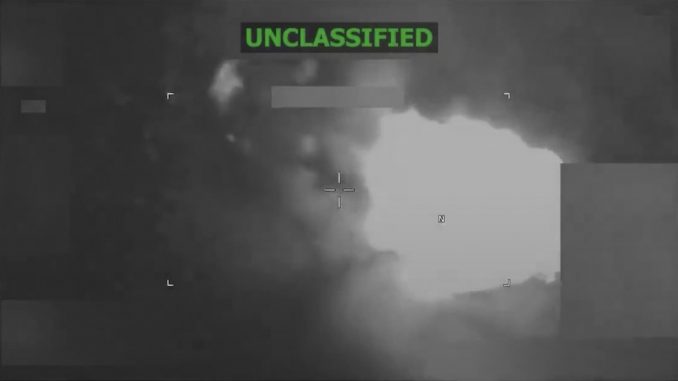
A screengrab from a video released by the US military in December 2025 shows the moments before a vessel is attacked by US forces in the eastern Pacific Ocean [File: Handout/US Southern Command via Reuters]
Published February 21, 2025
The U.S. military has carried out another lethal strike on a vessel in the eastern Pacific Ocean, killing three men that Washington claims were involved in narco-trafficking operations. The operation, which took place on Feb. 20, 2026, is part of the broader Operation Southern Spear, a campaign aimed at disrupting maritime drug trafficking networks.
According to the U.S. Southern Command, the boat was monitored and identified via intelligence sources as transporting illicit narcotics before it was targeted in what was described as a “lethal kinetic strike.” Officials emphasized that no U.S. personnel were harmed, and the operation was conducted in compliance with international law, according to Pentagon statements.
A video released by the Southern Command shows the vessel engulfed in flames, capturing the strike in real-time. The footage has been shared on military social media channels and news outlets, highlighting the precision and speed of the operation.
Timeline of U.S. Maritime Counter-Narcotics Operations
The Feb. 20 strike is the latest in a series of U.S. military actions targeting suspected drug trafficking vessels in the Pacific and Caribbean. Key points in the campaign include:
-
September 2025: Operation Southern Spear officially launched, targeting transnational drug trafficking via maritime routes.
-
October–December 2025: First 20 strikes reported, killing an estimated 75 suspected traffickers.
-
January 2026: Campaign expanded to include the eastern Pacific corridor; 15 boats reportedly intercepted or destroyed.
-
Feb. 20, 2026: Strike on the latest vessel, resulting in three confirmed deaths.
According to analysts, the eastern Pacific Ocean corridor has become increasingly significant for trafficking networks attempting to bypass heavily monitored Caribbean routes.(euronews.com)
Legal and Ethical Concerns
While the U.S. government frames these operations as necessary to combat global drug trafficking, critics argue that lethal strikes in international waters raise serious legal questions. International law experts note that:
-
Evidence disclosure is minimal: No publicly released proof confirms the victims’ involvement in trafficking.
-
Extrajudicial action: Targeting individuals without a trial may violate principles of due process under international law.
-
Risk of misidentification: There is concern that civilian or non-trafficking vessels could be mistakenly targeted, increasing the potential for unintended casualties.
Professor Maria Delgado, an international law scholar at Georgetown University, commented:
“Strikes like this, even with military intelligence backing, must be scrutinized. The line between counter-narcotics operations and extrajudicial killings is thin when there’s no judicial oversight.”
Impact on Drug Trafficking and Regional Security
The U.S. military asserts that these strikes disrupt supply chains before narcotics reach U.S. shores, especially targeting high-value shipments of cocaine and methamphetamine. However, some analysts argue that:
-
Land routes remain dominant: The majority of drugs entering the United States, particularly fentanyl and methamphetamine, travel through Mexico, not maritime corridors.
-
Cartels adapt quickly: Strikes may temporarily hinder trafficking but do not dismantle the larger networks.
Moreover, neighboring countries in Central and South America have expressed concern over the frequency of strikes in international waters, citing sovereignty issues and the risk of escalating regional tensions.
Political Messaging and Domestic Debate
The Trump administration has defended the policy as a proactive and necessary measure against transnational criminal organizations. Officials argue that maritime interdiction operations are a critical complement to domestic law enforcement and border security efforts.
Domestic reactions are mixed:
-
Supporters praise the military’s decisive action and view it as a strong stance against cartels.
-
Critics question the transparency, effectiveness, and legality of the campaign, particularly since human intelligence confirming the targets’ involvement has not been released.
Congressional members from both parties have called for hearings to examine the legality and oversight of lethal strikes on vessels in international waters, reflecting the heightened scrutiny of military counter-narcotics operations.
Two additional boats were hit last week.
MORE:
 Implications from a National Security–First Perspective
The Feb. 20 strike on an alleged drug-trafficking vessel in the eastern Pacific carries multiple strategic, security, and societal implications when viewed through a national security–oriented lens. While the operation has sparked controversy internationally, supporters of decisive action against transnational criminal networks see it as part of a proactive defense strategy that goes beyond borders.
1. Strengthening Deterrence
A key goal of these operations is to send a clear signal to transnational criminal organizations that illicit activity will not go unchallenged. By taking lethal action against vessels suspected of smuggling narcotics, the U.S. military demonstrates its ability to detect, track, and neutralize threats far from its shores.
-
Traffickers may reconsider using maritime routes knowing that the U.S. has the capability and intent to strike preemptively.
-
Public release of strike footage amplifies the deterrent effect, showing precision and reach.
This approach reflects a philosophy that visible, decisive measures can prevent future threats, reinforcing the idea that national security relies on both strength and readiness.
2. Preemptive Protection of Citizens
One of the strongest arguments from a national security–oriented perspective is that intervening abroad reduces domestic harm. By targeting drug shipments at sea:
-
The influx of dangerous substances like cocaine, methamphetamine, and synthetic opioids could be slowed, lowering overdose and crime rates domestically.
-
Communities burdened by drug-related violence or addiction see indirect protection as traffickers are disrupted before reaching American streets.
This aligns with a principle that prevention is as critical as enforcement, aiming to reduce harm before it escalates.
3. Supporting Law Enforcement and Public Safety
Military interdiction operations abroad are seen as complementary to domestic law enforcement, rather than replacing it. By striking trafficking networks overseas:
-
The U.S. Coast Guard and Drug Enforcement Administration (DEA) face fewer high-risk seizures at home.
-
Intelligence gathered during these strikes can feed into investigations, prosecutions, and coordinated international operations.
From this perspective, the strikes are not just symbolic—they directly support operational goals for domestic safety.
4. Geopolitical and Strategic Signaling
Beyond domestic security, these operations carry international messaging implications:
-
They demonstrate U.S. reach and resolve, showing that the country is willing to act decisively to protect its interests globally.
-
Criminal networks receive a clear warning that high-value smuggling operations will face lethal consequences.
-
Allied and partner nations observing these actions may feel reassured by American commitment to fighting transnational threats, strengthening cooperation in counter-narcotics and maritime security.
This dual-purpose effect—deterrence abroad, protection at home—is a hallmark of a national security–first approach.
5. Addressing Critics and Operational Challenges
Even from a security-focused lens, several operational and legal considerations remain:
-
International law compliance: Operations must respect sovereignty and avoid civilian casualties to maintain credibility and legitimacy.
-
Adaptability of traffickers: Criminal organizations often shift routes or methods in response to military actions, highlighting the need for multi-layered strategies.
-
Evidence transparency: Skeptics point out that public trust depends on some level of evidence being disclosed to show that targets are genuinely involved in illicit activity.
Supporters argue that these challenges do not invalidate the strategy but instead highlight the need for intelligence-driven, precise, and accountable operations.
6. Societal and Economic Implications
From a broader perspective, preventing narcotics from entering the country also has tangible economic and social benefits:
-
Reduced healthcare and law enforcement costs: Fewer drugs on the streets translate to lower spending on emergency care, rehabilitation, and criminal justice.
-
Improved community safety: Preemptive action reduces crime linked to trafficking, including violence, theft, and gang activity.
-
Long-term deterrence effects: Demonstrating consequences abroad may discourage domestic criminal activity as traffickers reassess the risks of participating in drug networks.
This aligns with a philosophy that security measures abroad can produce measurable benefits at home, reinforcing the link between proactive defense and societal well-being.
 Overall Takeaway:
The Feb. 20 U.S. military strike on an alleged drug-trafficking vessel in the Pacific underscores the country’s willingness to take decisive, preemptive action to protect its citizens and interests abroad. From a national security–first perspective, such operations are seen as critical tools for deterrence, disruption of illicit networks, and support of domestic law enforcement.
While the campaign has sparked debate over legality, transparency, and long-term effectiveness, it also highlights the complex challenges of combating transnational criminal organizations in an interconnected world. Advocates argue that a proactive, intelligence-driven approach can save lives, reduce domestic harm, and send a clear message to traffickers that the U.S. will act to defend its borders and communities.
Ultimately, these operations reflect a philosophy that security, prevention, and strategic action are intertwined, demonstrating the difficult but necessary balance between protecting citizens, upholding international norms, and maintaining operational effectiveness against evolving threats.
SOURCES: THE GATEWAY PUNDIT – WATCH: US Takes Out Drug Boat Killing 3
EURONEWS – Three people killed as US military strikes another alleged narcotics boat in the Pacific Ocean
AL JAZEERA – US military says it attacked vessel in Pacific Ocean, killing three people