Published June 26, 2026
CARACAS, Venezuela — Venezuelan authorities said Thursday that at least 235 people have been killed and more than 4,300 injured after a pair of powerful earthquakes rocked the South American nation, flattening buildings, crippling infrastructure and leaving thousands searching desperately for missing loved ones.
The catastrophic twin quakes — measuring 7.2 and 7.5 magnitude — struck less than a minute apart Wednesday evening, triggering widespread destruction across northern Venezuela, including the capital city of Caracas and the heavily damaged coastal region of La Guaira. Officials warned that the death toll is expected to rise as rescue teams continue combing through collapsed apartment buildings and debris fields.
“We are still in a rescue phase,” Health Minister Magaly Gutiérrez said during a national briefing, adding that emergency workers remain focused on locating survivors trapped beneath the rubble.
 US military service members of Joint Task Force-Bravo load equipment into a CH-47 Chinook at Soto Cano Air Base, Honduras, on Thursday, June 25, in preparation to support earthquake relief efforts in Venezuela. US Southern Command
The rare seismic event, described by experts as a “doublet earthquake sequence,” occurred when two major earthquakes struck along Venezuela’s complex fault system within approximately 39 seconds of each other. Seismologists say such back-to-back earthquakes dramatically increase the potential for structural collapse because buildings weakened by the initial tremor often fail during the second, stronger shock.
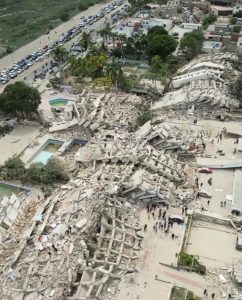
Scenes of devastation stretched across several states. In Caracas, residents fled swaying office towers and residential high-rises as chunks of concrete rained onto streets. Multiple buildings collapsed in the capital, while hospitals, roads and communication systems suffered extensive damage.
Along the Caribbean coast, entire neighborhoods in La Guaira were reduced to rubble. Witnesses described frantic efforts by neighbors using shovels, hammers and even their bare hands to search for survivors before heavy rescue equipment arrived.
 A man walks through the rubble of a house on Thursday, June 25, in La Guaira, Venezuela. Stringer/picture-alliance/dpa/AP
The earthquakes are among the strongest to strike Venezuela in more than a century and have intensified concerns about the country’s ability to respond effectively amid long-standing economic and humanitarian challenges.
Search-and-rescue operations remained ongoing Thursday night as families gathered outside shelters, hospitals and damaged neighborhoods awaiting word on missing relatives.
🧩 Reading Between the Lines:
Reading Between the Lines: Venezuela’s Earthquake Crisis
More Than Just a Natural Disaster
The twin earthquakes devastating Venezuela are not simply a geological event. The disaster is exposing broader challenges related to infrastructure resilience, emergency preparedness, and the country’s ability to respond to large-scale crises. The extent of the destruction has raised questions about how vulnerable densely populated areas remain to future disasters.
A Test of Emergency Response Capabilities
Rescue operations are serving as a major test for Venezuela’s emergency management system. The speed at which authorities can locate survivors, restore essential services, and coordinate aid efforts will likely shape public confidence in the government’s disaster response capabilities.
International Assistance Becomes Critical
The arrival of foreign rescue teams and humanitarian aid highlights the importance of international cooperation during major disasters. Given the scale of the destruction, outside assistance could play a significant role not only in immediate rescue efforts but also in long-term reconstruction initiatives.
Infrastructure Resilience Under Scrutiny
The collapse of residential buildings, damage to hospitals, and disruption of transportation networks are drawing renewed attention to building standards and infrastructure maintenance. Analysts are likely to examine whether existing construction practices adequately accounted for seismic risks.
Recovery Will Be a Long-Term Challenge
While the immediate focus remains on saving lives, attention will eventually shift toward rebuilding affected communities. Reconstruction efforts could take years and require substantial financial resources, making the recovery process a defining challenge for Venezuela in the months ahead.
🔗 The Stakes: Why This Story Matters
Venezuela’s devastating twin earthquakes go far beyond a natural disaster. The catastrophe has become a major test of the country’s emergency response capabilities, infrastructure resilience, and ability to manage a large-scale humanitarian crisis. As rescue operations continue, many observers are now asking whether Venezuela can effectively respond to the immediate emergency while also preparing for what could be a lengthy and costly recovery.
Public Safety Comes First
The immediate priority remains protecting lives and assisting affected communities. Rescue crews are racing against time to locate survivors trapped beneath collapsed structures, while authorities work to provide medical treatment, shelter, food, and other essential services to displaced residents. Continued aftershocks also pose an ongoing threat to both civilians and emergency personnel.
Pressure on Emergency Response Systems
The scale of the disaster is placing enormous strain on Venezuela’s emergency management and healthcare systems. The effectiveness of rescue operations, hospital capacity, and coordination among government agencies will likely influence both survival rates and public confidence in the response effort.
Humanitarian Needs vs. Recovery Challenges
While search-and-rescue efforts remain the immediate focus, officials must simultaneously begin planning for long-term recovery. Rebuilding damaged infrastructure, restoring public services, and assisting displaced families could require substantial resources and sustained support over many months or years.
Infrastructure and Preparedness Questions
The widespread collapse of buildings and damage to critical infrastructure are raising broader questions about construction standards, disaster preparedness, and the country’s resilience to future seismic events. The disaster may prompt renewed scrutiny of building safety measures and emergency planning.
The Bigger Picture
Ultimately, the earthquakes highlight how vulnerable modern societies remain to major natural disasters. Beyond the tragic loss of life, the long-term impact will depend on the effectiveness of relief efforts, the pace of reconstruction, and the ability of national and international actors to support Venezuela’s recovery.
🏁 The Final Word:
Venezuela’s twin earthquakes have transformed into more than an immediate humanitarian emergency—they have become a defining test of the country’s resilience. While rescue teams continue their race against time to save lives, the nation’s longer-term challenge will be rebuilding communities, restoring critical infrastructure, and supporting thousands of affected families. The coming weeks will reveal not only the full human cost of the disaster, but also how effectively Venezuela and the international community can respond to one of the country’s most devastating natural catastrophes in decades.
SOURCES: GOSKAGIT – Venezuela health minister says around 235 people dead and 4,300 injured in catastrophic earthquakes
CNN – Death toll from Venezuela earthquakes rises to around 235 as massive rescue effort is underway
AL JAZEERA – Venezuela rescue teams race to find earthquake survivors
THE WALL STREET JOURNAL – The Science Behind Venezuela’s Doublet Earthquake
AP NEWS – Venezuela health minister says around 235 people dead and 4,300 injured in catastrophic earthquakes