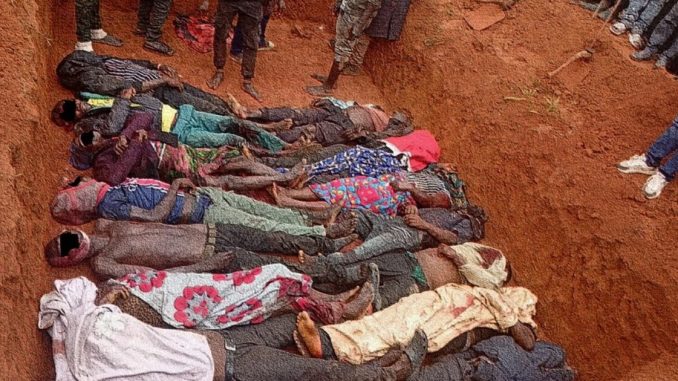
Nigerian Christians continue to be killed and abducted in large numbers. The latest attacks came as the church commemorated the first anniversary of the Yelwata massacre, in which Fulani militants killed more than 250 people during a three-hour assault in Benue State. Photo courtesy of Paul, a local journalist.
Published June 26, 2026
YELWATA, Benue State, Nigeria — The prayers had barely ended when the sound of gunfire shattered the night.
For residents of Yelwata, a predominantly Christian farming community in Nigeria’s Benue State, the attack came with terrifying speed. Homes were set ablaze, families fled into the darkness, and by dawn, hundreds of lives had been forever changed.
One year later, survivors continue to grapple with the pain of one of the deadliest attacks on a Christian community in recent Nigerian history. What was once a peaceful farming village has become a symbol of both profound loss and remarkable resilience.
 A man stands in front of a damaged and burnt house following a deadly gunmen attack in Yelwata, Benue State, Nigeria, on June 16, 2025. Marvellous Durowaiye/Reuters
A man stands in front of a damaged and burnt house following a deadly gunmen attack in Yelwata, Benue State, Nigeria, on June 16, 2025. Marvellous Durowaiye/ReutersA Night of Unimaginable Horror
In June 2025, armed attackers stormed Yelwata, killing more than 200 people, according to church officials and humanitarian groups.
Many of the victims were internally displaced persons who had sought refuge in church compounds, believing they would be safe from the violence that had increasingly plagued Nigeria’s Middle Belt region.
Survivors recalled scenes of chaos as gunmen moved through homes and shelters, forcing residents to flee for their lives. Entire families were wiped out, while homes, food supplies, and farmlands were destroyed in the assault.
For those who survived, memories of that night remain vivid and painful.
 45-year-old farmer, Terhemba Lormba, who lost 8 members of his family including three of his children. They were killed during an attack in Yelwata Village, central Nigeria in mid-June.Terna Iwar for NPR
45-year-old farmer, Terhemba Lormba, who lost 8 members of his family including three of his children. They were killed during an attack in Yelwata Village, central Nigeria in mid-June.Terna Iwar for NPRRemembering the Fallen
One year after the massacre, residents, clergy, and grieving families gathered to honor those who lost their lives.
Memorial services were held across the community as church leaders unveiled a monument bearing the names of the victims. Candles were lit, prayers were offered, and survivors reflected on lives cut short by violence.
For many families, the memorial represents more than remembrance. It stands as a testament to a community determined not to let its tragedy be forgotten.
Yet beneath the prayers and commemorations lies an enduring demand for justice.
 A burned Christian text is seen on the ground in Yelwata Village, after the attacks in mid-June.
A burned Christian text is seen on the ground in Yelwata Village, after the attacks in mid-June. Violence That Has Yet to End
Even as Yelwata marked the anniversary of the massacre, fresh attacks continued to strike Christian communities elsewhere in Nigeria.
Recent assaults in Plateau and Kaduna states have claimed dozens more lives, renewing fears among residents that rural communities remain vulnerable despite repeated government promises to improve security.
Church leaders and human rights advocates have repeatedly called on authorities to bring perpetrators to justice and strengthen protection for communities facing persistent attacks.
For many survivors, peace remains uncertain.
 Terhemba Lormba holds bullet casings covered in ash. He lost 8 members of his family including three of his children.
Terhemba Lormba holds bullet casings covered in ash. He lost 8 members of his family including three of his children. Life After the Massacre
The attack left behind more than grief.
Many displaced families have yet to return home, fearful that violence could erupt again. Homes remain damaged, livelihoods disrupted, and farmlands abandoned.
Despite the hardships, many residents have chosen to stay, rebuilding homes and attempting to restore a sense of normalcy.
Their determination reflects a deep connection to the land and to the generations of family history rooted in Yelwata.
 Left: Ash and debris can be seen in a building where rice was stored in the village of Yelwata in Nigeria. During the attack, rice harvests were targeted. Right: A survivor of the attack sits on a hospital bed. Terna Iwar for NPR
Left: Ash and debris can be seen in a building where rice was stored in the village of Yelwata in Nigeria. During the attack, rice harvests were targeted. Right: A survivor of the attack sits on a hospital bed. Terna Iwar for NPRA Community Refusing to Be Forgotten
For the people of Yelwata, the struggle is no longer solely about recovering from tragedy. It is also about preserving the memory of those who were lost and ensuring that their suffering is not ignored.
 Survivors and village residents in Yelwata Village, central Nigeria after the attacks in mid-June. Terna Iwar for NPR
Survivors and village residents in Yelwata Village, central Nigeria after the attacks in mid-June. Terna Iwar for NPRAs memorial candles continue to burn, Yelwata stands as a solemn reminder of the human cost of violence—and of a community’s enduring hope that peace will one day prevail.
 Bottom Line
As Nigeria continues to confront recurring violence in its rural communities, Yelwata remains more than a place marked by tragedy. It has become a symbol of a community’s resilience—and a sobering reminder of the human cost when peace remains elusive.
For the families who continue to mourn, the hope is simple yet urgent: that the names remembered in Yelwata will not be joined by new ones in the years to come.
SOURCES: THE GATEWAY PUNDIT – Nigeria: More Than 30 Christians Killed as Church Marks First Anniversary of the Yelwata Massacre