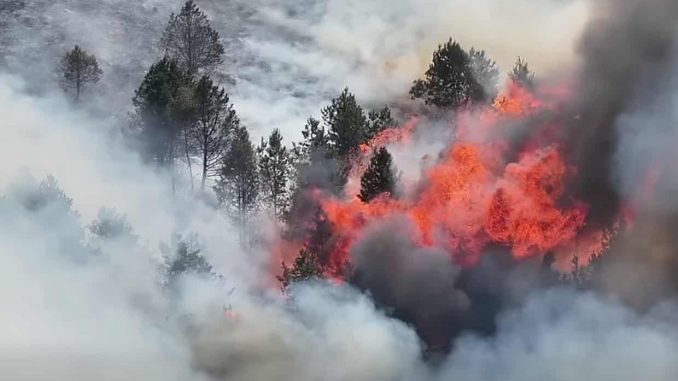
Tintwistle Moor, near Glossop on Thursday evening. Photograph: Derby Mountain Rescue Team
Published June 26, 2026
A major wildfire burning on Tintwistle Moor near Glossop, close to Greater Manchester, has forced road closures, triggered widespread smoke warnings, and prompted a large-scale emergency response as Britain grapples with record-breaking temperatures and extreme fire conditions.
The blaze, which erupted late Wednesday evening, has burned through significant areas of moorland and woodland, sending thick plumes of smoke across communities throughout Greater Manchester and neighboring Derbyshire. Emergency officials say firefighters are expected to remain on the scene as efforts continue to contain the fire.
Residents in communities including Tintwistle, Hollingworth, and Woolley Bridge have been directly affected, while reports of smoke and falling ash have emerged from areas as far away as Bolton, Bury, Oldham, Rochdale, and Crumpsall. Authorities have urged residents to keep windows and doors shut to minimize exposure to smoke.
 Credit: MEN Media
Major Emergency Response Underway
Fire crews from both Derbyshire Fire and Rescue Service and Greater Manchester Fire and Rescue Service have mounted an extensive operation to tackle the blaze.
Six fire engines, specialized moorland vehicles, high-volume pumps, command support units, and a United Utilities helicopter equipped for water drops have been deployed to combat the rapidly spreading flames. Mountain rescue teams have also joined the operation, utilizing drones to provide live aerial footage to commanders directing the response on the ground.
Officials described the operation as a significant incident requiring substantial manpower and resources.
Critical Transport Route Closed
The wildfire has forced the closure of the A628 Woodhead Pass, a key trans-Pennine route linking Greater Manchester with South Yorkshire.
National Highways closed the road in both directions, warning motorists to seek alternative routes as emergency crews continue their work. The closure has disrupted travel across northern England, with authorities cautioning that restrictions could remain in place while firefighting efforts continue.
Heatwave Creates Perfect Conditions for Wildfires
The fire comes as much of the United Kingdom experiences an intense heatwave, with temperatures reaching record June levels.
Large portions of England remain under rare high-level heat warnings, and emergency services say the exceptionally dry conditions have transformed moorland vegetation into tinder-like fuel capable of igniting from even the smallest spark.
Fire officials warned that discarded cigarettes, barbecue embers, or campfires could rapidly escalate into major incidents under current conditions.
“The ground is tinder dry,” emergency authorities said, urging the public to exercise extreme caution while hot weather persists.
Echoes of Past Moorland Disasters
The latest blaze has revived memories of previous major moorland fires in northern England, including devastating wildfires that swept across nearby moorlands in recent years.
Experts warn that prolonged heatwaves combined with increasingly dry vegetation are creating conditions more favorable for large, difficult-to-control wildfires across parts of the United Kingdom. Peat-rich moorland can prove especially challenging because fires may continue smoldering underground long after visible flames appear to have been extinguished.
Communities on Alert
Authorities continue to urge the public to stay away from the affected areas, allowing emergency vehicles unobstructed access while minimizing risks to public safety.
With hot, dry conditions forecast to continue, officials remain concerned that additional wildfires could break out elsewhere unless residents take extra precautions.
For now, firefighters remain locked in a race against time — battling flames, heat, and shifting conditions to prevent the wildfire from spreading further across the moors surrounding Greater Manchester.
🧩 Reading Between the Lines: Britain’s Growing Wildfire Challenge
More Than a Seasonal Fire
The wildfire near Greater Manchester is not being viewed by emergency planners as an isolated incident. Instead, it reflects a broader trend of increasingly severe fire conditions across parts of the United Kingdom, where prolonged periods of heat and dry weather are creating environments more susceptible to large-scale wildfires.
Extreme Weather Is Changing Risk Patterns
Historically, the UK has not experienced wildfires on the scale seen in countries such as the United States, Canada, or Australia. However, recent years have seen a rise in major moorland and grassland fires, prompting questions about whether emergency services and infrastructure are fully prepared for more frequent extreme weather events.
Critical Infrastructure Vulnerabilities
The closure of the A628 Woodhead Pass highlights how even relatively remote wildfires can have wider economic and logistical consequences. Transport disruptions, smoke impacts on nearby communities, and pressure on emergency resources demonstrate how natural hazards can quickly affect critical infrastructure and daily life.
A Test for Emergency Response Systems
Large moorland fires require coordination among multiple agencies, including fire services, mountain rescue teams, local authorities, and utility companies. The response to the Greater Manchester wildfire underscores the growing importance of interagency cooperation as climate-related emergencies become more complex and resource-intensive.
Public Behavior Remains a Key Factor
Authorities have repeatedly warned that small actions—such as discarded cigarettes, unattended campfires, or disposable barbecues—can ignite major fires under dry conditions. As heatwaves become more common, public awareness and prevention measures may play an increasingly important role in reducing wildfire risk.
Adapting to a New Reality
The broader implication is that wildfires may no longer be viewed as rare events in the UK. Instead, they are becoming part of a changing environmental landscape that could require new approaches to land management, emergency planning, and climate resilience in the years ahead.
🔗 The Stakes: Why This Story Matters
The wildfire near Greater Manchester highlights a growing challenge facing the United Kingdom: how to manage increasingly severe natural hazards in areas that historically have not experienced large-scale wildfires on a regular basis. As extreme heat and prolonged dry conditions become more common, the risk posed by moorland fires is drawing greater attention from emergency planners and policymakers.
Public Safety Comes First
The immediate concern is the safety of residents, firefighters, and travelers in affected areas. Wildfires can spread rapidly under hot and windy conditions, threatening nearby communities, reducing air quality, and forcing road closures or evacuations. Even when homes are not directly threatened, smoke exposure can pose health risks, particularly for vulnerable populations.
Pressure on Emergency Services
Large-scale moorland fires require substantial resources and sustained operations. Fire crews, rescue teams, and support agencies must coordinate across multiple jurisdictions, often for extended periods. Repeated incidents of this nature could place additional strain on emergency services already responding to other weather-related events.
Economic and Infrastructure Impacts
The closure of major transport routes such as the A628 Woodhead Pass demonstrates how wildfires can disrupt commerce, commuting, and regional connectivity. Extended closures and damage to infrastructure can carry significant economic costs, affecting businesses and local communities far beyond the immediate fire zone.
Environmental Consequences
Moorland ecosystems are particularly sensitive to wildfire damage. Fires can destroy habitats, threaten wildlife, and damage peatlands, which play an important role in carbon storage. Recovery from severe moorland fires can take years, raising concerns about long-term environmental impacts.
The Bigger Picture
Ultimately, the Greater Manchester wildfire underscores the broader question of how the UK adapts to a changing climate and evolving disaster risks. The incident serves as a reminder that extreme weather events can have wide-ranging consequences, requiring continued investment in preparedness, prevention, and resilience measures.
🏁 The Final Word:
The wildfire burning near Greater Manchester serves as a stark reminder that large-scale wildfires are no longer confined to traditionally fire-prone regions. As firefighters continue working to contain the blaze, the incident highlights the growing challenges posed by prolonged heat, dry conditions, and increasingly complex emergency responses. While authorities remain focused on protecting lives and limiting further damage, the fire also underscores broader concerns about infrastructure resilience, environmental impacts, and the need for long-term adaptation to evolving weather extremes across the United Kingdom.
SOURCES: ITVX – Fire crews continue to tackle large wildfire on moorland near Glossop