Published January 24, 2025
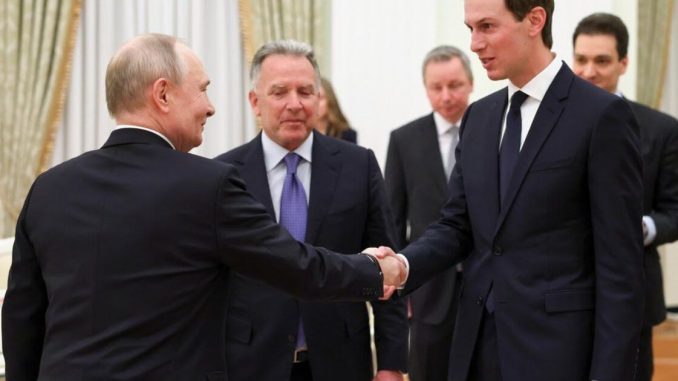
In a rare and highly consequential diplomatic effort, representatives from the United States, Russia, and Ukraine have convened in Abu Dhabi for trilateral talks aimed at ending Russia’s nearly four‑year invasion of Ukraine. The negotiations follow intense preparatory diplomacy, including a four‑hour meeting at the Kremlin between Russian President Vladimir Putin and U.S. envoys Steve Witkoff and Jared Kushner, senior advisers connected to U.S. President Donald Trump.
Kremlin Meeting: Setting the Stage
On January 22, 2026, Steve Witkoff — the U.S. special presidential envoy — and Jared Kushner met with President Putin in Moscow’s Kremlin for what Russian officials described as a “very substantive, constructive, frank, and trust‑based” discussion.
According to Kremlin aide Yury Ushakov, the talks focused on laying the groundwork for a trilateral working group on security issues that would begin in Abu Dhabi on January 23. Russia’s delegation, led by Admiral Igor Kostyukov, head of the Main Directorate of the General Staff of the Russian Armed Forces, was instructed by Putin to proceed directly to the United Arab Emirates following the Kremlin session.
Historic Trilateral Talks in Abu Dhabi
The Abu Dhabi negotiations marked the first publicly acknowledged three‑way peace discussions involving Russia, Ukraine, and the United States since the invasion began in February 2022 — a notable milestone in diplomatic engagement.
Hosted by the United Arab Emirates, talks brought together high‑level representatives including:
-
Steve Witkoff and Jared Kushner for the United States,
-
Rustem Umerov and other senior Ukrainian officials for Kyiv,
-
Igor Kostyukov and Russian military leadership for Moscow.
The delegation heads were welcomed by UAE leaders including Sheikh Khaled bin Mohamed and Deputy Prime Minister Sheikh Abdullah bin Zayed, who framed the summit as a potential step toward peace.
Core Issues and Early Outcomes
Territorial control — especially the fate of the Donbas region in eastern Ukraine — dominated the agenda. Russia demanded Ukrainian forces fully withdraw from contested areas, a position strongly rejected by Kyiv and underscored as unacceptable by Ukrainian leaders.
Ukrainian President Volodymyr Zelenskyy called the talks “constructive” but cautioned that it was too early to draw conclusions about any breakthrough.
Challenges Amid Continued Conflict
Despite diplomatic engagement, fighting on the ground has persisted. During the first days of the Abu Dhabi talks, Russia launched significant missile and drone strikes on major Ukrainian cities including Kyiv and Kharkiv, causing civilian casualties and widespread power outages. Kyiv condemned the strikes as undermining the peace process.
Conclusion of Talks and Next Steps
After two days, the official trilateral talks concluded without a formal peace agreement or public resolution of the core issues. Both sides reported intentions to return to their capitals to consult leadership and possibly reconvene discussions soon — potentially as early as next week.
While diplomats described the dialogue as direct and engaged, the path to a negotiated peace remains uncertain. Territorial integrity, security guarantees, and the cessation of hostilities — particularly against the backdrop of ongoing attacks — continue to pose formidable obstacles to a lasting settlement.
 Implications of the Witkoff‑Kushner Kremlin Meeting and Abu Dhabi Trilateral Talks
1. U.S. Mediation Role Strengthened (or Scrutinized)
The direct involvement of Steve Witkoff and Jared Kushner, close to former U.S. leadership circles, signals a shift toward private or semi-official diplomacy alongside formal State Department channels.
Implications:
-
The U.S. is positioning itself as a key mediator, bridging gaps between Ukraine and Russia.
-
It raises questions about transparency, legitimacy, and alignment with official U.S. foreign policy, potentially creating friction with current U.S. administration diplomats or allies.
-
Long-term, if successful, it could boost U.S. influence in Eastern Europe, but failure could damage credibility as a neutral mediator.
2. Russia Signals Flexibility, But Core Demands Remain
Putin’s engagement in high-level discussions does not indicate a willingness to concede territorial ambitions, particularly in the Donbas region.
Implications:
-
Russia’s participation may be strategic rather than conciliatory, aimed at delaying sanctions, gaining leverage, or testing U.S.-Ukraine negotiation capacity.
-
Ukraine faces pressure to make difficult compromises, possibly including partial concessions on contested regions.
-
Any peace framework without enforceable measures risks being unstable and short-lived, especially given ongoing military actions.
3. UAE as a Neutral Diplomatic Hub
Holding talks in Abu Dhabi underscores the growing role of Gulf states as mediators in global conflicts.
Implications:
-
The UAE’s neutrality and strategic location make it attractive for confidential diplomacy outside traditional Western venues.
-
Gulf states may leverage such initiatives to enhance international political standing, strengthen trade partnerships, and position themselves as peace brokers.
4. Limited Immediate Impact on Ground Conflict
Reports indicate that Russian missile strikes continued during the talks, highlighting a disconnect between diplomacy and ongoing hostilities.
Implications:
-
Trilateral negotiations may not immediately reduce violence, which could erode public trust in diplomatic solutions.
-
Continued conflict may harden positions on both sides, making future negotiations more difficult.
-
The timing of strikes during talks could be interpreted as strategic signaling from Russia to test the U.S. and Ukraine’s negotiating resolve.
5. Potential Precedent for Trilateral Negotiation Format
The Abu Dhabi meeting was the first publicly acknowledged trilateral format, including the mediator (U.S.) and both warring parties.
Implications:
-
Could establish a new model for conflict resolution involving a third-party superpower in a facilitation role.
-
May encourage future back-channel negotiations before public announcements.
-
However, it risks overcomplicating diplomacy if multiple semi-official actors (e.g., Kushner/Witkoff) operate alongside formal government diplomats, creating confusion over authority and accountability.
6. Global Geopolitical Signaling
This initiative sends broader geopolitical messages:
-
To Europe: The U.S. is actively seeking solutions, which could ease pressure on NATO allies for direct involvement.
-
To China and other major powers: Demonstrates U.S. willingness to influence the post-Soviet space while attempting to avoid direct military confrontation.
-
To domestic audiences (U.S. and Russia): Leaders may use the talks to signal diplomacy efforts without committing to concessions, shaping public opinion.
7. Economic and Security Implications
-
Sanctions and energy markets: Even preliminary talks can influence sanctions policy, trade negotiations, and global oil/gas markets.
-
Defense commitments: Ukraine may need continued military support while engaging in negotiations, affecting U.S. and European defense planning.
-
Investor sentiment: The involvement of high-profile business figures like Witkoff could signal potential private sector roles in reconstruction or post-conflict investment, impacting global markets.
 Overall Takeaway:
The meetings between Putin, U.S. envoys Steve Witkoff and Jared Kushner at the Kremlin, followed by the first trilateral talks in Abu Dhabi, mark a significant diplomatic moment in the Russia‑Ukraine conflict. While no formal agreements were reached, the discussions demonstrate a willingness from all sides to engage in direct dialogue — a rare opportunity for negotiation amid continued hostilities.
The implications are far-reaching: the U.S. positions itself as a key mediator, Russia signals strategic flexibility without compromising core demands, and Ukraine faces complex choices regarding territorial integrity and security guarantees. Moreover, Abu Dhabi’s role as a neutral host highlights the growing influence of Gulf states in international diplomacy.
Ultimately, the Abu Dhabi talks reflect both hope and uncertainty. They signal a potential path toward dialogue, but translating diplomacy into lasting peace will require sustained effort, compromise, and commitment from all parties. The coming weeks will be crucial in determining whether these discussions evolve into a framework capable of ending one of Europe’s most devastating conflicts in recent history.
SOURCES: THE GATEWAY HISPANIC – After Meeting with Putin in the Kremlin, Witkoff and Kushner Head to Abu Dhabi for Trilateral Negotiations Between the United States, Ukraine, and Russia
REUTERS – Putin agrees next steps with US envoys but Kremlin says territory is key
ABC NEWS – Russia, Ukraine and US hold 1st trilateral talks since start of war