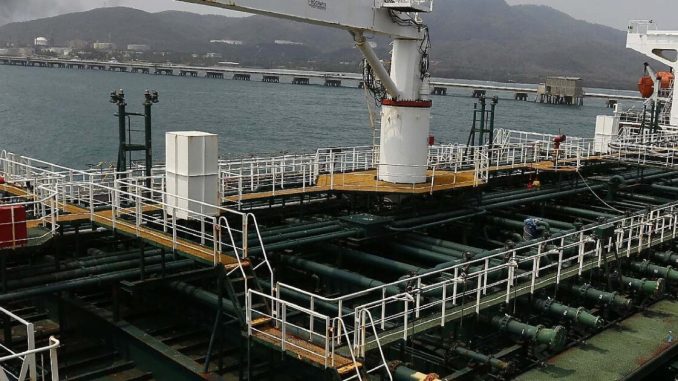
Photo courtesy of the U.S. Embassy in Venezuela.
Published January 24, 2025
In early 2026, the Trump administration unveiled a bold strategy to recover billions of dollars that Venezuela allegedly owes American companies and investors — a plan centered on controlling Venezuelan oil revenues and using them to satisfy long‑standing legal claims and rebuild the nation’s beleaguered energy sector.
Background: Billions in Unpaid Claims
Venezuela’s massive oil industry was nationalized beginning under former President Hugo Chávez in the early 2000s. U.S. oil companies such as ConocoPhillips and ExxonMobil refused nationalization terms, leading to international arbitration panels awarding them billions in damages for unlawful seizures of their assets. ConocoPhillips alone has an arbitration award worth nearly $8.7 billion, and ExxonMobil another $1.6 billion, with interest piling on in the years since.
U.S. courts have treated Venezuela’s state oil firm PDVSA as virtually indistinguishable from the regime itself, enabling enforcement of foreign judgments and seizure of U.S.–based assets like CITGO, a U.S. refining company historically owned by PDVSA.
New U.S. Policy: Oil Control and Revenue Allocation
Following the removal of Nicolás Maduro from power on January 3, 2026, President Trump signed an executive order declaring a national emergency to protect Venezuelan oil revenues. This order effectively places control of crude sales and related funds under U.S. executive authority, exempting those revenues from creditor seizures and other judicial claims.
Under the initiative, Venezuela has agreed to turn over up to 50 million barrels of oil, with initial sales valued at roughly $500 million completed by mid‑January 2026. Some proceeds have been directed into offshore accounts, including in Qatar, rather than solely into U.S. Treasury accounts—a point critics say raises transparency and constitutional concerns.
Reportedly, $300 million of revenue has been distributed locally in Venezuela to support banks and workers, though the bulk remains under U.S. control.
Conditioning Debt Recovery on Investment
A key element of Trump’s plan is to pressure U.S. oil companies to invest billions in restoring Venezuela’s dilapidated oil infrastructure. These companies would front capital needed to bring production up from roughly 800,000 barrels per day toward historical levels — a task analysts say could require $100 billion or more over many years. Companies like ConocoPhillips and ExxonMobil have signaled caution and reluctance to commit new capital without assurances for full restitution.
If companies invest and production rises, they could recover owed debts through future profits and shared output under negotiated contracts. The administration has described this as a practical method to balance debt recovery with economic revitalization.
Broader Impacts and Controversies
Supporters argue that using Venezuela’s vast oil reserves to repay creditors and boost U.S. energy companies could create jobs, reduce reliance on foreign oil, and chip away at Chinese and Russian influence in Latin America.
Critics — including legal scholars and constitutional experts — contend that diverting foreign oil revenues and using executive orders to allocate them may exceed presidential authority and sidestep congressional power of the purse. They also warn that massive reconstruction costs and political instability could delay or derail expected returns.
Internationally, the policy has coincided with a U.S. blockade of Venezuelan oil tankers and expanded naval efforts to enforce sanctions, moves that have stirred debate over geopolitical risk and the legal basis for maritime seizures.
 Implications of Trump’s Plan to Recover Venezuelan Debt
1. Economic Implications for the U.S.
-
Debt recovery for U.S. companies: American oil companies could finally collect billions from arbitration awards, strengthening their balance sheets.
-
Investment opportunities: If U.S. firms invest in rebuilding Venezuela’s oil infrastructure, this could create revenue streams for decades.
-
Risk of sunk costs: Reconstructing Venezuela’s oil industry could cost $100 billion+, with political instability potentially delaying returns.
2. Geopolitical Implications
-
Reduced foreign influence: By controlling Venezuelan oil, the U.S. could reduce Chinese and Russian influence in Latin America.
-
International tensions: Seizing oil revenues or enforcing sanctions may strain relations with other countries and international bodies.
-
Regional destabilization: Aggressive U.S. involvement in Venezuela may provoke political backlash in Latin America.
3. Legal and Constitutional Implications
-
Executive authority questions: Using executive orders to control foreign assets raises concerns about overstepping presidential powers.
-
Potential lawsuits: Venezuela or international entities could challenge the U.S. seizure of oil revenues in courts, leading to prolonged legal battles.
4. Implications for Venezuela
-
Economic reconstruction: If funds are used locally, it could stabilize banks, create jobs, and restore oil production.
-
Sovereignty concerns: Venezuela might see the U.S. control over its oil revenues as an infringement on national sovereignty.
-
Political risk: If Maduro loyalists resist, instability could undermine recovery efforts.
5. Energy Market Implications
-
Global oil prices: Increased Venezuelan production could put downward pressure on oil prices, benefiting U.S. consumers.
-
Energy security: Securing Venezuelan oil could diversify U.S. energy sources, reducing reliance on Middle Eastern oil.
 Overall Takeaway:
Trump’s strategy to reclaim billions Venezuela owes the United States represents a high-stakes mix of economic ambition, legal maneuvering, and geopolitical strategy. By leveraging U.S. legal awards and gaining control over Venezuelan oil revenues, the plan aims not only to satisfy American creditors but also to rebuild a critical energy sector while reducing foreign influence in the region.
However, the path forward is fraught with challenges. Massive reconstruction costs, political instability, legal questions over executive authority, and potential international pushback all pose significant risks. Success depends on careful management of investments, enforcement of sanctions, and diplomacy with both regional and global actors.
Ultimately, Trump’s plan underscores a larger trend: the intertwining of energy policy, foreign debt recovery, and national strategic interests. If executed effectively, it could set a precedent for how the U.S. engages with resource-rich but politically complex nations, while also reshaping the balance of power in Latin America and the global energy market.
SOURCES: THE GATEWAY PUNDIT – How Trump Plans to Recover Billions Venezuela Owes the US
FOX NEWS – Venezuela still owes US energy companies billions as Trump calls for new investment
REUTERS – US pushes oil majors to invest big in Venezuela if they want to recover debts