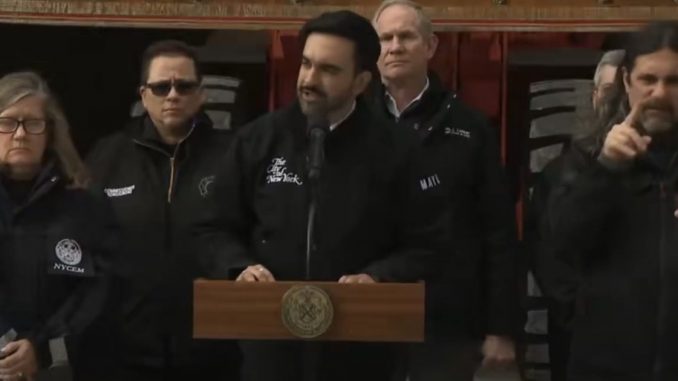
Mayor of New York City Zohran Mamdani during a press conference on Saturday.
Published February 22, 2025
New York City, NY — As a powerful late‑winter nor’easter threatens the New York area with blizzard‑level snowfall for the first time in nearly a decade, Mayor Zohran Mamdani has called on city residents to step up and help clear the streets — but not without showing their paperwork first.
With the National Weather Service issuing a blizzard warning for New York City from early Sunday into Monday, officials announced plans to bolster snow‑clearing efforts by recruiting emergency snow shovelers through the Department of Sanitation. Snow totals of roughly 15–24 inches are forecast, with strong winds and dangerous travel conditions expected.
“For those who want to help your neighbors and earn some extra cash, you too can become an emergency snow shoveler,” Mamdani said at a Saturday news conference. He instructed interested residents to report to their local sanitation garage between 8 a.m. and 1 p.m. with the required paperwork in hand.
However, some argued that the two policies differ and cannot be compared, with one writing: ‘Criticize policy if needed, but comparing snow removal registration to voting laws is misleading.’
‘The comparison is more political than practical. ID checks for emergency work are usually about payment verification and worker safety, while voting laws are governed by separate legal standards,’ another pointed out.
It comes after Mamdani was criticized for letting heaps of trash and filthy snow clutter New York City streets, while the grounds of his $100 million mansion remained spotless.
Large piles of snow remained on the streets of the city more than three weeks after the last snow storm.


Unusual ID Requirements Ignite Criticism
The conditions for signing up have drawn widespread attention: applicants are being told to bring multiple forms of identification, including two small photos, two original forms of government ID plus copies, and a Social Security card, before they can register and be assigned snow‑clearing duties.
While the pay — about $19.14 per hour, rising to $28.71 after overtime — is above typical temporary labor rates, many online commentators have mocked what they see as a bureaucratic hurdle to volunteer‑style work. Critics have contrasted the requirement for multiple IDs with voting in New York City, where most registered voters are not required to present an ID at the polls — a point that opponents have seized on to question the logic and consistency of policy.
Some conservative voices on social media have quipped that requiring ID to shovel snow but not to vote amounts to a kind of “Jim SNOW 2.0,” lampooning the perceived double standard. Others said the irony was heightened because Mamdani’s own political allies, like the Democratic Socialists of America, oppose stricter voter ID laws as discriminatory.

Emergency snow shovelers must be 18 years old, eligible to work in the US, and able to perform heavy physical labor

Mamdani said in a press conference that New Yorkers who want to earn some extra cash and help their neighbors can sign up to shovel snow. The position requires applicants to provide two small photos of themselves, two original forms of ID, and a Social Security card
Context: Storm Preparation and Safety Messaging
The call for volunteer shovelers comes as city agencies mobilize heavy equipment, expand snow‑clearing plans, and attempt to shore up public safety ahead of the storm. In his remarks, Mamdani also urged residents to stay informed through official alerts and prepare for potentially dangerous conditions.
With blizzard conditions looming and winter weather historically taxing city services, the administration’s recruitment push reflects both the scale of the challenge and ongoing debates about how to engage community involvement in emergency response.

New York will soon be hit with another major snow storm. Pictured above are shovelers clearing out a subway station in Brooklyn
 Implications of Mayor Mamdani’s Snow-Shoveling ID Requirements
-
Government Overreach Concerns
Critics argue that requiring multiple forms of ID for residents to volunteer or earn temporary pay for shoveling snow reflects an unnecessary expansion of bureaucracy into everyday community efforts. It can be seen as treating ordinary civic participation like a highly regulated government program, rather than a simple public service. -
Irony vs. Voter Access Policies
The rules highlight a perceived inconsistency: citizens must show extensive identification to shovel snow, yet no ID is required to vote. Some see this as an example of double standards in municipal policy, raising questions about fairness and the selective application of rules. -
Labor Market & Economic Messaging
Offering $19–$28 per hour for emergency snow-clearing work is relatively generous, yet the added paperwork could discourage willing participants. This may signal a disconnect between government incentives and practical implementation, which critics might frame as a mismanagement of taxpayer funds or inefficient labor mobilization. -
Public Trust & Engagement
Policies perceived as overcomplicated can erode trust in local leadership, especially among those who value minimal government interference in routine civic tasks. Even a well-intentioned program like snow-shoveling assistance can become a flashpoint in broader debates about personal freedom and government control. -
Cultural Perception & Political Messaging
The episode becomes fodder for discussions around government priorities, civic responsibility, and personal autonomy. Messaging that emphasizes bureaucracy over simplicity may feed narratives that question the practicality and priorities of city leadership.
 Overall Takeaway:
Mayor Mamdani’s call for New Yorkers to assist with snow removal comes at a time when the city faces one of its most significant winter storms in years. While the initiative is framed as a way to involve residents in helping their neighbors and supporting essential services, the extensive ID and documentation requirements have sparked debate about the practicality and fairness of such measures. Many see the policy as an example of bureaucratic overreach—turning a simple, community-oriented task into a highly regulated process that could discourage participation.
The contrast between the requirements for snow shovelers and the lack of similar documentation for other civic activities, like voting, has amplified public scrutiny. Observers argue this inconsistency raises questions about how government chooses to enforce rules and prioritize oversight, potentially undermining trust in municipal leadership.
Beyond procedural concerns, the episode also touches on broader economic and societal implications. Offering competitive pay for emergency snow-clearing work is a positive step toward incentivizing community involvement, but cumbersome bureaucracy can negate those benefits by limiting accessibility. For residents willing to contribute, the experience may feel more like navigating red tape than engaging in meaningful civic action.
Ultimately, the snow-shoveling program highlights the tension between good intentions and practical execution. It underscores the importance of balancing accountability with simplicity, ensuring that community-driven efforts remain inclusive and efficient. The conversation sparked by these ID requirements may serve as a catalyst for broader discussions about government efficiency, civic participation, and the proper role of regulation in everyday life—especially during emergencies when rapid, collective action is most needed.
SOURCES: THE GATEWAY PUNDIT – Mayor Mamdani Urges New Yorkers to Help Shovel Snow — But They Must Show Two Forms of ID!
DAILYMAIL ONLINE – NYC mayor blasted for requiring multiple forms of ID to shovel snow… while his socialist group says you don’t need it to vote