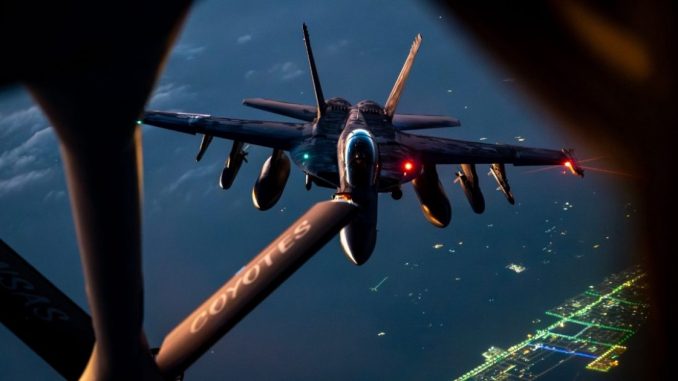
US Air Force KC-135 Stratotanker refuels US Navy F/A-18F Super Hornet / CENTCOM
Published March 14, 2025
TAMPA, FL — The U.S. military has confirmed that all six crew members aboard a KC‑135 Stratotanker refueling aircraft that went down in western Iraq on March 12, 2026, have been confirmed deceased, following an earlier period of search and rescue operations.
The loss of the Boeing KC‑135 Stratotanker, one of the United States Air Force’s primary aerial refueling aircraft, was announced by U.S. Central Command (CENTCOM). The aircraft was operating over “friendly airspace” in western Iraq at the time of the incident while supporting Operation Epic Fury, the U.S. military campaign connected to ongoing conflict in the region.
Incident Details
According to CENTCOM and military statements, two KC‑135 aircraft were involved in an in‑flight incident over Iraq. One of the tankers crashed and was destroyed, killing all six airmen on board. The second aircraft — also a KC‑135 — suffered damage but was able to return and land safely in Israel.
Officials emphasized that the crash was not caused by hostile fire or friendly fire, and the circumstances of the event are currently under investigation. Details regarding what exactly transpired in the air have not been released, though the involvement of another aircraft suggests a possible mid‑air collision during aerial operations.
Crew and Casualties
The identities of the six airmen killed aboard the aircraft have not yet been released, as families are being formally notified. In earlier hours after the crash, U.S. officials reported that some crew members were missing, but confirmed later that all six had died as rescue and recovery operations concluded.
Military Context
The KC‑135 Stratotanker has been a backbone of U.S. aerial refueling operations for more than six decades, enabling extended range and duration for combat and support aircraft. However, its age — with the oldest airframes dating to the 1960s — has raised concerns about reliability, and it is gradually being replaced by the newer KC‑46A Pegasus aircraft.
This incident marks one of the deadliest non‑combat losses of U.S. airmen in recent months. It is also the most recent of several aircraft losses in the region since large‑scale operations began in late February 2026, and highlights the inherent risks of complex aerial refueling missions, especially amid intense operational tempos.
Broader Impact
The service members’ deaths add to the growing toll of U.S. personnel in the Middle East theater. In addition to the tanker crash, multiple U.S. aircraft have been lost since the conflict escalated, some due to misidentification or equipment issues, though many service members involved in other crashes survived.
Defense officials and service leaders have praised the fallen aircrew members for their service, describing them as heroes who lost their lives in support of U.S. military objectives. Further updates on the investigation are expected in the coming days as more information is gathered and analyzed.
 Public / Political Reactions of the KC‑135 Crash:
U.S. Government and Military Leadership
-
Defense Secretary Pete Hegseth described the six aircrew members killed in the crash as “American heroes,” emphasizing the inherent dangers of wartime operations even outside direct combat, and reaffirmed the U.S. commitment to ongoing military objectives in the Middle East. Hegseth said “bad things can happen” in the fog of war and underscored the military’s investigation into the circumstances of the loss.
-
Gen. Dan Caine, Chairman of the Joint Chiefs of Staff, publicly honored the fallen crew and stressed that the incident occurred “over friendly territory” while on a combat mission. He reiterated that hostile or friendly fire were not believed to be involved and extended condolences to the families and units affected.
-
The White House and Pentagon also expressed deep regret over the loss of life, framing the tragedy within the broader context of U.S. military operations against Iranian forces. Officials restated that the crash was under investigation and reaffirmed support for service members and their families.
International Political Responses
-
Iran‑aligned armed groups, including the Islamic Resistance in Iraq, immediately claimed responsibility for downing the aircraft and framed the incident as a defensive action against U.S. military presence in Iraqi airspace. U.S. officials have denied these assertions, maintaining that the crash was not due to hostile action.
-
Worldwide, some governments and analysts highlighted the crash as another grim reminder of the escalating conflict in the region and the risks faced by military personnel during such operations. Global media coverage tied the tragedy to ongoing tensions from U.S. and allied operations against Iran and its proxies.
-
Foreign leaders and international organizations also expressed concern about the broader implications of continued military engagement in the Middle East, calling for clarity on the incident and emphasizing the need to avoid further escalation. While many aligned with U.S. efforts against Iranian aggression, others raised questions about the long‑term strategy and human costs of extended conflict.
Public Reaction and Civil Commentary
-
In the United States, the crash has sparked debate among the public and political commentators. Some voices honored the sacrifice of service members and reaffirmed support for U.S. strategic objectives, while others criticized the broader war strategy, questioning the risks and goals of extended military operations in the Middle East. Online discussions and social media reactions reflect a mix of grief, frustration, and political contention, with some users lamenting the death of the aircrew and others debating U.S. foreign policy direction.
-
Veterans and defense analysts have noted the dangers of aerial refueling missions and the operational strains imposed by high‑tempo combat environments, especially with older aircraft like the KC‑135. These discussions have highlighted broader questions about military readiness, equipment modernization, and support for service members in high‑risk theaters.
 Resulting Effects of the KC‑135 Crash:
Military Readiness and Operational Strain
The loss of the KC‑135 tanker highlights the strain on U.S. aerial refueling operations, especially in high‑tempo theaters like Iraq. The incident raises concerns about aging aircraft still in active service and the pressure placed on crews operating under extended missions. Many military analysts argue that incidents like this underscore the need for modernized equipment and stronger support systems to maintain operational effectiveness while minimizing risk to personnel.
Impact on U.S. Strategy in the Middle East
This crash may force reassessment of U.S. mission priorities and force posture in the region. With the loss occurring over friendly airspace, the event draws attention to the challenges of maintaining U.S. presence and deterrence without unnecessarily risking lives. Officials are likely to weigh operational necessity against personnel safety, potentially accelerating the deployment of newer refueling aircraft or reconsidering the frequency of high‑risk missions.
Public Perception and Political Pressure
The deaths of six service members have already intensified public scrutiny of ongoing military operations, prompting calls for accountability and transparency. While there is broad support for defending U.S. interests abroad, the incident may increase demands for clear objectives and cost‑benefit analyses in military engagements. Decision-makers are facing pressure to justify operations while protecting those who serve, balancing strategic goals with human costs.
Defense Modernization and Policy Implications
Beyond immediate operational consequences, the crash is likely to accelerate debates on military modernization and readiness. Aging aircraft like the KC‑135, some over 60 years old, are increasingly viewed as vulnerable under high-demand scenarios, driving discussion on investment in advanced aircraft and technology. The incident could influence policy prioritization, including accelerating replacements like the KC‑46 Pegasus and improving training protocols for high-risk missions.
 Future Outlook:
Enhanced Military Preparedness
In the wake of the KC‑135 crash, U.S. military leaders are likely to prioritize operational readiness and crew safety. Expect increased maintenance oversight, training drills, and risk assessments for aerial refueling missions and other high-stakes operations. The incident underscores the need for modernized aircraft and improved logistical planning to prevent similar tragedies in the future.
Strategic Reassessment in the Middle East
The loss may prompt a careful review of U.S. presence and mission profiles in Iraq and surrounding regions. Commanders will likely evaluate how to maintain deterrence and project power effectively while minimizing unnecessary exposure to danger. Future operations could rely more heavily on advanced aircraft, surveillance technology, and tactical coordination to mitigate risks in contested airspace.
Acceleration of Modernization Programs
The KC‑135 crash highlights the limitations of aging airframes, reinforcing calls for investing in newer refueling and support platforms. Programs like the KC‑46 Pegasus are expected to see higher priority in funding, deployment, and integration into operational planning. Long-term, this could improve mission reliability, reduce personnel risk, and sustain U.S. global military capabilities.
Public Confidence and Policy Implications
Maintaining public support for ongoing military operations will hinge on demonstrating accountability, operational competence, and readiness for future contingencies. Officials may use lessons from this tragedy to strengthen safety protocols and reassure both domestic and allied audiences that U.S. forces are prepared to respond effectively while minimizing avoidable losses.
Outlook Summary
While the loss of six service members is a stark reminder of the risks inherent in military operations, the broader trajectory suggests a renewed emphasis on modernization, tactical prudence, and strategic resilience. The U.S. military is likely to adapt lessons learned from this incident to ensure future missions are safer, more efficient, and capable of meeting national security objectives.
 Bottom Line:
The tragic loss of six aircrew members in the KC‑135 crash underscores the inherent risks of maintaining U.S. military operations in high-demand environments. While the incident did not involve hostile fire, it highlights the need for vigilance, modernization, and careful operational planning to protect service members and sustain mission effectiveness.
Moving forward, the U.S. military faces the dual challenge of projecting strength abroad while minimizing unnecessary risks. Investments in modern aircraft, improved training, and advanced operational protocols will be essential to prevent similar tragedies and maintain the readiness of U.S. forces.
Ultimately, the crash serves as a solemn reminder of the sacrifice required to uphold national security and global stability, reinforcing the importance of prudence, preparedness, and accountability in all aspects of military operations.