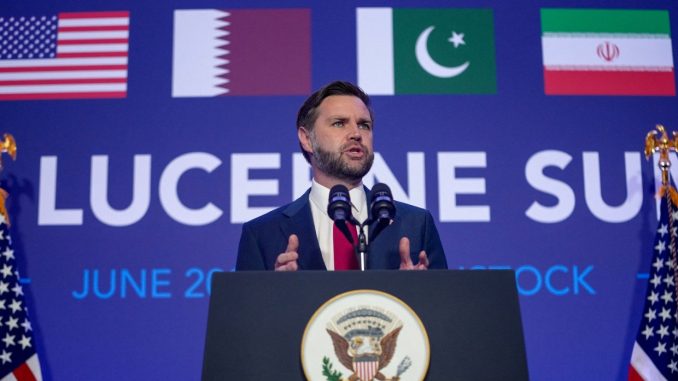
Vice President JD Vance speaks to members of the media after the U.S. and Iran held talks at the Lake Lucerne Summit, near Stansstad, Switzerland, June 22, 2026.(Nathan Howard/Pool via Reuters)
Editor: Diana Zapata
Published June 23, 2026
 CONTEXT SIGNAL
The Trump administration returned to power with a clear mandate centered on restoring stricter immigration enforcement, reducing illegal crossings, and reasserting federal control over the border after years of what supporters describe as inconsistent and overly permissive policies under previous administrations. Early policy actions have reflected that priority, with renewed emphasis on deportations, tighter asylum standards, expanded interior enforcement, and broader use of executive authority to accelerate implementation.
At the same time, governing has revealed familiar structural tensions. Immigration is not just a political issue but an administrative system that depends on coordination between federal agencies, immigration courts, state and local law enforcement, and the broader legal framework established by Congress. When one part of that system is changed rapidly—especially through executive action—it often produces downstream friction, including legal challenges, uneven enforcement, and operational uncertainty.
This dynamic is not unique to any one administration. Past presidents from both parties have relied on executive tools to advance immigration priorities when legislative compromise proved difficult. However, such approaches tend to expand administrative discretion while leaving underlying statutory gaps unresolved. Over time, this can create a cycle where enforcement intensity rises and falls depending on leadership style rather than consistent legal structure.
The current debate centers on whether the Trump administration’s approach is breaking from that cycle or unintentionally reproducing it in a different form. Supporters argue that strong executive action is necessary to regain control of the border quickly. Critics caution that without durable legislative reform and institutional clarity, even aggressive enforcement strategies may prove temporary, legally vulnerable, or difficult to sustain across political transitions.
 EDITORIAL POSITION
The central issue is whether the Trump administration is actually building a fundamentally different immigration system—or simply operating the same system with more force behind it. The promise was structural change: clearer rules, stronger enforcement, and less reliance on executive improvisation. But what is emerging instead, in several areas, is a continuation of the same governing pattern where day-to-day policy is driven less by stable legislation and more by shifting administrative decisions.
This matters because immigration policy is not just about enforcement levels; it is about predictability. A system that changes direction based on court rulings, internal agency guidance, or political pressure becomes difficult to administer consistently. Officers on the ground are left interpreting evolving priorities, courts are forced to adjudicate policy questions that should have been settled by Congress, and the public receives mixed signals about what the rules actually are.
The deeper concern is institutional drift. When executive action becomes the primary tool for achieving policy goals, it gradually reshapes the balance of power in Washington. Even if the policy goals are widely supported—such as stronger border security—the method of achieving them can still weaken long-term governance if it bypasses durable legislative frameworks. Over time, this creates a system where each administration feels compelled to reset or re-interpret the rules rather than operate within a stable structure.
There is also a credibility issue. Governments lose authority when their enforcement posture appears reactive rather than consistent. If enforcement intensifies dramatically in one phase and then loosens or shifts in another, the system begins to look political rather than procedural. That perception affects not only public trust but also compliance, deterrence, and institutional morale.
In that sense, the critique is not about the direction of enforcement alone, but about sustainability. A policy approach that depends heavily on executive momentum may achieve visible short-term results, but it risks collapsing into the same cycle of expansion, litigation, and partial reversal that has defined immigration governance for decades.
 SUPPORTING CONTEXT
1. Immigration as a System Under Strain
U.S. immigration policy is built on a legal framework that has not been comprehensively updated in decades. As a result, modern migration pressures are being managed through an outdated system that was not designed for today’s scale of border crossings, asylum claims, or visa overstays. This mismatch forces each administration to rely heavily on interpretation and enforcement discretion rather than clear, modern statutes.
2. Executive Action Filling Legislative Gaps
Because Congress has repeatedly failed to pass large-scale immigration reform, presidents from both parties have used executive authority to adjust enforcement priorities, create temporary protections, or expand operational guidance for federal agencies. While this allows governments to respond quickly to changing conditions, it also means immigration policy often shifts without permanent legal grounding.
3. The Role of the Courts in Immigration Policy
Immigration policy is frequently shaped not just by lawmakers and the executive branch, but also by federal courts. Major policy changes—whether tightening or loosening enforcement—are often challenged legally, resulting in injunctions, partial rulings, or delayed implementation. This judicial involvement creates a system where immigration policy is continuously negotiated rather than definitively settled.
4. Enforcement Capacity and Operational Limits
Even when policy changes are announced at the federal level, implementation depends on agency capacity. Border enforcement, immigration courts, detention space, and coordination with state and local authorities all affect how policy is carried out in practice. These constraints often slow down or dilute policy changes, regardless of political intent.
5. Political Cycles and Policy Instability
Immigration policy in the United States has tended to swing between periods of stricter enforcement and periods of expanded discretion, depending on which party holds power. These shifts can create uncertainty for enforcement agencies, local governments, and migrants themselves, as rules and priorities change over time rather than remaining consistent across administrations.
6. External Migration Pressures
Migration flows are also influenced by conditions outside the United States, including economic instability, cartel activity, political unrest, and regional crises in Latin America and other parts of the world. These external factors ensure that U.S. immigration policy is constantly reacting to global events, not operating in isolation or under stable conditions.
⚖️ EDITORIAL STANCE
A serious immigration strategy cannot be built on momentum alone. Even when the goal is widely shared—stronger border enforcement and clearer immigration rules—the method of governance determines whether those goals actually last. What is currently emerging is a system that risks relying too heavily on executive action and agency-level discretion rather than on durable, congressionally established law.
That approach may feel effective in the short term because it allows rapid policy shifts and visible enforcement changes. But it also carries a built-in weakness: it is fragile. Policies that depend on executive authority can be slowed, reshaped, or blocked through litigation, and they can be quickly reversed or reinterpreted by future administrations.
As a result, enforcement becomes cyclical rather than consistent, and the underlying system never fully stabilizes.
There is also a broader institutional concern. When major policy decisions are repeatedly made through executive channels, Congress is gradually sidelined from its constitutional role in setting immigration law. Over time, this weakens legislative accountability and shifts too much governing power into the executive branch. Even if the outcomes are popular in the moment, the long-term effect is a less balanced and less predictable system of governance.
On the ground, this creates real consequences. Enforcement agencies are left operating under shifting priorities, which can change with court rulings, political pressure, or internal guidance updates. That uncertainty affects how consistently laws are applied, how resources are allocated, and how immigration cases are processed. A system that changes tone without changing structure tends to produce uneven results and public confusion about what the rules actually are.
None of this is an argument against enforcement itself. The core issue is whether enforcement is being anchored in a framework that can survive beyond a single administration. Without that foundation, even aggressive policy measures risk becoming temporary surges rather than lasting corrections.
The concern, ultimately, is sustainability. A governing approach that prioritizes speed and executive flexibility over legislative clarity may succeed in projecting control, but it does not necessarily build it. If the goal is a lasting immigration system—one that is consistent, enforceable, and insulated from political swings—then the reliance on executive-driven solutions must eventually give way to structural reform rooted in law rather than administration.
 CONCLUSION
The broader challenge facing U.S. immigration policy is not simply about enforcement levels or political messaging, but about whether the system can move beyond cycles of short-term action and long-term instability. Executive measures may deliver quick results and demonstrate political resolve, but they rarely create lasting structure on their own. Without clearer legislation from Congress and more stable rules that outlast individual administrations, immigration policy is likely to remain reactive, uneven, and vulnerable to constant legal and political disruption. The central question going forward is whether current efforts will build a durable framework—or repeat the same pattern of temporary fixes followed by reversal and uncertainty.