Published June 27, 2026
WASHINGTON, D.C. — The United States, Israel, and Lebanon have signed a framework agreement intended to establish a pathway toward ending months of hostilities along the Israel-Lebanon border, marking one of the most significant diplomatic initiatives between the neighboring countries in decades. However, the accord has already encountered resistance from Hezbollah and its supporters, raising questions about its long-term viability.
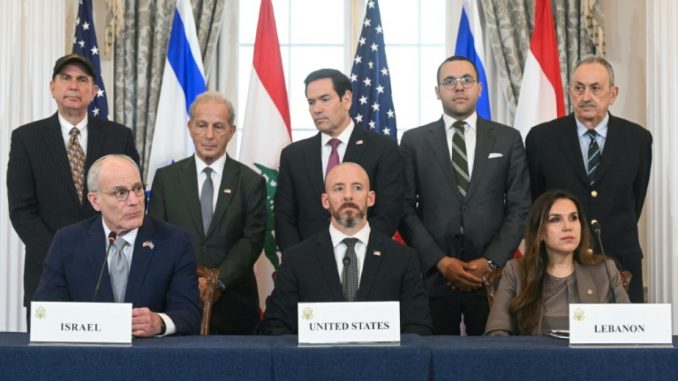
The agreement was formally announced in Washington on Friday during a ceremony attended by U.S. Secretary of State Marco Rubio alongside senior Israeli and Lebanese representatives. American officials described the accord as an initial step designed to reduce tensions, strengthen Lebanese state authority, and lay the groundwork for broader peace negotiations.
Israeli Ambassador Yechiel Leiter and Lebanese Ambassador Nada Hamadeh Moawad signed the framework agreement with U.S. officials acting as mediators and guarantors. The accord follows months of U.S.-led diplomatic efforts aimed at ending clashes between Israeli forces and Hezbollah fighters that have destabilized southern Lebanon and northern Israel.
According to officials familiar with the agreement, the framework envisions the gradual expansion of Lebanese Armed Forces control over designated areas in southern Lebanon through the establishment of so-called “pilot zones.” Israeli troops would eventually withdraw from these areas once Lebanese authorities assume security responsibilities and ensure that non-state armed groups no longer operate there.
The United States also announced the creation of a Military Coordination Group intended to oversee implementation of the agreement, facilitate communication among the parties, and help prevent renewed hostilities. Washington further pledged approximately $100 million in humanitarian assistance to support recovery efforts in Lebanon.
Despite the diplomatic breakthrough, Israeli Prime Minister Benjamin Netanyahu emphasized that Israeli forces would continue maintaining a security presence in parts of southern Lebanon until Hezbollah is effectively disarmed and no longer poses a threat to Israeli communities. Israeli officials have repeatedly insisted that any lasting settlement must ensure that Hezbollah fighters are removed from areas near the border.
The agreement, however, was negotiated without Hezbollah’s direct participation, a factor that immediately generated opposition from the Iran-backed militant and political movement. Hezbollah officials rejected key aspects of the arrangement, particularly provisions related to disarmament, and warned against attempts to forcibly implement the agreement.
In Beirut, hundreds of Hezbollah supporters reportedly gathered in several neighborhoods to protest the deal, denouncing what they described as concessions to Israel and criticizing foreign involvement in Lebanese affairs. Demonstrators waved Hezbollah and Lebanese flags while expressing support for what they called the “resistance” against Israel. Protesters argued that the movement’s weapons remain necessary to defend Lebanon against future Israeli military operations.
Political observers noted that Hezbollah’s opposition presents a significant challenge to implementation of the framework agreement. Analysts warned that attempts by Lebanese authorities to enforce provisions involving Hezbollah’s military capabilities could deepen internal political tensions and potentially trigger unrest.
The latest agreement builds upon earlier ceasefire arrangements brokered by the United States in recent months. Although previous truces succeeded in temporarily reducing violence, sporadic clashes and airstrikes continued, underscoring the fragility of existing understandings.
Regional and international observers have cautiously welcomed the framework while acknowledging the substantial obstacles that remain. Many analysts believe the accord could provide an opportunity to stabilize the border region and strengthen Lebanese sovereignty, but they also caution that lasting peace will depend largely on whether all major actors—including Hezbollah—ultimately accept and adhere to the agreement.
 Public / Political Reactions:
🇮🇱 Israeli Government Officials
Israeli leaders welcomed the U.S.-brokered framework agreement as an important step toward improving security along Israel’s northern border.
- Israeli officials stated that any lasting arrangement must guarantee that Hezbollah can no longer threaten Israeli communities near the border.
- Prime Minister Benjamin Netanyahu emphasized that Israeli forces would maintain security positions until Hezbollah is effectively disarmed and security conditions are met.
- Israeli officials described the agreement as a strategic opportunity to reduce Iranian influence in Lebanon and strengthen regional stability.
➡️ Position: Israeli officials support the framework agreement but insist that long-term peace depends on Hezbollah’s disarmament and robust security guarantees.
🇱🇧 Lebanese Government Officials
Lebanese leaders portrayed the agreement as an opportunity to strengthen state authority and restore stability in southern Lebanon.
- Lebanese officials emphasized the importance of expanding the role of the Lebanese Armed Forces in areas previously affected by conflict.
- Government representatives argued that restoring full state control over Lebanese territory is essential for long-term peace and national sovereignty.
- Some officials expressed cautious optimism while acknowledging the significant challenges associated with implementing the agreement.
➡️ Position: The Lebanese government generally supports the framework as a means of restoring sovereignty and reducing the risk of renewed conflict.
🇺🇸 United States Officials
U.S. officials described the agreement as a significant diplomatic achievement and an important first step toward ending hostilities.
- Secretary of State Marco Rubio said the framework is intended to create conditions for lasting peace and security between Israel and Lebanon.
- American officials pledged continued diplomatic engagement and oversight through the newly established Military Coordination Group.
- Washington also announced humanitarian assistance for Lebanon as part of broader efforts to stabilize the country.
➡️ Position: The United States strongly supports the agreement and views it as a foundation for broader regional stability and future peace efforts.
🚩 Hezbollah and Its Supporters
Hezbollah and many of its supporters strongly opposed the agreement, particularly provisions related to disarmament and Israeli security demands.
- Hezbollah officials rejected calls to surrender their weapons, arguing that their military capabilities remain necessary to defend Lebanon.
- Hundreds of Hezbollah supporters reportedly staged demonstrations in Beirut, criticizing the agreement and denouncing foreign involvement in Lebanese affairs.
- Hezbollah representatives warned that attempts to impose disarmament could generate domestic tensions and instability.
➡️ Position: Hezbollah rejects key elements of the framework agreement and maintains that its armed presence remains necessary as part of what it describes as the resistance against Israel.
🌍 International Analysts and Regional Observers
Regional experts and international analysts largely welcomed the diplomatic breakthrough while cautioning that implementation will be difficult.
- Analysts noted that Hezbollah’s exclusion from direct negotiations could complicate enforcement of the agreement.
- Some observers argued that strengthening Lebanese state institutions will be crucial for the framework’s success.
- Others warned that any effort to disarm Hezbollah could trigger significant political and security challenges inside Lebanon.
➡️ Position: Analysts see the agreement as a potentially important diplomatic breakthrough, but many caution that substantial political and security obstacles remain.
 Resulting Effects:
The signing of the U.S.-brokered framework agreement between Israel and Lebanon is expected to have significant military, political, and diplomatic consequences across the region.
1. Potential Reduction in Cross-Border Hostilities
The agreement aims to establish mechanisms designed to reduce violence along the Israel-Lebanon border.
📌 Coordinated security arrangements could decrease the frequency of cross-border exchanges of fire.
📌 The establishment of pilot security zones may help stabilize areas most affected by the conflict.
📌 Civilians displaced by fighting could eventually begin returning to their communities if security conditions improve.
➡️ Result: Framework agreement → potential reduction in border hostilities and improved regional stability.
2. Expanded Role for the Lebanese Armed Forces
A central component of the agreement involves increasing the presence and authority of the Lebanese military in southern Lebanon.
🛡️ Lebanese Armed Forces are expected to assume greater responsibility for maintaining security in designated areas.
🏛️ The expansion of state authority could strengthen Lebanon’s central government and national institutions.
📄 Successful implementation may reduce the influence of non-state armed groups in certain regions.
➡️ Result: Increased military deployment → stronger Lebanese state presence in southern Lebanon.
3. Heightened Political Tensions Inside Lebanon
The agreement has already generated opposition from Hezbollah and some of its supporters.
⚠️ Disagreements over disarmament and security arrangements could deepen existing political divisions.
🚩 Demonstrations and protests may continue as opponents criticize aspects of the agreement.
🏛️ Internal debates regarding sovereignty, security, and Hezbollah’s future role are likely to intensify.
➡️ Result: Opposition to the accord → increased domestic political tensions within Lebanon.
4. Increased U.S. Diplomatic and Security Involvement
Washington is expected to play a major role in overseeing implementation of the agreement.
🤝 The newly established Military Coordination Group will likely require sustained American engagement.
💰 U.S. humanitarian and reconstruction assistance could expand as part of broader stabilization efforts.
🌍 Continued diplomatic involvement may strengthen Washington’s influence in regional security matters.
➡️ Result: U.S.-mediated agreement → expanded American diplomatic and security role in the region.
5. Challenges to Hezbollah’s Military Position
The framework’s security provisions may place additional pressure on Hezbollah’s armed presence near the Israeli border.
🚁 Restrictions on armed activity in designated areas could limit Hezbollah’s operational freedom.
⚔️ Efforts to increase Lebanese state control may challenge Hezbollah’s long-standing influence in southern Lebanon.
📊 The group’s response to implementation efforts will likely become a key factor determining the agreement’s success.
➡️ Result: New security arrangements → increased pressure on Hezbollah’s military presence.
6. Renewed Momentum for Regional Diplomacy
The agreement may encourage additional diplomatic initiatives aimed at reducing tensions elsewhere in the Middle East.
🌍 Regional and international actors could view the accord as a model for future conflict-management efforts.
🤝 Successful implementation may improve prospects for broader diplomatic engagement between neighboring states.
📄 International mediators are expected to closely monitor developments and encourage continued dialogue.
➡️ Result: Diplomatic breakthrough → renewed international efforts to promote regional stability and conflict resolution.
 Future Outlook:
The U.S.-brokered framework agreement between Israel and Lebanon represents a potentially significant diplomatic breakthrough, but its long-term success will depend on implementation, political will, and security developments on the ground.
1. Implementation of the Agreement Will Face Significant Challenges
While the signing of the framework marks an important diplomatic step, translating the agreement into lasting realities on the ground is expected to be difficult.
📄 The phased implementation process will require sustained cooperation among Israel, Lebanon, and the United States.
⚠️ Disagreements over security arrangements, troop deployments, and timelines could delay implementation.
🤝 Continued diplomatic engagement will likely be necessary to address disputes and maintain momentum.
➡️ Outlook: Complex implementation process → continued diplomatic and security challenges.
2. Hezbollah’s Response Will Be Critical
The future of the agreement may largely depend on how Hezbollah responds to its provisions.
🚩 Hezbollah is expected to continue resisting calls for disarmament and restrictions on its military activities.
⚔️ Any attempt to forcibly implement security measures could generate tensions or trigger localized confrontations.
📊 The group’s willingness—or refusal—to accommodate the agreement may determine whether the framework succeeds or stalls.
➡️ Outlook: Hezbollah’s position → key factor shaping the agreement’s long-term viability.
3. Lebanese State Institutions Could Gain Greater Authority
If successfully implemented, the agreement could strengthen Lebanon’s central government and national institutions.
🛡️ The Lebanese Armed Forces are expected to expand their presence and responsibilities in southern Lebanon.
🏛️ Greater state control over border areas could enhance government authority and national sovereignty.
📈 International assistance may help Lebanese institutions improve their operational capabilities.
➡️ Outlook: Successful implementation → stronger Lebanese state authority and institutional capacity.
4. Israel Is Likely to Maintain a Strong Security Posture
Israeli leaders have indicated that security concerns will remain a top priority.
🛡️ Israel is expected to continue closely monitoring developments along its northern border.
🚁 Israeli forces may maintain military readiness and reserve the option to respond to perceived threats.
📄 Future Israeli withdrawals or security adjustments will likely depend on conditions on the ground and compliance with the agreement.
➡️ Outlook: Persistent security concerns → continued Israeli vigilance and military preparedness.
5. The United States Is Expected to Remain Deeply Engaged
Washington is likely to play an ongoing role in supervising and supporting implementation efforts.
🤝 U.S. officials are expected to continue mediating disputes and facilitating communication between the parties.
💰 Additional humanitarian, economic, and security assistance could be provided to support stability in Lebanon.
🌍 Continued American involvement may shape broader regional diplomatic initiatives.
➡️ Outlook: Sustained U.S. engagement → continued diplomatic oversight and regional influence.
6. Regional Stability Will Remain Uncertain
Despite the agreement, broader geopolitical tensions in the Middle East are expected to continue affecting the situation.
🌍 Regional actors, including Iran and other neighboring states, will likely continue monitoring developments closely.
⚔️ Any major escalation elsewhere in the region could undermine progress achieved through the agreement.
📰 International attention is expected to remain focused on whether the framework can deliver a durable reduction in hostilities.
➡️ Outlook: Fragile regional environment → uncertain prospects for long-term peace and stability.
 Bottom Line
The signing of the U.S.-brokered framework agreement between Israel and Lebanon marks one of the most significant diplomatic developments between the two countries in years, offering a potential pathway toward reducing hostilities along their volatile border. The agreement aims to strengthen Lebanese state authority, improve border security, and create conditions for a more stable security environment.
However, strong opposition from Hezbollah and its supporters underscores the substantial political and security challenges that lie ahead. Because the Iran-backed group was not directly involved in negotiations and continues to reject key provisions—particularly those related to disarmament—the success of the agreement will ultimately depend on whether all major stakeholders are willing to support and implement its terms.
SOURCES: REUTERS – Israel, Lebanon sign initial agreement after US-mediated talks
JAPAN TIMES – Israel and Lebanon reach framework deal aiming to end conflict
BANGKOK POST – Lebanon, Israel and US sign framework pact
THE MANILA TIMES – Hezbollah supporters take to streets of Beirut to protest Israel deal