
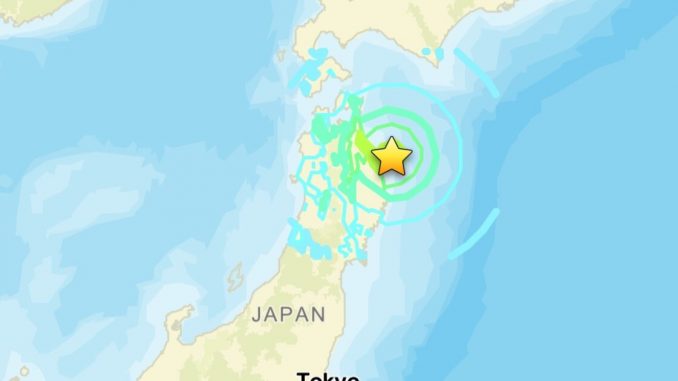
The Japan Meteorological Agency said the epicenter was 50 kilometers deep off the coast of Iwate Prefecture
Published June 25, 2026
TOKYO, Japan — June 25, 2026 — A powerful magnitude 6.9 earthquake struck off the coast of northern Japan on Thursday morning, shaking buildings across a wide area, including parts of Tokyo, but authorities reported no immediate casualties and issued no tsunami warning.
According to the Japan Meteorological Agency (JMA), the earthquake occurred off the coast of Iwate Prefecture on Japan’s main island of Honshu at a depth of approximately 50 kilometers. The U.S. Geological Survey also recorded the quake at magnitude 6.9.
The strongest shaking was recorded in parts of Aomori Prefecture, where the tremor reached an upper six on Japan’s seven-level Shindo seismic intensity scale. At that intensity, people often struggle to remain standing, and unsecured furniture can topple.
Despite the quake’s strength, authorities said there were no immediate reports of deaths or serious injuries. Chief Cabinet Secretary Minoru Kihara stated that the government was continuing to assess the situation while monitoring for possible damage.
The earthquake temporarily disrupted transportation across northeastern Japan. Several Shinkansen bullet train services were suspended for safety inspections before operations gradually resumed. Public broadcaster NHK reported that traffic signals and major roadways remained operational in affected areas.
Officials also confirmed that no abnormalities were detected at nuclear facilities, including monitoring systems linked to power plants in northern Japan.
Prime Minister Sanae Takaichi directed government agencies to coordinate closely with local authorities and urged residents in affected regions to remain vigilant for potential aftershocks.
Japan sits along the Pacific “Ring of Fire,” one of the world’s most seismically active regions. The country experiences hundreds of earthquakes annually and remains highly sensitive to seismic threats following the devastating 2011 earthquake and tsunami disaster.
While Thursday’s earthquake caused concern across northern Japan, early assessments suggest that damage was limited and that the country’s extensive earthquake preparedness systems helped minimize disruption. Authorities continue to monitor the situation as aftershocks remain possible in the coming days.
 Public / Political Reactions:
🇯🇵 Japanese Government Officials
Japanese government leaders moved quickly to reassure the public and coordinate emergency response efforts following the powerful earthquake.
- Prime Minister Sanae Takaichi stated that the government was putting public safety first while assessing damage and preparing relief measures if necessary.
- Chief Cabinet Secretary Minoru Kihara reported that there were no immediate reports of major injuries or significant damage.
- Authorities urged residents to remain alert for aftershocks and follow official safety guidance.
➡️ Position: Government officials emphasized public safety, rapid assessment of damage, and preparedness for potential aftershocks.
🚆 Local Residents and Communities
Residents across northern Japan experienced strong shaking but largely remained calm due to the country’s extensive earthquake preparedness measures.
Many residents reported feeling prolonged shaking during the morning rush hour.
Schools in some affected areas dismissed students early as a precaution.
Local communities closely monitored official updates while transportation services underwent safety inspections.
➡️ Position: Residents expressed concern but generally followed established earthquake safety procedures.
📺 Media and Public Broadcasters
Japanese media provided extensive live coverage of the earthquake and its aftermath.
- Public broadcaster NHK reported visible shaking in several cities, including Sendai and Morioka.
- Journalists on the ground reported no immediate signs of major structural damage despite the quake’s strength.
- Coverage focused heavily on transportation disruptions, aftershock risks, and official safety guidance.
➡️ Position: Media coverage emphasized public safety information and updates from emergency authorities.
⚛️ Nuclear and Safety Officials
Given Japan’s history with major earthquakes and nuclear facilities, safety inspections became an immediate priority.
- Officials confirmed that facilities including Fukushima Daiichi Nuclear Power Plant reported no abnormalities following the earthquake.
- Nuclear regulators continued monitoring facilities in affected regions as a precaution.
- The absence of a tsunami warning helped ease concerns about wider infrastructure impacts.
➡️ Position: Safety officials reassured the public that critical infrastructure and nuclear facilities remained secure.
🌍 International Observers
The earthquake attracted global attention due to Japan’s location along the Pacific Ring of Fire and its history of devastating seismic disasters.
- International monitoring agencies closely tracked the event and confirmed the earthquake’s magnitude.
- Disaster experts praised Japan’s preparedness systems, which helped minimize disruption despite the strong shaking.
- Global media highlighted the absence of a tsunami threat and the lack of major reported damage.
➡️ Position: International observers viewed the response as another example of Japan’s strong disaster preparedness and emergency management capabilities.
 Resulting Effects
The powerful 6.9-magnitude earthquake that struck northern Japan has prompted emergency response measures, transportation disruptions, and heightened public vigilance, while also highlighting the country’s advanced disaster preparedness systems.
1. Transportation Services Temporarily Disrupted
The earthquake caused precautionary interruptions to rail and transportation networks across northeastern Japan.
🚆 Several Shinkansen bullet train services were temporarily suspended for safety inspections.
🛣️ Transportation authorities conducted checks on roads, bridges, and critical infrastructure.
🚉 Rail operations gradually resumed after officials confirmed the safety of tracks and facilities.
➡️ Result: Strong earthquake → temporary transportation disruptions and safety inspections.
2. Emergency Response Systems Activated
Government agencies and local authorities quickly mobilized to assess potential damage and protect residents.
🚨 Emergency management teams were deployed to monitor affected areas.
📡 Authorities issued public safety advisories and aftershock warnings.
🏛️ Government officials coordinated with local governments to evaluate infrastructure conditions.
➡️ Result: Earthquake event → rapid activation of emergency response and monitoring systems.
3. Increased Public Awareness and Preparedness
The earthquake reminded residents of the ongoing seismic risks associated with living in one of the world’s most earthquake-prone regions.
📢 Authorities urged residents to remain alert for aftershocks.
🏠 Families reviewed emergency plans and disaster preparedness supplies.
📱 Many residents relied on earthquake alert systems for real-time updates.
➡️ Result: Powerful tremor → heightened public awareness and preparedness efforts.
4. Infrastructure and Facility Inspections Conducted
Critical infrastructure operators carried out extensive inspections following the quake.
⚛️ Nuclear facilities reported no abnormalities during initial safety checks.
🔌 Utility providers monitored power, communication, and water systems for disruptions.
🏗️ Engineers inspected public facilities and transportation infrastructure for potential damage.
➡️ Result: Strong ground shaking → precautionary inspections of critical infrastructure.
5. Economic Activity Faces Short-Term Disruptions
Although major damage was not immediately reported, some business operations experienced temporary interruptions.
🏢 Offices and businesses briefly paused operations during and after the quake.
🚆 Transportation delays affected commuters and commercial activity.
📊 Authorities continue assessing any economic impact resulting from the disruption.
➡️ Result: Earthquake-related interruptions → short-term effects on business and transportation activities.
6. Renewed Focus on Disaster Preparedness
The earthquake has reinforced the importance of Japan’s long-standing investments in disaster resilience.
🌍 Emergency preparedness systems were tested under real-world conditions.
🏗️ Earthquake-resistant infrastructure helped limit potential damage.
📚 Officials may review response procedures and preparedness measures based on lessons learned from the event.
➡️ Result: Major seismic event → renewed emphasis on disaster readiness and resilience planning.
 Future Outlook
The days and weeks ahead will be important as Japanese authorities continue assessing the impact of the 6.9-magnitude earthquake and monitoring for aftershocks. While no major damage or tsunami threat has been reported, officials remain cautious given Japan’s history of significant seismic activity.
1. Continued Monitoring for Aftershocks
Seismologists expect aftershocks to remain possible in the affected region.
🌎 The Japan Meteorological Agency will continue monitoring seismic activity.
⚠️ Residents in northern Japan are being advised to remain prepared for additional tremors.
📡 Emergency alert systems will remain active to provide rapid warnings if necessary.
➡️ Outlook: Major earthquake → increased risk of aftershocks in the coming days and weeks.
2. Ongoing Infrastructure and Safety Assessments
Authorities will continue inspecting transportation networks and critical facilities.
🚆 Rail operators are expected to conduct additional safety checks on affected routes.
🏗️ Engineers will evaluate public infrastructure for any hidden structural damage.
⚛️ Nuclear and energy facilities will remain under close observation as a precaution.
➡️ Outlook: Continued inspections → confirmation of infrastructure safety and operational stability.
3. Potential Improvements to Emergency Preparedness
The earthquake may lead to reviews of existing disaster response procedures.
📋 Government agencies could analyze response effectiveness and emergency coordination.
🚨 Local authorities may strengthen preparedness campaigns in vulnerable communities.
🏠 Residents are likely to be encouraged to update emergency plans and supplies.
➡️ Outlook: Real-world emergency response → opportunities to improve disaster preparedness.
4. Economic and Transportation Recovery Expected
With limited damage reported, disruptions are expected to be temporary.
🚉 Transportation services are likely to return to normal operations quickly.
🏢 Businesses and public institutions are expected to resume regular activities.
📈 Economic impacts are anticipated to remain minimal unless significant aftershocks occur.
➡️ Outlook: Limited damage reports → relatively swift recovery and normalization.
5. Renewed Focus on Japan’s Seismic Risks
The earthquake serves as another reminder of Japan’s vulnerability to natural disasters.
🌍 Experts are expected to emphasize the importance of earthquake-resistant infrastructure.
📚 Public awareness campaigns may highlight preparedness and evacuation procedures.
🏛️ Policymakers could continue investing in disaster mitigation and resilience programs.
➡️ Outlook: Strong earthquake → renewed national focus on disaster resilience and long-term preparedness.
6. International Attention on Japan’s Response
The event is likely to be closely watched by disaster management experts worldwide.
🌐 International observers may study Japan’s emergency response and preparedness systems.
🤝 Japan’s handling of the earthquake could reinforce its reputation as a global leader in disaster resilience.
📰 Global media will continue monitoring developments, particularly if significant aftershocks occur.
➡️ Outlook: Effective response efforts → continued international recognition of Japan’s disaster management capabilities.
 Bottom Line
The powerful 6.9-magnitude earthquake that struck northern Japan served as a major test of the country’s disaster preparedness systems, triggering emergency responses and temporary transportation disruptions but causing no immediate reports of widespread damage, casualties, or a tsunami threat. Authorities continue to monitor the situation closely for aftershocks while conducting safety inspections across affected areas. The event highlights both Japan’s ongoing vulnerability to seismic activity and the effectiveness of its earthquake-resistant infrastructure, early warning systems, and emergency response capabilities. As assessments continue, the focus remains on public safety, infrastructure stability, and preparedness for any further seismic developments.
SOURCES: THE GATEWAY PUNDIT – RING OF FIRE: Powerful Magnitude 6.9 Earthquake Hits Northern Japan
AP NEWS – Powerful 6.9-magnitude earthquake strikes off northern Japan. No tsunami warning
THE ECONOMIC TIMES – Magnitude 6.9 quake hits northern Japan, no tsunami warning
THE JAPAN TIMES – Magnitude 6.9 quake hits northern Japan




Up to 100,000 feared dead as Venezuela earthquake leaves trail of destruction
Venezuela declares state of emergency after deadly earthquakes
“Heavy Casualties” After Massive Twin Quakes Rock Venezuela, Topple Buildings; “International Response May Be Needed”
The 9.0 Earthquake That Will Send Us Back to the Stone Age