
Denmark is planning to ban the Islamic call to prayer, with the country’s immigration minister claiming parts of the nation risk sounding like ‘a suburb of Islamabad’.
Published June 25, 2026
COPENHAGEN, Denmark — June 25, 2026
Denmark’s government is moving forward with efforts to examine whether the public broadcasting of the Islamic call to prayer, known as the adhan, can be restricted or banned, reigniting a national debate over religious expression, integration, and the country’s cultural identity.
Immigration and Integration Minister Rasmus Stoklund has instructed government officials to continue investigating the legal framework for restricting public calls to prayer from mosque loudspeakers. According to Danish media reports, the initiative revives an earlier examination that began in 2020 but was left unresolved following subsequent political developments.
Supporters of the proposal argue that amplified religious calls do not fit within Denmark’s public space and that the measure would help preserve the country’s secular traditions. Critics, however, contend that such restrictions could infringe upon religious freedom and disproportionately target the Muslim minority.
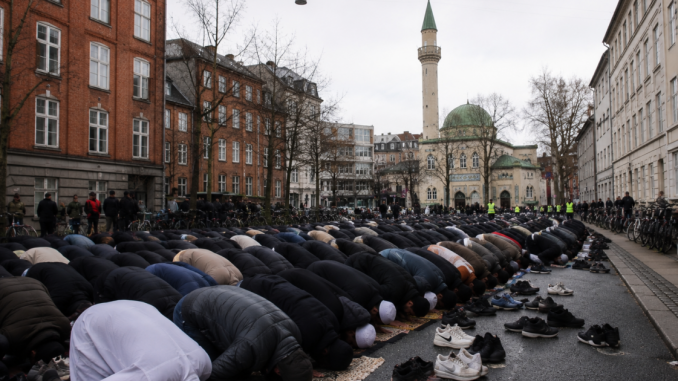
 The Islamic organization Hizb ut-Tahrir holds its Friday prayer at the Parliament Square in commemoration of the victims of the Christchurch massacre on March 22, 2019 in Copenhagen, Denmark
The debate emerges amid broader discussions in Denmark over the role of religion in public institutions. In recent years, Danish leaders have also proposed expanding restrictions on full-face veils and reducing the presence of prayer facilities in educational settings, measures that have drawn both domestic and international scrutiny.
Human rights advocates have expressed concern that restrictions aimed specifically at Islamic practices could contribute to social division and raise questions about equal treatment under the law. Supporters of the government’s approach maintain that the proposals are intended to strengthen social cohesion and protect Denmark’s secular democratic values.
 Morten Bødskov said the government would reopen an investigation into whether the Muslim call to prayer can be outlawed nationwide, arguing that what he described as creeping ‘Islamisation’ was taking up too much public space
Any attempt to prohibit public calls to prayer would likely face legal review, including questions regarding constitutional protections for religious practice and international human rights obligations.
The issue remains politically sensitive in Denmark, where immigration and integration policies continue to be prominent topics in national debate. Government officials have not yet announced a timetable for any final legislative proposal, and discussions are expected to continue as the legal review progresses.
( This video was uploaded about 7 months ago and is being recirculated because Denmark’s government has reopened or continued an investigation into banning the public call to prayer, making the older video relevant again because it contains many of the same arguments now being discussed.)
 Public / Political Reactions:
🇩🇰 Danish Government and Supporters of the Proposal
Supporters of the proposed ban argue that public broadcasts of the Islamic call to prayer do not align with Denmark’s cultural traditions and secular public sphere.
- Immigration Minister Rasmus Stoklund has argued that Denmark should preserve its national identity and avoid developments that could fundamentally alter the character of Danish society.
- Supporters view the proposal as part of broader efforts to strengthen integration and social cohesion.
- Some advocates believe religious worship should remain unrestricted inside places of worship but that amplified calls to prayer in public spaces should be limited.
➡️ Position: Supporters see the measure as a way to protect Denmark’s cultural traditions, secular values, and social cohesion while maintaining freedom of worship.
🕌 Muslim Organizations and Religious Freedom Advocates
Muslim groups and civil liberties advocates have expressed concern that the proposal could disproportionately target one religious community.
Critics argue that the Islamic call to prayer is an important expression of religious identity and practice.
Several advocates warn that restrictions could raise questions about equal treatment of different faiths under Danish law.
Some organizations contend that existing noise regulations are sufficient and that a specific ban is unnecessary.
➡️ Position: Opponents argue that a ban may infringe upon religious freedom and risk marginalizing Denmark’s Muslim communities.
🏛️ Political Parties and Parliamentarians
The proposal has generated debate across Denmark’s political spectrum.
- Politicians favoring stricter immigration and integration policies have generally supported examining a ban.
- More liberal and left-leaning lawmakers have questioned whether such a measure would be compatible with constitutional protections and human rights commitments.
- Some parliamentarians have called for a thorough legal review before any legislation is introduced.
➡️ Position: Political leaders remain divided, balancing concerns about integration and national identity against protections for religious freedom.
🇪🇺 Human Rights and International Observers
European human rights advocates and international observers are closely monitoring the debate.
- Critics warn that restrictions aimed at specific religious practices could face legal challenges under European human rights frameworks.
- Others note that several European countries have ongoing debates about the visibility of religious practices in public spaces.
- Legal experts emphasize that any future legislation would likely undergo extensive judicial scrutiny.
➡️ Position: International observers are focused on whether Denmark can reconcile public policy objectives with its obligations regarding freedom of religion and equal treatment under the law.
 Resulting Effects
The Danish government’s renewed effort to examine a ban on the public Islamic call to prayer has reignited a national debate over religious freedom, integration, and cultural identity, with potential implications for both domestic politics and community relations.
1. National Debate on Religious Expression Intensifies
The proposal has sparked renewed discussion about the role of religion in Denmark’s public spaces.
🏛️ Government officials are reviewing legal options for restricting public broadcasts of the adhan.
🕌 Muslim communities and religious organizations have voiced concerns about the impact on religious freedoms.
📰 The issue has generated significant media attention both within Denmark and internationally.
➡️ Result: Proposed restrictions → intensified public debate over religious expression and national identity.
2. Increased Political Focus on Integration Policies
The discussion has become part of Denmark’s broader conversation about immigration and integration.
🇩🇰 Supporters argue the measure would reinforce Danish cultural norms and social cohesion.
🗳️ Political parties are using the issue to highlight differing approaches to integration and multiculturalism.
📋 Policymakers may face pressure to introduce additional measures related to immigration and cultural integration.
➡️ Result: Call-to-prayer controversy → renewed focus on integration and immigration policy.
3. Potential Legal and Constitutional Challenges
Any future ban could face significant legal scrutiny.
⚖️ Legal experts are examining whether restrictions would comply with constitutional protections and human rights obligations.
🇪🇺 European legal frameworks concerning freedom of religion may become relevant if legislation is enacted.
📑 Courts could be asked to review any future restrictions if challenged by affected groups.
➡️ Result: Proposed legislation → increased likelihood of legal review and constitutional debate.
4. Impact on Muslim Communities
The proposal has raised concerns among Denmark’s Muslim population.
🕌 Community leaders fear the measure could be perceived as targeting a specific religious group.
🤝 Some organizations are calling for dialogue between government officials and faith communities.
📣 The debate may increase public discussion about the place of Islam within Danish society.
➡️ Result: Government proposal → heightened concern and engagement among Muslim communities.
5. International Attention and Diplomatic Discussion
The issue has attracted coverage from international media outlets and observers.
🌍 Human rights organizations are monitoring developments closely.
📰 European and global media have highlighted Denmark’s debate as part of wider discussions about religion and public life in Europe.
🤝 The proposal may influence similar debates occurring in other countries regarding public religious practices.
➡️ Result: Danish policy debate → increased international attention and scrutiny.
 Future Outlook
The coming weeks and months are expected to be significant as Denmark’s government continues its review of whether the public Islamic call to prayer can be restricted or banned. The outcome could have lasting implications for religious freedom, integration policy, and political debate in Denmark.
1. Government Review and Legal Assessment Continue
Current indications suggest that Danish authorities will continue examining the legal feasibility of imposing restrictions on the public call to prayer.
🏛️ Government officials are conducting legal and policy reviews of potential measures.
⚖️ Constitutional and human rights considerations are expected to play a central role in the decision-making process.
📋 Any proposed legislation would likely require extensive parliamentary and legal scrutiny before implementation.
➡️ Outlook: Ongoing government review → continued debate over the legality and practicality of a potential ban.
2. Debate Over Integration and National Identity Likely to Intensify
The issue is expected to remain a prominent topic in Denmark’s broader discussion on immigration and integration.
🇩🇰 Supporters of the proposal are likely to continue emphasizing cultural cohesion and national identity.
🗳️ Political parties may use the debate to highlight contrasting visions for Denmark’s future.
📣 Public discussion surrounding multiculturalism, secularism, and religious expression is expected to remain active.
➡️ Outlook: Continued political attention → deeper national debate on integration and cultural identity.
3. Potential Legal Challenges if Restrictions Are Introduced
Should the government move forward with legislation, legal challenges are considered likely.
⚖️ Religious organizations and civil rights advocates could challenge the measures in court.
🇪🇺 European human rights standards may be cited in any legal proceedings.
📑 Judicial review could delay or alter the implementation of any proposed restrictions.
➡️ Outlook: Future legislation → potential constitutional and human rights challenges.
4. Increased Engagement from Religious and Community Groups
Faith leaders and community organizations are expected to play a larger role in the public discussion.
🕌 Muslim organizations will likely continue advocating for religious freedom protections.
🤝 Community leaders may seek dialogue with government officials to address concerns.
📢 Advocacy groups are expected to increase public awareness campaigns as the debate develops.
➡️ Outlook: Growing public engagement → greater involvement from religious and civil society organizations.
5. International Scrutiny Will Remain High
The controversy is likely to continue attracting attention beyond Denmark.
🌍 Human rights organizations are expected to monitor developments closely.
📰 International media outlets will likely follow any major policy announcements.
🇪🇺 The debate may become part of wider European discussions concerning religion, secularism, and public space.
➡️ Outlook: Continued international interest → increased scrutiny of Denmark’s approach to religious expression and integration policies.
 Bottom Line
Denmark’s renewed consideration of a ban on the public Islamic call to prayer has reignited a national debate over religious freedom, integration, and cultural identity. Supporters argue that restricting amplified calls to prayer would help preserve Denmark’s secular traditions and strengthen social cohesion, while critics contend that such a move could unfairly target Muslim communities and raise concerns about religious liberty. As the government continues its legal review, the proposal is expected to face intense political discussion and possible legal challenges. The outcome will serve as an important test of how Denmark balances cultural integration policies with its commitments to religious freedom and equal treatment under the law.
SOURCES: THE GATEWAY PUNDIT – Denmark Moves to Ban Islamic Call to Prayer, Minister Says Country Should Not Sound Like Pakistan
DAILYMAIL ONLINE – Denmark plans to ban Islamic call to prayer: ‘Shouldn’t sound like a suburb of Islamabad’
JIJI PRESS – Denmark wants to ban the Muslim call to prayer: “Looks like Islamabad”
INTERNATIONAL BUSINESS TIMES – Denmark Moves to Ban the Islamic Call to Prayer Nationwide and Says It Has No Place Over Danish Rooftops




Italy Just Dealt ISLAM a DEVASTATING Blow!
Aussie Judges Issues Secret Order Protecting Muslims Who Threatened to Kill Jews