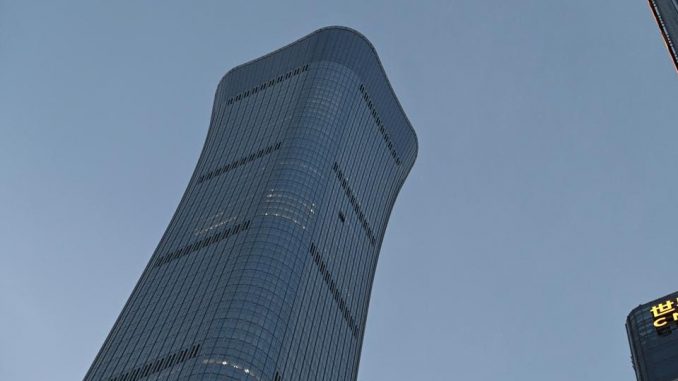
The Citic Tower, also known as the Zun Tower. was hit by a small plane on Friday, June 26, 2026. dpa/picture alliance via Getty Images
Published June 27, 2026
A small aircraft believed to be a pilot-training plane crashed into Beijing’s tallest skyscraper Friday, sending debris raining onto city streets below and triggering a massive emergency response in the heart of China’s tightly controlled capital, according to eyewitnesses and multiple media reports.
The aircraft reportedly struck the upper floors of the 109-story CITIC Tower — also known as China Zun — shortly before 6 p.m. local time in Beijing’s central business district. Dramatic videos circulating online appeared to show debris and shattered glass falling from the skyscraper as pedestrians scrambled to flee the area.
Flight-tracking data reviewed by media outlets indicated the aircraft was likely a Sunward SA60L Aurora, a lightweight two-seat sport aircraft commonly used for pilot training. The plane is believed to have departed from an airport east of Beijing before deviating significantly from its planned flight path shortly before the crash.
“It is normally used for pilot training east of Beijing,” FlightRadar24 spokesman Ian Petchenik told reporters, describing Friday’s flight as “out of character” and adding that investigators could not rule out any possibilities at this stage.
Authorities quickly sealed off surrounding streets as police, firefighters, and emergency medical personnel flooded the scene. Witnesses described hearing a loud explosion-like noise moments before debris began falling from the tower. One eyewitness told Reuters the impact was “louder than fireworks.”
Photos and videos circulating outside China’s heavily censored internet ecosystem appeared to show damage to several glass panels high on the tower, along with wreckage scattered near the base of the building. A heavy police presence remained at the site for hours following the incident.
Chinese authorities had not publicly disclosed the cause of the crash or released detailed information regarding casualties as of Friday evening. State media also remained largely silent on the incident, while reports indicated that social media posts and images related to the crash were rapidly removed from Chinese platforms.
The crash is particularly striking given Beijing’s highly restricted airspace. The Chinese capital enforces some of the world’s strictest aviation controls, and unauthorized civilian flights over central Beijing are exceedingly rare. Commercial flights are required to follow tightly regulated corridors, while private aviation and drone activity are subject to extensive government approval.
The CITIC Tower, which stands approximately 1,731 feet (528 meters) tall and houses the headquarters of the state-owned CITIC Group, is one of China’s most recognizable landmarks and is located only a few miles from key government and Communist Party facilities.
Investigators are expected to examine whether mechanical failure, pilot error, unauthorized flight activity, or other factors contributed to the crash.
The incident is likely to trigger renewed scrutiny of aviation safety and airspace security procedures in the Chinese capital as authorities seek to determine how a small aircraft was able to penetrate one of the world’s most tightly controlled urban airspaces.
🧩 Reading Between the Lines: Aircraft Crash Exposes Potential Vulnerabilities in China’s Security Apparatus
More Than an Aviation Accident
An Extraordinary Incident in a Highly Controlled Capital
The reported crash of a small training aircraft into Beijing’s tallest skyscraper is unlikely to be viewed merely as an aviation accident. Given Beijing’s extensive security infrastructure and tightly regulated airspace, the incident is expected to trigger intense scrutiny from Chinese authorities and could prompt a comprehensive review of existing aviation and security protocols.
Questions Surround China’s Airspace Security
How Did the Aircraft Reach Central Beijing?
Beijing maintains some of the world’s strictest aviation restrictions, particularly around politically sensitive areas and critical infrastructure. Reports that the aircraft deviated from its planned route before reaching the capital’s central business district are likely to raise difficult questions about airspace monitoring, interception capabilities, and the effectiveness of existing safeguards.
Transparency and Information Control Under the Spotlight
Public Access to Information May Remain Limited
The limited public information released by authorities and reports of online content being removed highlight the Chinese government’s longstanding emphasis on information management during sensitive events. How officials communicate findings from the investigation could influence both domestic public confidence and international perceptions.
Urban Critical Infrastructure Faces Emerging Risks
Modern Megacities Are Increasingly Vulnerable
The incident underscores how even small aircraft can pose significant risks when operating near densely populated urban centers. Damage to a landmark skyscraper in the heart of Beijing illustrates the challenges facing major cities worldwide in protecting critical infrastructure against both accidental and intentional threats.
A Test of Emergency Response and Crisis Management
Coordinated Response Capabilities Put to the Test
Major incidents in dense urban environments require rapid coordination among emergency responders, law enforcement agencies, medical personnel, and government authorities. The response to the crash is likely to be closely evaluated as a real-world test of Beijing’s crisis management systems.
Broader Security Implications Could Follow
Potential Changes to Aviation Oversight and Regulations
Depending on the findings of the investigation, Chinese authorities may consider tightening regulations governing flight training operations, private aviation activities, and low-altitude airspace management. Additional surveillance and security measures could also be implemented around key government and commercial districts.
The Bigger Picture
Balancing Urban Expansion, Aviation Growth, and National Security
Ultimately, the incident highlights the growing complexity of managing safety and security in rapidly evolving megacities. As urban centers become more densely populated and aviation activity expands, governments may face increasing pressure to strengthen safeguards while maintaining efficient transportation systems.
🔗 The Stakes: Why This Story Matters
The reported crash of a small aircraft into Beijing’s tallest skyscraper is significant not only because of the immediate danger posed to those on the ground, but also because it occurred in one of the world’s most tightly controlled airspaces. The incident raises broader questions about aviation safety, urban security, emergency preparedness, and public confidence in China’s extensive surveillance and airspace management systems.
Public Safety Comes First
Protecting Lives in a Dense Urban Environment
The immediate concern is the safety of office workers, nearby residents, first responders, and pedestrians in the area. Falling debris, potential fires, and structural damage in a densely populated business district can pose serious risks and may require evacuations and prolonged safety inspections.
Airspace Security Faces New Scrutiny
A Rare Breach in a Highly Regulated Capital
Beijing enforces strict controls over civilian aviation, particularly near sensitive government and commercial areas. Reports that a small aircraft was able to enter central Beijing and strike a prominent skyscraper are likely to prompt questions about surveillance systems, flight monitoring procedures, and whether additional safeguards are necessary.
Economic and Business Disruptions Could Follow
A Major Commercial Hub Temporarily Impacted
The CITIC Tower is a key financial and corporate center in Beijing. Building evacuations, road closures, and possible structural assessments could disrupt business operations, affect thousands of employees, and temporarily impact activity in one of China’s most important commercial districts.
Pressure on Emergency Response Systems
A Real-World Test of Crisis Management Capabilities
Responding to an aircraft crash in the heart of a megacity requires rapid coordination among firefighters, police, medical teams, and government agencies. The effectiveness of the response may influence public confidence in the city’s ability to manage large-scale emergencies.
Information Transparency Will Be Closely Watched
Public Confidence Depends on Timely Communication
High-profile incidents often generate intense public interest. The speed, accuracy, and transparency of official updates regarding casualties, the cause of the crash, and the status of the investigation could shape both domestic and international perceptions of how authorities handle crises.
Potential Policy Changes May Emerge
Aviation Rules and Security Measures Could Tighten
Depending on the outcome of the investigation, Chinese authorities could introduce stricter oversight of pilot training operations, private aviation activities, and low-altitude airspace management. Additional security measures around critical infrastructure may also be considered.
The Bigger Picture
Urban Resilience and Infrastructure Security in Focus
Ultimately, the incident underscores the challenges facing modern megacities as they seek to balance economic growth, aviation activity, and national security. The lessons learned from the crash could influence future policies on aviation safety, infrastructure protection, and emergency preparedness.
🏁 The Final Word:
The reported crash of a small aircraft into Beijing’s tallest skyscraper serves as a stark reminder that even the most tightly controlled and heavily monitored cities are not immune to unexpected emergencies. Beyond the immediate questions surrounding the cause of the incident, the crash has highlighted broader issues involving aviation safety, urban resilience, critical infrastructure protection, and crisis management. As investigators work to determine what went wrong, the findings could shape future aviation regulations and security protocols in China, while offering important lessons for major cities around the world grappling with increasingly complex safety and security challenges.
SOURCES: THE WALL STREET JOURNAL – Aircraft Crashes Into Beijing’s Tallest Building
FORBES – Plane That Crashed Into Beijing’s Tallest Building Usually Used For Pilot Training, Report Says