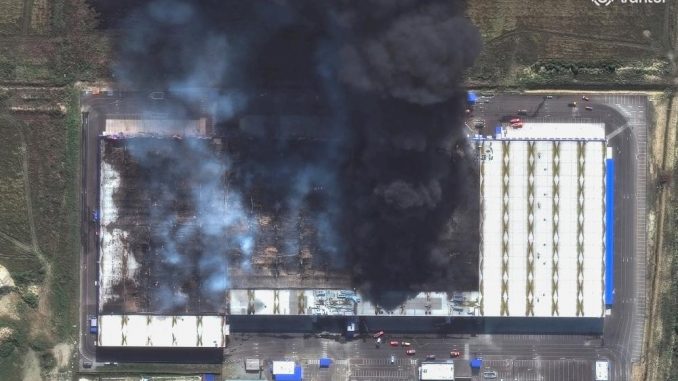
Major fire damage to an Ozon warehouse in Enem, Adygeya, Russia. Photograph: Vantor/Reuters
by Diana Zapata • News Writer /Editorial Specialist
Published August 25, 2026
MOSCOW/KYIV — Ukraine is expanding its long-range drone campaign deep inside Russian territory, with a growing focus on major logistics and e-commerce facilities that Kyiv says are connected to Russia’s wartime economy.
The latest targets include Ozon, Russia’s second-largest online marketplace. At least six Ozon logistics facilities were reportedly targeted over a three-day period across several Russian regions, with fires, injuries and significant disruption reported.
The escalation marks a significant development in Ukraine’s strategy. Rather than limiting attacks to traditional military targets, Kyiv is increasingly striking economic infrastructure that it says contributes to Russia’s ability to sustain the war.
Ozon becomes Ukraine’s latest target
Ozon has emerged as the newest major target following a sustained Ukrainian campaign against Wildberries, Russia’s largest online retailer.
Reuters reported that four Ozon logistics hubs were initially targeted, while subsequent reporting indicated attacks against additional facilities. The strikes affected sites in several regions, including Dagestan, Krasnodar, Adygeya, Stavropol, Samara and Orenburg.
The attacks have had immediate financial consequences.
Ozon shares reportedly plunged by nearly 30% on the Moscow Exchange following news of the warehouse attacks, wiping billions of dollars from the company’s market value.
For Moscow, the attacks represent a challenge that extends beyond battlefield losses.
They demonstrate that Ukraine’s drone capabilities can reach deep into Russian territory and threaten facilities that ordinary Russians depend upon for everyday commerce.
Kyiv says the economic war is intentional
Ukraine has increasingly focused its long-range strikes on Russia’s economic infrastructure, including oil refineries, fuel facilities, logistics hubs and industrial sites.
Ukrainian officials have portrayed the attacks as part of a deliberate campaign to disrupt supply chains and weaken Russia’s ability to finance and sustain its military operations.
The Institute for the Study of War has assessed that Ukrainian forces are conducting a broader campaign against Russian military and economic assets, including efforts to suppress Russian air defenses in border regions.
The strategy effectively attempts to bring the consequences of the war closer to Russia’s population and economic centers.
From Wildberries to Ozon
The campaign against Ozon follows weeks of attacks on Wildberries warehouses.
Ukrainian officials have indicated that the transition from Wildberries to Ozon is deliberate. Both companies operate enormous logistics networks throughout Russia, making their warehouses important nodes in the country’s commercial infrastructure.
The attacks have caused fires and operational disruptions at multiple facilities.
Analysts say the strategy could create economic pressure if Ukraine succeeds in repeatedly disrupting large logistics networks rather than simply hitting isolated military installations.
Putin responds with extraordinary decree
The Kremlin has already taken steps to respond to the growing threat.
Russian President Vladimir Putin signed a decree allowing the government to temporarily take control of critical infrastructure when private owners fail to adequately protect facilities from drone attacks or fail to rebuild them after damage.
The measure covers strategically important sectors including:
- Energy
- Fuel
- Communications
- Transportation
- Industrial facilities
- Logistics
Russian officials have emphasized that the measure is not intended as broad nationalization. Instead, Moscow says the government would intervene on a case-by-case basis when facilities are considered vital to national security.
But the move underscores the seriousness of the problem confronting Russian businesses.
The war is reaching deeper into Russia
The Ozon attacks are only one part of a much larger Ukrainian drone offensive.
Ukraine has also targeted Russian oil refineries and industrial facilities. Recent strikes reportedly affected the Afipsky refinery and other energy infrastructure, adding further pressure to Russia’s already strained fuel and logistics networks.
Ukraine has also claimed strikes against a Russian MiG-29, vessels in the Black Sea and a rocket-fuel facility in the Rostov region.
The cumulative effect is changing the geography of the war.
For years, most Russians experienced the invasion primarily through television broadcasts, mobilization and economic sanctions. Ukraine’s expanding drone campaign is increasingly bringing explosions and disruption directly to Russian territory.
Russia continues attacking Ukraine
The escalation is occurring while Russia continues its own missile and drone attacks against Ukrainian cities and infrastructure.
Both sides are therefore increasingly relying on long-range weapons to strike targets far from the immediate front lines, creating a dangerous cycle of retaliation.
The result is a conflict in which economic infrastructure has increasingly become part of the battlefield.
What this means for the war
1. Ukraine is widening its target list
The attacks demonstrate Kyiv’s willingness to target economic and logistical facilities that it believes support Russia’s war effort.
2. Russia faces growing pressure to defend its rear areas
Moscow must now protect not only military installations but also oil facilities, warehouses, railways and commercial logistics networks spread across a vast territory.
3. Businesses are being pulled deeper into the conflict
Companies such as Ozon and Wildberries are commercial enterprises, but their enormous logistics networks have become strategically important in wartime Russia.
4. The economic consequences could grow
Ozon’s dramatic stock-market decline shows how quickly military attacks can translate into financial losses. Continued strikes could increase insurance costs, disrupt deliveries and force companies to spend heavily on security.
💬 Overall Takeaway:
The attacks on Ozon warehouses represent something larger than another series of drone strikes. They demonstrate how dramatically the Russia-Ukraine war has evolved into a contest over economic endurance, logistics and the ability to operate safely far behind the front lines.
Ukraine is betting that Russia cannot indefinitely protect thousands of critical facilities spread across one of the world’s largest countries. By targeting oil refineries, logistics centers and major commercial warehouses, Kyiv is attempting to make the war increasingly expensive for Moscow—not only on the battlefield, but inside Russia’s economy.
The Kremlin’s response shows that Russian officials recognize the seriousness of the threat. Putin’s decision to allow temporary state control over vulnerable critical infrastructure signals that Moscow is preparing for a prolonged campaign in which private companies will increasingly be expected to defend assets considered essential to national security.
For ordinary Russians, however, the consequences could become increasingly visible. Disrupted deliveries, damaged warehouses, fuel shortages and rising costs are the kinds of effects that can transform a distant war into an everyday reality.
And for Ukraine, the calculation is equally stark: if Russia can continue striking Ukrainian cities and infrastructure, Kyiv wants the ability to demonstrate that Russian territory and its economic machinery are no longer beyond reach.
The Ozon campaign may therefore be remembered not simply as an attack on an online retailer, but as another sign that the war is becoming a broader battle over the economic heart of Russia.