
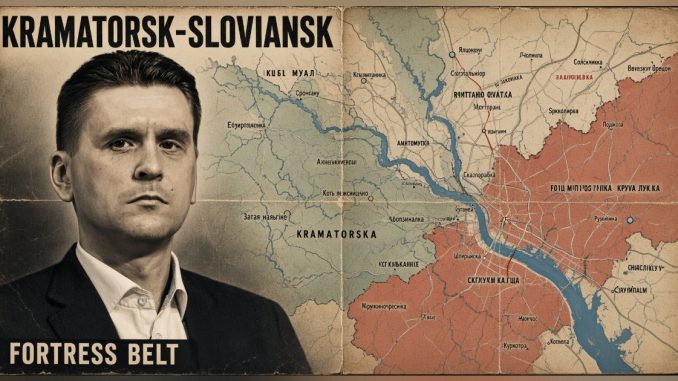
Oleksandr Kovalenko – AI-Generated Image by Grok
Reported by:

Cherry Meigh Timbol
News Content Editor
Published August 26, 2026
KRAMATORSK, Donetsk Oblast — One of Ukraine’s most respected military analysts is warning that Russian troops have advanced to within roughly 12–13 kilometers (7–8 miles) of the twin fortress cities of Slovyansk and Kramatorsk, raising fears that Moscow’s long-anticipated offensive against the Donbas “Fortress Belt” could begin before the end of 2026.
The assessment comes from Oleksandr Kovalenko, a Ukrainian military observer widely cited by domestic media for his battlefield analysis. According to Kovalenko, Russian forces have accelerated their advance across eastern Donetsk during August, capturing territory near Mykolaivka, Piskunivka, Nykyforivka, and Kryva Luka while steadily narrowing the distance to Ukraine’s most important defensive stronghold in the region.
Why Kramatorsk and Slovyansk Matter


The Slovyansk–Kramatorsk agglomeration has served as the backbone of Ukraine’s eastern defenses since fighting first erupted in Donbas in 2014. Military planners often refer to the interconnected cities as the Fortress Belt because they anchor a network of fortified positions, logistics hubs, rail connections, and command infrastructure stretching across northern Donetsk Oblast.
Losing either city would represent a major strategic setback for Kyiv, potentially opening the way for deeper Russian advances into the remaining Ukrainian-held portions of Donetsk.
According to Ukrainian reporting, the eastern flank of the fortress belt has become increasingly unstable despite repeated efforts to reinforce defensive positions.
Kovalenko’s Warning


Kovalenko argues that the pace of Russian advances has become the central concern—not merely the distance to the cities themselves.
Kovalenko argues that the pace of Russian advances has become the central concern—not merely the distance to the cities themselves.
He estimates that Russian forces seized approximately 21 square kilometers in the Slovyansk sector during the third week of August and believes the next phase will likely focus on infiltrating Mykolaivka, a settlement east of Slovyansk that could provide a staging ground for urban operations.
His forecast is stark: if the current operational tempo continues, Russian infiltration into Slovyansk or Kramatorsk could begin as early as December 2026. He also warned that reinforcing city garrisons after enemy penetration would likely delay, rather than prevent, a broader assault.
Battlefield Pressure Is Growing


Independent battlefield assessments broadly support the view that Russia is shaping the battlefield around the fortress belt, though they are more cautious about predicting an imminent breakthrough.
Analysts at the Institute for the Study of War (ISW) say Russian forces have intensified a battlefield air interdiction campaign, relying heavily on glide bombs, FPV drones, and strikes against bridges, rail infrastructure, and supply routes leading into Slovyansk and Kramatorsk. The objective appears to be degrading Ukrainian logistics before launching larger ground offensives.
Recent strikes have targeted transportation corridors, industrial facilities, and residential districts across both cities, complicating nighttime resupply missions for Ukrainian defenders.
Competing Assessments
While Russian military sources have claimed their forces are reaching the outskirts of Slovyansk and threatening to encircle Ukrainian troops, independent observers have not confirmed many of the more expansive territorial claims.
ISW notes that Russian forces continue offensive operations in the Slovyansk direction and are increasing pressure through infiltration tactics, but it also reports that Ukrainian forces have successfully cleared some Russian infiltrator positions near Kostiantynivka and continue resisting advances along several sectors of the front.
The difference highlights the ongoing fog of war: Russian advances are well documented in parts of eastern Donetsk, yet the exact extent of territorial control remains contested between Ukrainian, Russian, and independent sources.
What Happens Next?
Military observers expect Russia to continue three parallel efforts over the coming months:
-
Expand infiltration operations into villages east of Slovyansk.
-
Intensify glide bomb and drone strikes against logistics corridors and bridges.
-
Pressure Ukrainian supply lines before attempting larger assaults on the urban fortress belt.
Whether those operations culminate in a successful assault by December remains uncertain. Even analysts who acknowledge Russia’s growing momentum caution that capturing heavily fortified cities such as Slovyansk and Kramatorsk would likely require prolonged urban combat rather than a rapid breakthrough.
🧩 Bottom Line:
The battle for the Slovyansk–Kramatorsk Fortress Belt is emerging as one of the most consequential phases of the war in eastern Ukraine. Ukrainian analyst Oleksandr Kovalenko’s warning reflects mounting concern inside Ukraine that Russian forces are approaching the region’s most critical defensive hub, while independent assessments indicate Moscow is systematically weakening logistics and infrastructure ahead of future operations. Although the timeline for a direct assault remains debated, the coming months could determine the fate of Ukraine’s last major fortified cities in Donetsk.




