
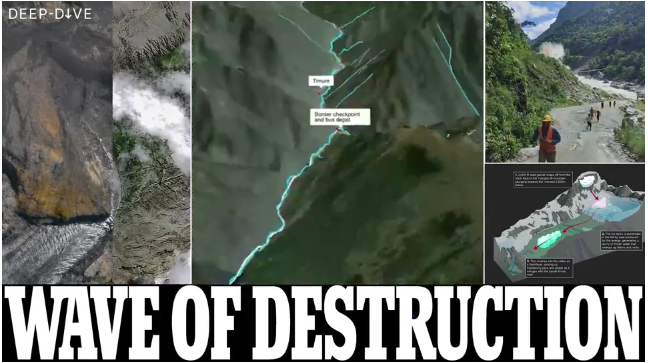
Thousands are feared dead after a churning wall of mud, rock and pulverised ice bulldozed down a Himalayan valley straddling the border of Nepal and China, crumpling concrete and washing away entire villages in scenes reminiscent of a Hollywood disaster movie. The towering wave of the unstoppable flash flood stood up to 650ft high, scientists probing the tragedy say.
Reported by:

Cherry Meigh Timbol
News Content Editor
Published August 28, 2026
Tsunami from the sky
They are calling it a Tsunami from the Sky, but the flash flood that swept through Nepal, destroying almost everything in its path, almost certainly began life on the northern slopes of Tsangbu Ri, a Himalayan peak roughly 50 miles north of Kathmandu. This is how it happened…
8.37AM NPT
(3.52AM BST)
An enormous chunk of a glacier suddenly snapped off the north-side of the Tsangbu Ri mountain, according to preliminary investigations. Falling from roughly 5,200m above sea level, the block of ice – thought to measure around 2,000ft-wide – then plunged into the valley below.
As it plummeted to the bed, around 2,000m below, the wall of ice was pulverised into a terrifyingly fast-flowing mix of freezing water that swept up debris and rocks from the side of the mountain into the Lende Khola river below.
10.59AM CST
(3.59AM)
Nightmarish footage emerges of the tower of darkened water crashing over a border checkpoint in Rasuwagadhi, where the Lende Khola feeds into the Trishuli river. Before disaster strikes, CCTV captures dozens of people attempting to run for their lives. Seconds later, everything appears to be wiped out.
A bus depot on the Chinese side of the border buckles under the immense pressure as the surge soars upstream.
The ‘tsunami from the sky’ – as it was called by Bishal Nath Upreti, a geologist and academic at Tribhuvan University in Kathmandu, who said the wave unleashed stood up to 650ft-high and ‘completely wiped out’ communities – then flowed down the meandering Trishuli river. The sheer volume of water beggared belief.
A helicopter passing by films the devastation from above at Syapru Besi, eight-and-a-half miles south of the border. Water appears to plough into Langtang Khola tributary as it continues to fill the valley.
Aware of the threat to their life from the wall of water approaching, a group of workers stationed near a bridge sprint to high ground in hope of escaping.
Now carrying hundreds of tons of washed-away debris, the flood completely devours a bridge in the town of Trishuli Colony. Video caught by a resident perched on the hill, watching the apocalyptic scenes unfold, shows the bridge flying down the river, fully in-tact. This is thought to have occurred between 9.30-10am local time (4.45am BST).
11.43AM NPT
(6.58AM BST)
Gathering at a seemingly safe distance, dozens of terrified locals watch on as another bridge is destroyed by the water’s wrath.
Flooding stopped 12 miles shy of the Indian border, according to data collated by Google, slowing down following the Trishuli river until it was eaten by larger
HOW DID IT HAPPEN?
Alerted to a seismic event in the region, the US Geological Survey (USGC) initially reported that an earthquake had occurred near the border. This, it was speculated, triggered a landslide that blocked the Lende Khola with tons of debris – only for the water to violently breach the dam. The USGC later clarified, however, that the seismic event – which registered as magnitude 5.2 – was an extremely powerful ‘glacial collapse and debris flow that caused subsequent catastrophic impacts downstream’.

Devastation strikes a town along the flood-stricken valley, with residents left assessing the damage
Geologist Dr Daniel Shugar, of Canada’s University of Calgary, highlighted satellite imagery that showed a ‘perfect straight line where it snapped off’ from a glacier at around 5,200m. Although unproven, he told the New Scientist that he guessed melting snow and ice ‘injected a lot of liquid water into the glacier, which percolated down to the bed and lubricated it. That was enough for it to collapse.’
The riverbed below stood at around 3,000m, meaning the chunk of ice dropped around 2km down the north face of Tsangbu Ri. From there, it generated steam as the river dropped another 300m before it reached the border crossing – the scene of one of the horrifying videos.
As the mass accelerates downhill, rock fragments and ice collide and rub against each other, creating vast amounts of friction which converts into heat. This will partially melt the ice, producing water inside the moving mass and rendering the avalanche considerably more fluid and dangerous. As water from streams gets incorporated into the mass, its volume increases, acting as a lubricant that picks up loose sediment, rocks, trees, and heavy material from the valley floor. By this point, the mass is ‘like liquid concrete’ according to Hatim Sharif, a hydrologist at the University of Texas, San Antonio. It’s incredibly dense, and fast moving, so extremely tricky to flee. ‘Running will not help,’ nor will trying to flee by vehicle, unless it’s up a steep hill, he said.
Scientists caution that it’s too early to be certain of the exact cause. But one crucial factor is likely to be the weather. At present, Nepal is experiencing a relatively warm summer, which has caused significant snow and ice melt in the Himalayas.
‘Some of the glaciers in the valley were covered in snow yesterday and today they are mostly bare ice. So in other words (and I haven’t seen any weather station data yet), it was probably warm,’ Dr Shugar said. He believes, however, the glacier collapse ‘was only part of what failed’. The wider scientific community warned other factors could be at play, including long-term tectonic plate movement that made the glacier get steeper and steeper. Others have said it has the hallmarks of a ‘glacial lake outburst flood’ or GLOF – when a mountainside dam fails.
Aerials of the damage


Source: EOS


Source: EOS


Source: EO
COUNTRIES WHERE THE MISSING CAME FROM
Nepal’s National Tourism Board said more than 500 foreigners were missing. Among them were 33 Britons. The actual toll, once the dust settles on the tragedy in the coming weeks, could be vastly different.
🧩 Conclusion: A Disaster That Will Echo Across the Himalayas
The catastrophic glacier collapse on the Nepal–Tibet border was not merely a tragic natural disaster—it was a stark reminder of how vulnerable the world’s highest mountains have become. In a matter of minutes, an avalanche of ice, rock, and debris unleashed a devastating flood that erased villages, destroyed vital infrastructure, and left hundreds dead while more than a thousand people remain missing.
Scientists caution that while the exact trigger is still under investigation, rising temperatures are increasingly destabilizing Himalayan glaciers and thawing the frozen ground that holds mountain slopes together, making catastrophic collapses more likely.
As rescue teams continue searching through mud and shattered valleys, the tragedy stands as both a humanitarian catastrophe and a warning: without stronger monitoring, early-warning systems, and climate resilience in high-altitude regions, similar disasters could threaten millions of people living downstream throughout the Himalayas.




Nepal Floods 2026 Explained: What Caused the Deadly Flash Flood?