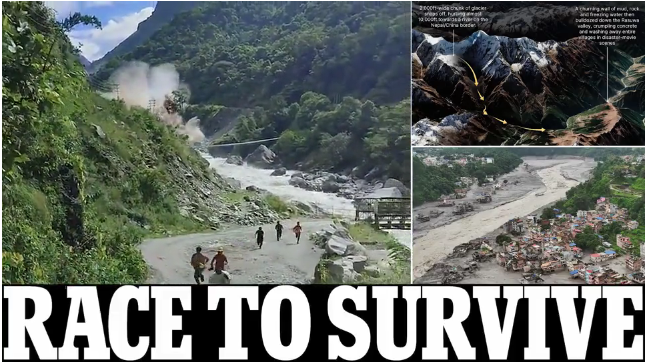
Nepal’s disaster agency said 823 people, including 579 tourists from Nepal and abroad, remained out of contact. In Tibet, meanwhile, Chinese state media described the event as a ‘mudslide disaster’ which killed three people, while 558 people, including 260 foreigners, were missing.
Reported by:

Cherry Meigh Timbol
News Content Editor
Published August 27, 2026
A catastrophic glacier collapse in the Himalayas unleashed what experts are calling a “Himalayan tsunami”—a massive wall of ice, rock, mud, and water that devastated communities along the Nepal–Tibet border, killing hundreds of people and leaving more than 1,300 missing.
The disaster struck with terrifying speed after an enormous section of a mountain glacier broke free and plunged nearly 1,200 meters into the valley below. The collapse released an estimated 20 million cubic meters of water, generating tsunami-like waves that witnesses described as towering through narrow Himalayan gorges.
Entire villages vanished in minutes
The hardest-hit region was Nepal’s Rasuwa District, where raging floodwaters swept away homes, schools, hotels, bridges, and roads before roaring downstream into China’s Tibet Autonomous Region.


Officials say the confirmed death toll continues to rise as rescue teams recover bodies from riverbanks more than 150 miles downstream. Many victims were buried beneath enormous boulders and thick layers of sediment deposited by the flood.
Among the missing are hundreds of foreign tourists and Hindu and Buddhist pilgrims traveling toward Mount Kailash, one of Asia’s most sacred destinations. Citizens from dozens of countries—including the United States, Britain, India, Canada, and Australia—remain unaccounted for.
The moment the mountain collapsed
Scientists believe the catastrophe began when the lower portion of a glacier suddenly detached, creating a violent ice-and-rock avalanche.
Satellite imagery shows the glacier’s snout collapsing before crashing into the Lhende Khola River, temporarily damming the water with debris. When that natural barrier failed, an explosive surge raced into the Bhote Koshi and Trishuli river systems.
Within just 30 minutes, river levels surged by nearly 9 meters, overwhelming everything in their path. The event was so powerful that seismic instruments initially mistakened it for an earthquake before researchers confirmed it was caused by the glacier itself.
Rescue turns into a race against time


Helicopters have become the only lifeline for many isolated communities after highways and mountain bridges were obliterated.
Nepal’s military has airlifted survivors from stranded villages while rescue crews search through unstable mudfields and collapsed infrastructure. Chinese authorities have also deployed military teams into Tibet as fears grow that a newly formed upstream barrier lake could burst again.
Aid agencies warn that thousands of displaced residents urgently need food, shelter, clean water, and medical care as continuing rain threatens additional landslides.
Why experts call it a “tsunami from the sky”
Unlike an ocean tsunami, this disaster originated high in the mountains.
The collapsing glacier released an immense volume of water mixed with ice, rock, and sediment, producing a fast-moving surge powerful enough to strip valleys bare. Scientists say warming temperatures and accelerated glacial melting are making these rare but devastating events increasingly likely across the Himalayas.
The Hindu Kush–Himalaya region has already lost a significant share of its glacier ice over recent decades, raising alarms that unstable glaciers and expanding glacial lakes could trigger more catastrophic floods in the future.
Global shock as the death toll climbs
Governments across Asia and beyond have begun coordinating emergency assistance while families desperately await news of missing loved ones.
With rescue operations continuing across both Nepal and Tibet, officials caution that the number of fatalities is expected to increase as inaccessible valleys are reached in the coming days.
🧩 Bottom Line:
The Nepal–Tibet glacier collapse is more than a natural disaster—it is a chilling warning from the world’s highest mountains. In less than an hour, an entire landscape was transformed by a torrent so violent that survivors compared it to a tsunami falling from the sky. As climate scientists investigate the glacier’s sudden failure, one reality is already undeniable: the Himalayas are becoming increasingly unstable, and millions living downstream face growing risks from a warming world.
SOURCES: DAILYMAIL ONLINE – Nepal flood LIVE: Incredible footage shows workers flee wall of water as China warns second ‘dam’ has formed with ‘high risk of breaching’, sparking SECOND tsunami fears
THE GATEWAY PUNDIT – HORROR: Apocalyptic Videos Show Massive Flash Floods in Nepal – Wall of Water and Debris Destroys Everything on Its Path – Hundreds Missing, Untold Number Feared Dead