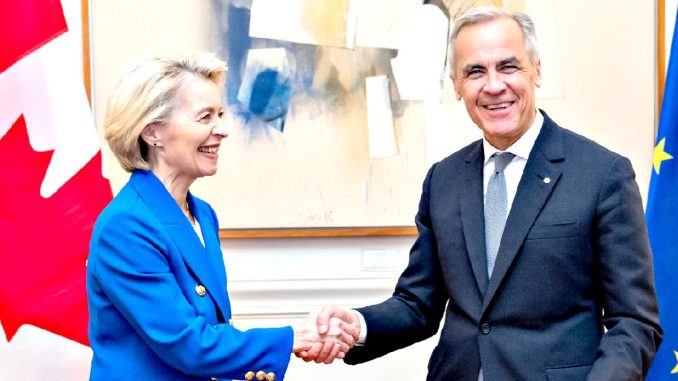
Von der Leyen and Carney – Wiki Commons-
Reported by:

Cherry Meigh Timbol
News Content Editor
Published September 17, 2026
STRASBOURG — European Commission President Ursula von der Leyen used her annual State of the European Union address to propose a new relationship between the European Union and Canada, calling for Canada to become the bloc’s first-ever “associate member.”
The proposal was one of the most notable announcements in a wide-ranging speech that covered European security, trade, artificial intelligence, energy, migration, Ukraine and relations with major global powers.
Canadian Prime Minister Mark Carney attended the address as a special guest. Von der Leyen told him that Europe wanted to take its relationship with Canada “to the highest level possible” and proposed opening the door to associate membership.
A New Status for Canada
Associate membership does not currently exist as a formal EU status under the bloc’s treaties. Unlike full EU membership, which involves a lengthy accession process and extensive legal and economic obligations, the proposed arrangement would create a new framework for closer cooperation between Canada and the 27-member bloc.
Von der Leyen proposed cooperation in areas including defense, energy, critical minerals, artificial intelligence, quantum technology, cybersecurity and Arctic policy.
The European Commission has not yet provided a complete legal framework for what associate membership would mean in practice. Any move toward such an arrangement would also require support from EU member states.
Carney Welcomes Closer EU Ties
Carney subsequently addressed the European Parliament and welcomed von der Leyen’s proposal.
He emphasized closer cooperation between Canada and Europe in defense, critical minerals, energy, technology and other strategic sectors. Carney also said Canada was not seeking to create a rival bloc against the United States or China.
The Canadian government has been pursuing stronger economic and security relationships outside its traditional dependence on the United States, including expanded cooperation with European countries.
Canada is already participating in the EU’s SAFE defense procurement initiative, providing Canadian defense companies access to the bloc’s joint procurement framework.
Trump Challenges the Proposal
The proposal quickly drew a response from U.S. President Donald Trump.
According to Reuters, Trump described the idea as “laughable” and warned that the United States could impose significant tariffs or restrict trade with Europe if he determined that the proposal represented a hostile act.
The European Commission rejected the characterization that its proposed closer relationship with Canada was directed against another country.
Commission spokesman Olof Gill said the proposal was intended to strengthen the EU-Canada partnership rather than act against the United States or another power.
Von der Leyen Calls for Greater European Security Cooperation
Von der Leyen’s speech extended beyond Canada.
She proposed creating a European Security Council involving partners including Canada, Norway, Ukraine and the United Kingdom. She also called for greater European defense capabilities and cooperation with Ukraine on missile defense.
Her proposals come as European governments reassess defense policy amid Russia’s war against Ukraine and concerns about security threats to European territory.
Von der Leyen also called for greater European economic resilience, including cooperation on critical raw materials, batteries, energy and advanced technologies.
AI, Social Media and Europe’s Economic Future
Artificial intelligence was another major component of the address.
Von der Leyen said Europe should consider slowing the development of increasingly advanced AI systems while establishing stronger safeguards and international cooperation. She also proposed restrictions on social media access for children, including a proposed ban on social media accounts for children under 15.
She also called for Europe to strengthen its position in intelligent manufacturing, quantum computing, cybersecurity and other emerging technologies.
A Broader Shift in Europe’s Alliances
The Canada proposal comes as Europe seeks to diversify and strengthen its international partnerships.
The EU and Canada already have a free-trade agreement, while both sides have been expanding cooperation in defense, energy, technology and critical minerals.
Von der Leyen framed the proposed relationship as an effort to build greater resilience and cooperation among democracies. However, the practical meaning of associate membership remains unresolved, and EU governments would have to determine whether and how such a new status could be created.
The proposal also comes amid changing relations between Washington, Ottawa and Brussels, adding another layer to an already complicated transatlantic relationship.
🧩 Bottom Line:
Von der Leyen’s State of the European Union address introduced a potentially new model for EU-Canada relations, with Canada being invited to become the bloc’s first “associate member.” The proposal remains at an early stage and would require further negotiations and approval by EU member states. Carney has welcomed closer cooperation, while Trump has publicly warned of possible economic consequences if the EU moves forward.
SOURCES: THE GATEWAY PUNDIT – COMMISSIONER CHAOS: During Her State of the European Union Address, Ursula von der Leyen Offered Canada ‘Associate Member’ Status – But Furious EU Leaders Were Blindsided by Announcement
POLITICO.EU – EU blindsided by von der Leyen’s Canada ‘associate member’ pitch
AL JAZEERA – EU chief von der Leyen proposes ‘associate member’ status for Canada