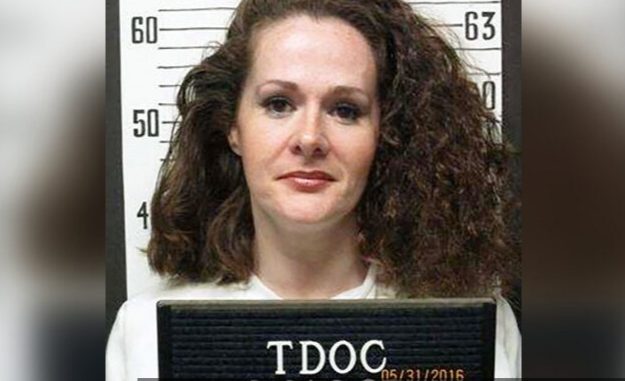
Tennessee death row inmate Christa Pike is in the hospital after efforts to execute her by two lethal injections failed on Wednesday night.
Reported by:

Cherry Meigh Timbol
News Content Editor
Published October 1, 2026
NASHVILLE, Tennessee — Tennessee has halted its remaining executions for 2026 and ordered an independent review after death-row inmate Christa Pike survived an attempted lethal-injection execution at Riverbend Maximum Security Institution in Nashville.
Pike, 50, was scheduled to become the first woman executed by Tennessee in more than 200 years. Instead, officials administered two doses of pentobarbital before the procedure was ultimately stopped and Pike was transported by ambulance to an outside medical facility. Her condition was not immediately disclosed.
The incident has raised questions about Tennessee’s execution procedures and comes only months after another execution attempt in the state was abandoned because officials could not establish intravenous access.
What Happened Inside the Execution Chamber
According to Pike’s attorneys and journalists who witnessed the procedure, Pike remained alive after receiving two doses of pentobarbital.
Witnesses reported hearing snoring, loud breathing, gasps and complaints of discomfort, while her attorneys subsequently filed an emergency motion saying she was still breathing and had a heartbeat after the second dose.
The execution began only after a series of last-minute legal developments.
A federal appeals court had temporarily blocked the execution earlier Wednesday while considering arguments concerning Pike’s history of childhood abuse and whether those circumstances had been adequately considered during her sentencing. The U.S. Supreme Court later lifted the stay, allowing Tennessee to proceed.
The execution chamber’s curtain was reportedly closed and reopened more than once during the process. Witnesses continued hearing sounds from inside the chamber before they were instructed to leave. Emergency vehicles were subsequently seen arriving at the prison.
Tennessee Defends Its Procedure
The Tennessee Department of Correction said officials followed the state’s established execution protocol.
In a statement issued late Wednesday, the department said the lethal-injection chemical used under the protocol had consistently been effective and that the procedure did not permit additional measures beyond those carried out. The department confirmed that Pike had been transported to an off-site medical facility.
Tennessee’s protocol provides for a second set of syringes if an inmate is not deceased after the first set. However, reporting on the protocol indicates that it does not specifically establish what officials should do if an inmate remains alive after the second administration.
That issue is expected to receive scrutiny during the state’s review.
Governor Suspends Remaining Executions
Tennessee Gov. Bill Lee announced that he was suspending the state’s remaining scheduled execution for the rest of 2026.
Lee also ordered what he described as a comprehensive, third-party review to determine what happened during Pike’s execution attempt.
The governor’s decision affects another execution that had been scheduled for December.
Lee said the state has a responsibility to carry out lawful sentences in a manner that is legal and constitutional, while also emphasizing that the process must be effective.
Who Is Christa Pike?
Pike was sentenced to death for the 1995 murder of 19-year-old Colleen Slemmer, a fellow student at the Knoxville Job Corps program.
Pike was 18 when Slemmer was killed. Pike and her boyfriend, Tadaryl Shipp, were convicted in connection with the killing. Shipp, who was 17 at the time, received a life sentence with the possibility of parole, while Pike received the death penalty.
Pike has not denied her involvement in the killing.
Her attorneys have nevertheless argued that her age, history of childhood abuse and documented mental-health issues should have been considered when determining whether she should be executed. Those arguments formed part of the legal challenges immediately preceding Wednesday’s attempted execution.
Questions Over the Execution Protocol
The failed execution is particularly significant because it follows another aborted Tennessee execution earlier this year.
In May, officials called off the lethal injection of Tony Joe Davis Carruthers after they were unable to establish a suitable intravenous line, according to reporting on Tennessee’s execution program.
Pike’s case is different because officials did administer the execution drug twice, yet witnesses and her lawyers reported that she remained alive.
Death Penalty Information Center executive director Robin Maher described the circumstances as unprecedented, according to the Associated Press. The organization said it was aware of previous cases involving difficulties accessing veins but not of a case in which an individual remained alive after receiving the drugs intended to cause death.
The Legal Battle Is Not Over
Pike’s attempted execution followed an extraordinary series of court decisions.
Earlier Wednesday, the 6th U.S. Circuit Court of Appeals issued a stay, citing the need to consider arguments concerning whether evidence about Pike’s childhood sexual abuse had been properly addressed when she was sentenced.
The U.S. Supreme Court subsequently vacated that stay, allowing Tennessee to proceed. Justice Sonia Sotomayor, joined by other liberal justices, dissented from that decision.
The failed execution now creates a new set of legal questions, including what happens to Pike’s death sentence after the state was unable to complete the execution and how the results of Tennessee’s investigation could affect future proceedings.
Effects on Tennessee’s Death-Penalty System
The immediate effect is clear: Tennessee has paused its remaining executions for 2026.
The longer-term consequences will depend on the findings of the third-party investigation and any subsequent court proceedings.
The case also places renewed attention on Tennessee’s execution protocol, particularly its provisions concerning failed lethal injections and the medical response when an execution does not proceed as expected.
What Happens Next?
The state is expected to conduct its review while Pike remains under medical care.
Her attorneys could pursue additional legal action concerning the failed execution, while prosecutors and state officials will have to determine what legal options remain available.
Meanwhile, Tennessee’s remaining scheduled execution has been postponed for the rest of the year.
The precise condition of Pike following her transfer to the medical facility was not publicly disclosed in the latest reports reviewed for this article.
🧩 Bottom Line:
Christa Pike’s scheduled execution in Tennessee became a highly unusual failed execution after officials administered two doses of pentobarbital but did not achieve the intended result.
Pike was transported to a hospital, Tennessee suspended its remaining 2026 executions, and Gov. Bill Lee ordered an independent review.
The investigation will be central to determining what went wrong and whether changes are required in Tennessee’s execution procedures.
SOURCES: THE GATEWAY PUNDIT – BREAKING: Christa Pike SURVIVES Two Lethal Injections, Witness Press Conference Interrupted by Ambulances (UPDATED)
TOWNHALL – There Was a Problem With Christa Pike’s Execution: She Wouldn’t Die
BREITBART NEWS – Death Row Inmate Christa Pike Survives Two Lethal Injections