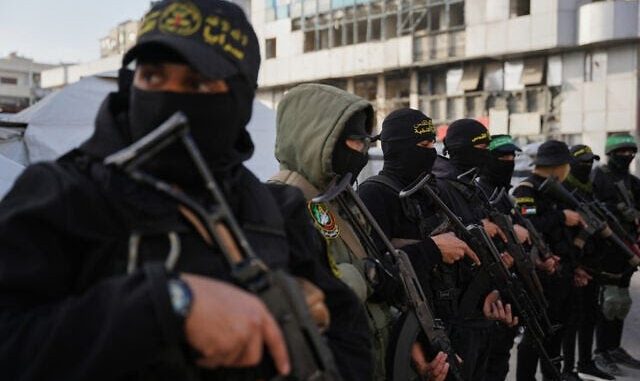
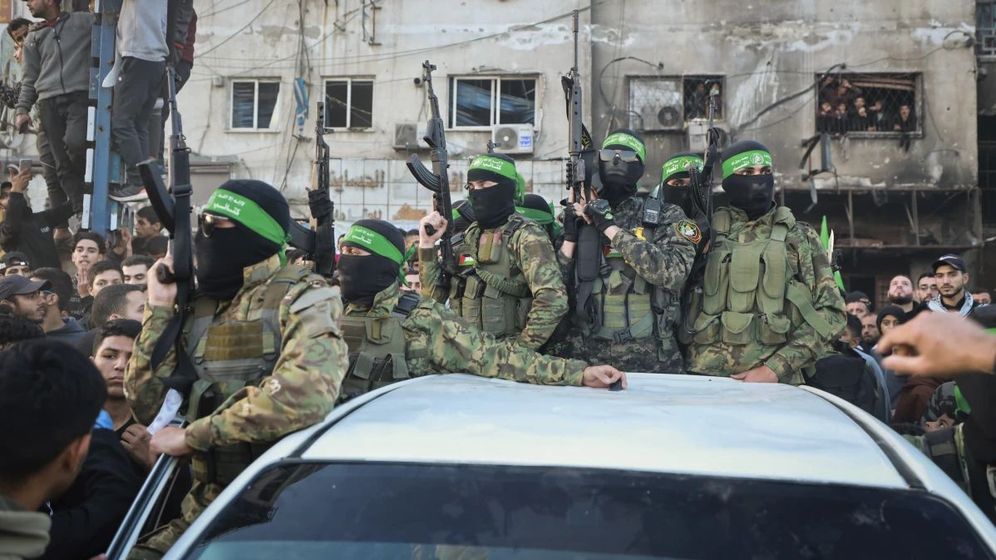
Palestinian gunmen from Hamas and Islamic Jihad gather next to Eid al-Fitr prayers in Gaza City, March 20, 2026. (AP Photo/Abdel Kareem Hana)
Published July 30 , 2026
CAIRO / JERUSALEM — Hamas is reportedly moving closer to accepting a proposal to relinquish control of its heavy weapons to a postwar Palestinian security force, a development that could mark one of the most significant shifts in the group’s position since the Gaza war began.
According to multiple reports, mediators working on a U.S.-backed ceasefire framework have presented a proposal under which Hamas would transfer heavy weapons into the custody of a newly established Palestinian security body responsible for maintaining order in postwar Gaza. While negotiations remain ongoing, officials involved in the talks have described the discussions as showing notable progress.
Despite the reported progress, major questions remain over whether Israel will regard the proposal as credible while Hamas continues to exercise de facto control over parts of the Gaza Strip.
Proposed Deal Centers on Postwar Security
Under the reported framework, Hamas would surrender heavy weapons to a future Palestinian security force rather than retain direct military control over them. The proposal is part of broader negotiations aimed at implementing the next phase of the Gaza peace plan, which includes expanding humanitarian aid, establishing civilian governance, and advancing Gaza’s reconstruction.
Reports indicate that discussions also include transitioning thousands of Hamas-affiliated personnel from military-related roles into civilian government positions as part of efforts to stabilize the territory after the conflict.
Disarmament Remains a Key Sticking Point
Despite the reported progress, negotiations remain complex.
Israeli officials have consistently maintained that the complete disarmament of Hamas is a central condition for any long-term political settlement. Hamas, meanwhile, has historically resisted calls for full disarmament, arguing that its armed wing serves as a form of resistance while seeking guarantees regarding Israeli military actions and Gaza’s future governance.
The latest reports suggest Hamas may now be willing to place heavy weapons under the control of a Palestinian authority, though questions remain over lighter weapons, enforcement mechanisms, and the timeline for implementation.
Ceasefire Talks Continue Amid Ongoing Violence
The diplomatic discussions come as Israeli military operations continue in parts of Gaza despite ongoing ceasefire negotiations.
Mediators from Egypt, Qatar, and Turkey remain engaged in talks aimed at advancing the next phase of the ceasefire agreement, while efforts continue to address hostage releases, humanitarian assistance, reconstruction, and long-term governance arrangements for Gaza.
Potential Turning Point for Gaza
If finalized, the reported agreement would represent one of the most significant political and security developments since the conflict began. Analysts say transferring heavy weapons to a postwar Palestinian security force could become a critical step toward implementing broader reconstruction plans and reducing the risk of renewed large-scale fighting.
However, officials caution that major differences remain unresolved, and no final agreement has been announced. Negotiators continue working to bridge disagreements over security guarantees, governance, and the future role of Hamas within Gaza’s political landscape.
👥 Public / Political Reactions:
🇮🇱 Israel
Israeli leaders have remained cautious despite reports that Hamas may be willing to place its heavy weapons under a Palestinian authority.
- Israeli officials continue to insist that Hamas must be fully disarmed before any lasting political settlement can move forward.
- Prime Minister Benjamin Netanyahu’s government has repeatedly maintained that Hamas cannot retain military capabilities or govern Gaza after the war.
- Israeli officials are expected to closely examine any proposal to determine whether it includes verifiable disarmament and effective enforcement mechanisms.
➡️ Position: Israel views complete demilitarization of Hamas as a non-negotiable requirement for a permanent ceasefire.
🇵🇸 Hamas
Hamas has reportedly signaled greater flexibility during ongoing negotiations but has not publicly confirmed that it will fully disarm.
- Officials familiar with the talks said Hamas is willing to place heavy weapons under the control of a Palestinian body rather than surrender them directly to Israel.
- Hamas continues seeking guarantees that Israeli military operations will end and that Israeli forces will withdraw from Gaza.
- The group maintains that any agreement must address Gaza’s future governance and reconstruction.
➡️ Position: Hamas is reportedly open to compromises on heavy weapons but continues seeking political and security guarantees before accepting a final agreement.
🇪🇬 Egypt, Qatar, and Turkey (Mediators)
Regional mediators continue working to bridge the remaining gaps between the parties.
- Negotiators remain engaged in discussions aimed at advancing the next phase of the ceasefire framework.
- Mediators are focusing on disarmament, hostage issues, humanitarian aid, and postwar governance.
- Officials have described recent discussions as showing progress while acknowledging that major differences remain unresolved.
➡️ Position: Mediators remain cautiously optimistic but stress that additional negotiations are needed before a final agreement can be reached.
🇺🇸 United States
The United States continues supporting efforts to advance the Gaza peace framework.
- Washington has backed negotiations designed to secure a lasting ceasefire, expand humanitarian assistance, and establish a civilian governing structure in Gaza.
- U.S. officials have emphasized that durable peace will require effective security arrangements and a stable postwar administration.
- American diplomats continue working with regional partners to encourage both sides to reach an agreement.
➡️ Position: The United States supports continued negotiations while emphasizing security, governance, and long-term regional stability.
🌍 International Community
Governments and international organizations have welcomed signs of progress while urging caution.
- Many diplomats view the reported flexibility on heavy weapons as a potentially significant step toward advancing ceasefire negotiations.
- International observers continue calling for the protection of civilians, increased humanitarian access, and a sustainable political solution.
- Analysts caution that implementation and verification remain among the most difficult challenges.
➡️ Position: The international community supports continued diplomacy but stresses that any agreement must be credible, enforceable, and sustainable.
👥 Public Response
Reaction has been mixed across Israel, Gaza, and the broader international community.
- Some observers view the reported shift as the strongest indication yet that negotiations may produce a broader political settlement.
- Others remain skeptical, citing previous ceasefire efforts that ultimately collapsed.
- Many civilians continue prioritizing an end to the fighting, the release of hostages, humanitarian relief, and long-term security for both Israelis and Palestinians.
➡️ Position: Public opinion remains divided between cautious optimism over renewed negotiations and skepticism about whether a lasting agreement can be achieved.
🏛️ Broader Political Impact
The reported development could become a major turning point if negotiations succeed.
- A verified transfer of heavy weapons could reshape postwar governance discussions in Gaza.
- The proposal may influence future Israeli-Palestinian negotiations and broader regional diplomacy.
- Analysts say the success of the initiative will depend on implementation, international oversight, and continued cooperation among all parties.
➡️ Position: The reported shift has the potential to reshape the next phase of the Gaza peace process, but substantial political and security hurdles remain.
⚠️ Resulting Effects:
The reported willingness of Hamas to place its heavy weapons under the control of a future Palestinian security force could represent one of the most significant developments in Gaza ceasefire negotiations since the war began. While no final agreement has been reached, the proposal has the potential to influence military, political, humanitarian, and diplomatic efforts across the region.
1. Ceasefire Negotiations Could Gain Momentum
The reported shift may help narrow one of the largest obstacles to a broader peace agreement.
🤝 Mediators could use the proposal to advance negotiations on a long-term ceasefire.
🕊️ Greater flexibility from Hamas may encourage additional diplomatic engagement.
📋 Several major issues—including hostages, governance, and implementation—remain unresolved.
➡️ Result: Reported willingness to compromise → increased momentum for ceasefire negotiations.
2. Israel May Seek Strong Verification Measures
Israeli officials are likely to scrutinize any disarmament proposal before accepting an agreement.
🛡️ Israel has repeatedly stated that Hamas must no longer possess military capabilities.
🔍 Verification and international monitoring could become central components of any final deal.
⚖️ Negotiations may focus heavily on enforcement mechanisms and compliance.
➡️ Result: Proposed weapons transfer → greater emphasis on verification and security guarantees.
3. Gaza’s Postwar Governance Could Begin to Take Shape
The proposal may influence discussions over who governs Gaza after the conflict.
🏛️ A new Palestinian security structure could play a larger role in maintaining order.
👥 Civilian governance and institutional rebuilding may become more achievable if security arrangements are agreed upon.
📖 International partners are expected to remain involved in planning Gaza’s reconstruction.
➡️ Result: Security framework discussions → clearer path toward postwar governance.
4. Humanitarian Conditions Could Improve
Progress in negotiations may create opportunities to expand humanitarian assistance.
🚚 Aid deliveries could increase if security conditions improve.
🏥 Relief organizations may gain greater access to civilians in need.
🏘️ Reconstruction planning could accelerate if hostilities are reduced.
➡️ Result: Diplomatic progress → potential improvement in humanitarian operations.
5. Regional Diplomacy Could Be Strengthened
The negotiations highlight the growing role of regional mediators.
🌍 Egypt, Qatar, and Turkey continue facilitating dialogue between the parties.
🤝 Successful negotiations could reinforce regional diplomatic cooperation.
📡 International partners are expected to remain engaged throughout implementation.
➡️ Result: Continued mediation → stronger regional diplomatic coordination.
6. Security Risks Will Remain During Implementation
Even if an agreement is reached, significant challenges are expected.
⚠️ Enforcement of any weapons transfer will require careful monitoring.
🚨 Any violations or renewed hostilities could quickly undermine the agreement.
🛡️ Security arrangements will likely require ongoing coordination among regional and international stakeholders.
➡️ Result: Potential agreement → continued security challenges during implementation.
7. Long-Term Regional Stability Will Depend on Implementation
The success of the reported proposal will ultimately depend on whether commitments are fulfilled.
🌍 Lasting peace will require effective governance, reconstruction, and sustained diplomacy.
📈 Confidence among regional and international partners will depend on measurable progress.
🕊️ A successful agreement could reduce the likelihood of renewed large-scale conflict, while failure could prolong instability.
➡️ Result: Implementation of any agreement → critical to achieving long-term stability in Gaza and the broader Middle East.
🔮 Future Outlook:
The reported willingness of Hamas to place its heavy weapons under the control of a future Palestinian security force could mark an important step in ongoing ceasefire negotiations, but significant political and security challenges remain. The coming weeks are expected to determine whether the reported breakthrough evolves into a formal agreement or stalls over unresolved issues such as implementation, hostages, governance, and security guarantees.
1. Ceasefire Negotiations Will Continue
Mediators are expected to intensify efforts to finalize a broader agreement.
🤝 Egypt, Qatar, and Turkey are likely to continue facilitating negotiations between the parties.
📋 Discussions are expected to focus on hostage releases, humanitarian access, governance, and security arrangements.
⚖️ Remaining disagreements could still delay or derail a final deal.
➡️ Outlook: Continued negotiations → possibility of a broader ceasefire agreement.
2. Israel Will Seek Verifiable Disarmament
Israeli leaders are expected to maintain their demand for enforceable security guarantees.
🛡️ Israel is likely to insist that any transfer of heavy weapons be independently verified.
🔍 International monitoring mechanisms could become part of any final agreement.
⚠️ Israeli officials are expected to remain cautious until implementation begins.
➡️ Outlook: Security verification → essential before Israel accepts a long-term settlement.
3. Hamas’ Future Role Will Remain a Key Issue
Even if heavy weapons are transferred, questions surrounding Hamas’ political future are expected to remain.
🏛️ Negotiators will likely continue discussing Hamas’ role in postwar Gaza governance.
👥 Future arrangements may distinguish between civilian administration and military activities.
📖 Long-term political agreements will depend on broader Palestinian governance discussions.
➡️ Outlook: Hamas’ future status → likely to remain one of the most difficult issues in negotiations.
4. Humanitarian and Reconstruction Efforts Could Expand
A reduction in hostilities could improve conditions for civilians.
🚚 Aid organizations may gain greater access to deliver food, medicine, and other essential supplies.
🏥 International donors could accelerate reconstruction planning for Gaza.
🏘️ Recovery efforts will depend on sustained security and continued diplomatic progress.
➡️ Outlook: Improved security → greater opportunities for humanitarian relief and rebuilding.
5. Regional and International Diplomacy Will Remain Critical
Foreign governments are expected to stay actively involved.
🌍 Regional mediators and international partners will likely continue supporting negotiations.
🤝 Diplomatic engagement will remain necessary to resolve disputes over implementation and oversight.
📡 Continued international involvement may help reduce the risk of renewed fighting.
➡️ Outlook: Ongoing diplomacy → critical to maintaining progress toward a lasting agreement.
6. Implementation Will Be the Greatest Challenge
Reaching an agreement is only one part of the process.
📋 Any weapons transfer will require detailed implementation procedures and oversight.
⚠️ Compliance by all parties will be closely monitored.
🛡️ Any breakdown in implementation could jeopardize the ceasefire.
➡️ Outlook: Effective implementation → key to preserving any future agreement.
7. Regional Stability Will Depend on Lasting Political Progress
The broader Middle East will continue watching developments closely.
🌍 A successful agreement could reduce regional tensions and encourage further diplomatic initiatives.
⚖️ Failure to resolve remaining issues could lead to renewed violence and prolonged instability.
🕊️ The long-term future of Gaza will depend on sustained negotiations, effective governance, and continued international support.
➡️ Outlook: The coming weeks may prove pivotal in determining whether the reported breakthrough becomes the foundation for a durable peace or another missed opportunity in the long-running conflict.
🧩 Bottom Line:
The reported willingness of Hamas to relinquish control of its heavy weapons represents one of the most consequential developments in Gaza ceasefire negotiations since the war began. Although no final agreement has been reached and key details remain under negotiation, the proposal could reshape discussions over Gaza’s future security, governance, and reconstruction.
🕊️ The reported shift suggests that negotiators may be making progress on one of the conflict’s most difficult issues—how to prevent future violence while creating conditions for a lasting ceasefire.
🛡️ For Israel, any agreement will ultimately depend on whether the disarmament process is credible, verifiable, and capable of preventing Hamas from rebuilding its military capabilities.
🏗️ For Gaza’s civilians, a successful agreement could pave the way for expanded humanitarian aid, reconstruction efforts, and the gradual return of stability after months of devastating conflict.
🌍 For the international community, the negotiations represent an opportunity to move from crisis management toward a longer-term political solution, though major challenges—including hostage releases, governance, implementation, and mutual trust—remain unresolved.
➡️ Bottom Line: The coming days and weeks could determine whether this reported breakthrough becomes the foundation for a broader peace agreement or another difficult chapter in a conflict that has repeatedly seen diplomatic progress overshadowed by renewed violence. The success of any agreement will depend not only on commitments made at the negotiating table, but also on whether all parties are willing and able to carry them out.
SOURCES: THE TIMES OF ISRAEL – Progress said made on deal disarming Hamas, removing it from power; Gazan media says it’s conditioned on IDF pullout
YNET GLOBAL – Gaza Peace Board sources: ‘It appears Hamas is surrendering and agreeing to full and absolute disarmament’
i24NEWS – Hamas expected to agree to disarm heavy weapons in major shift