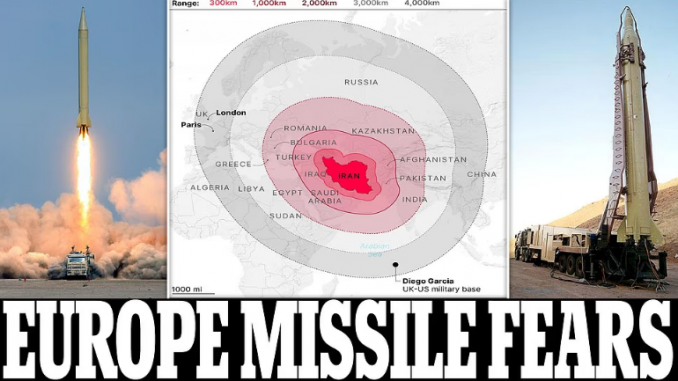
Iran’s ballistic missile strike on a British military base in the Chagos Islands has escalated fears that major European capitals are now within reach of another attack by the extremist regime – with London moving ‘closer to the edge of vulnerability’. Two ballistic missiles were fired towards Diego Garcia, a base in the Indian Ocean jointly operated by the US and the UK, on Friday night. The significant escalation in hostilities came just hours after Keir Starmer gave the green light for Donald Trump to use UK-based bombers threatening the Straits of Hormuz. But defence experts have suggested the incident is significant in that it marks the first time intermediate-range missiles have been deployed in the conflict – ones that can cover far greater distances than Iranian weapons were previously known to be capable of.
Published March 21, 2025
Iran’s war with the United States and its allies has taken a dramatic and alarming turn, with military analysts warning that Tehran’s ballistic missile capabilities may now put major European capitals — including London and Paris — within striking distance.
Failed Missile Strikes on Diego Garcia Signal New Range
On March 21, 2026, Iran launched two ballistic missiles in the direction of the US–UK military base at Diego Garcia, a strategically important joint facility in the Indian Ocean. Neither missile struck the target — one reportedly malfunctioned mid‑flight while a US destroyer fired an SM‑3 interceptor at the second — but the incident has nonetheless deepened concern among Western capitals.
Diego Garcia lies roughly 4,000 km (about 2,500 miles) from Iranian territory — far beyond the publicly acknowledged range of Iran’s missile arsenal. That has led defence experts to conclude that Tehran may now field ballistic missiles with significantly greater range than previously believed.
An arms analyst from the International Institute for Strategic Studies said the attempted strike “changes the threat assessment” for Europe, noting that distances to capitals such as London and Paris are roughly the same as that to Diego Garcia. European governments are expected to accelerate enhancements to their ballistic missile defence systems in response to this development.

Iran’s use of intermediate ballistic missiles on a British military base in the Chagos Islands has escalated fears that major European capitals are now within reach of another attack
Implications for Europe
Until now, Iran’s longest‑range missiles — such as the Khorramshahr — were understood to have a maximum range of around 4,000 km, which theoretically could reach southern and parts of western Europe if operational in combat scenarios.
The Diego Garcia launch, even though unsuccessful, suggests Iran may be deploying or testing systems at or above that level — something Western military planners had not expected to see used beyond the Middle East. Should operational long‑range capabilities be confirmed, most capitals across NATO Europe would lie within the same reach band demonstrated by the attempted strike.

Diego Garcia lies around 3,800km (2,360 miles) from Iran – undermining the regime’s previous assertion that its ballistic missiles could only reach 2,000 km (1,240 miles)
Political Fallout and Western Response
The missile attempt came amid growing tensions between Tehran and Western powers, especially after the United Kingdom granted the United States permission to use British bases — including RAF Fairford and Diego Garcia — for strikes on Iranian missile sites targeting maritime traffic in the Strait of Hormuz. Tehran has condemned the decision as provocative.
The UK Ministry of Defence called Iran’s actions “reckless,” and UK politicians from across the spectrum have accused the government of being drawn deeper into the conflict.
Meanwhile, the broader conflict — which has already seen strikes on US and allied positions in the Gulf, as well as attacks on civilian infrastructure — shows little sign of near‑term de‑escalation. European leaders are now under pressure to reassess their security postures and defence cooperation amid fears that a regional conflict could ripple outward.


Defence experts have suggested the strike on Diego Garcia (pictured) is significant in that it marks the first time intermediate-range missiles have been deployed in the conflict
 Public / Political Reactions:
United Kingdom
The attempted missile strike on Diego Garcia sparked immediate concern in London. Officials described Tehran’s action as “reckless” and a clear demonstration of Iran’s expanding military reach. The British Ministry of Defence reaffirmed its commitment to joint operations with U.S. forces in the region, but lawmakers criticized the government for allowing Iran to perceive British-affiliated bases as targets. Some opposition MPs called for stronger missile defense systems to protect the U.K. and its overseas territories.
European Union
Across Europe, political leaders expressed alarm that Iran’s missiles could now reach major capitals like Paris, Berlin, and Rome. EU foreign ministers convened emergency discussions to assess potential missile defense upgrades, intelligence sharing, and NATO coordination. Public statements emphasized the need for diplomatic pressure on Tehran, alongside continued vigilance to protect European citizens.
United States
The U.S. government labeled the strike attempt a provocative escalation and stressed the need to maintain a military presence in the Indian Ocean and the Middle East to deter further aggression. U.S. officials reassured both allies and domestic audiences that missile defense systems successfully intercepted one of the missiles and that no personnel were harmed.
Global Public Reaction
The wider international community expressed concern over the escalation. Analysts warned that the strike could signal a shift from regional to global threat dynamics, heightening fears of broader conflict. Social media and international news outlets highlighted public anxiety in Europe, with citizens calling for stronger defenses and diplomatic solutions to prevent potential strikes in the future.
 Resulting Effects:
The attempted Iranian missile strike on Diego Garcia has underscored the urgent need for robust defense and deterrence measures. By demonstrating the ability to reach distant targets, Tehran has shifted the strategic calculus for both Europe and U.S. forces, highlighting vulnerabilities in regional and global security.
Key effects include:
- Heightened military readiness: NATO allies and U.S. forces are likely to accelerate deployment of missile defense systems and early warning capabilities to counter potential long-range threats.
- Strengthened deterrence posture: Demonstrating the capability and willingness to act decisively sends a clear message that aggression toward Western bases or allies will meet a swift response.
- Energy and economic security concerns: The demonstration has triggered renewed attention to protecting critical trade routes and ensuring stability in global energy markets, particularly in strategic chokepoints such as the Strait of Hormuz.
- Unified international stance on threats: The event may foster stronger collaboration among Western nations to counter Iran’s long-range missile capabilities while reinforcing intelligence-sharing agreements.
Overall, the attempted strike reinforces the principle that vigilance, preparedness, and decisive action remain essential to prevent adversaries from challenging international security or threatening allied nations.
 Future Outlook:
The Diego Garcia missile incident signals a turning point in regional and global security dynamics. Experts warn that Iran’s demonstrated missile reach could alter strategic calculations for Europe, the Middle East, and U.S. forces operating abroad.
Key Projections
- Expanded missile defense initiatives: European nations and the U.S. are expected to accelerate deployment of advanced missile defense systems and early-warning technologies to deter future attacks.
- Continued military vigilance: The U.S. and allied forces will likely maintain a robust presence in strategic regions, including the Indian Ocean and the Persian Gulf, to ensure rapid response capabilities.
- Heightened deterrence messaging: Tehran’s show of missile capability may trigger a sustained policy of deterrence, making it clear that aggressive actions against Western assets or allies carry significant consequences.
- Increased international coordination: NATO members and partner nations are expected to strengthen intelligence-sharing and joint exercises to counter the evolving threat from long-range missile programs.
While diplomacy and sanctions remain tools for constraining Tehran, the incident underscores the necessity of preparedness, decisive action, and clear defense strategies to prevent potential escalation. The coming months will likely see a mix of heightened military readiness and strategic signaling aimed at maintaining stability while deterring further provocations.
 Bottom Line:
The attempted missile strike on Diego Garcia serves as a stark reminder that Iran’s long-range missile capabilities are advancing, bringing previously distant targets, including parts of Europe, within reach. While the immediate threat was intercepted, the demonstration highlights the need for vigilance, strong defense systems, and decisive deterrence.
Moving forward, the international community faces a clear choice: maintain robust military readiness and coordinated intelligence efforts, or risk allowing adversaries to exploit gaps in security. The incident underscores that preparedness, strategic foresight, and firm action remain essential to safeguarding allies, protecting critical infrastructure, and ensuring regional and global stability.
In short, the world is witnessing a new phase in security challenges—one that demands resolute defense measures and unwavering commitment to deterring threats from nations willing to project power far beyond their borders.