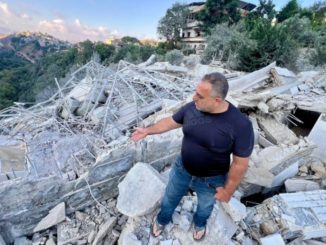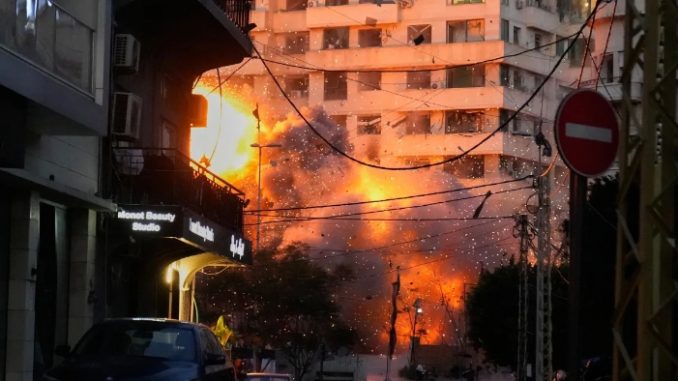
An explosion erupts from a building following an Israeli strike in central Beirut, Lebanon, Wednesday, March 18, 2026.
Published March 18, 2025
In a dramatic escalation of the wider Middle East conflict, Iran has launched a series of attacks against Israel and multiple Gulf states following the targeted killing of several senior Iranian officials in recent days.
On Wednesday, Iran responded to an Israeli airstrike that killed one of its top security leaders by firing missiles, drones and other projectiles toward Israeli territory, causing casualties in and around Tel Aviv.
At the same time, Iranian forces extended their attacks to neighboring Gulf nations — including the United Arab Emirates, Qatar, and Saudi Arabia — raising fears of an even broader regional confrontation. Gulf air‑defense systems intercepted dozens of missiles and drones, but some struck territory, causing damage and casualties.
Iran has explicitly threatened to target energy infrastructure across the Gulf in retaliation, a move that could further destabilize global oil and gas markets already disrupted by the conflict.
Israel Hits Iranian Energy Sites and Targets Beirut
The current flare‑up traces back to a coordinated campaign of strikes by Israel and its allies inside Iran, which have killed at least three senior Iranian security figures and struck key military and infrastructure sites.
Among the most significant was an attack on the South Pars natural gas field near Asaluyeh — a critical energy hub that supplies much of Iran’s domestic gas and contributes to regional energy stability. The facility caught fire and production was disrupted, prompting Iran to vow retaliation.
In response to Iranian attacks, Israel has also stepped up military action across Lebanon:
- Air strikes on central Beirut and southern Lebanese areas, including the destruction of several buildings and bridges, have killed civilians and infrastructure targets, according to Reuters.
- Israel says its focus is on Hezbollah positions and infrastructure, seeking to weaken the powerful Iran‑aligned militia that has been firing rockets into northern Israel.
These strikes have intensified a conflict that has already displaced hundreds of thousands of Lebanese civilians and killed scores of fighters and non‑combatants.
Regional and Global Impacts
*Humanitarian Toll
The ongoing conflict has produced a growing humanitarian crisis, with hundreds killed in Lebanon and Iran, and missile attacks sparking civilian casualties in Israel and Gulf states. Hospitals and essential infrastructure strain under the escalating violence.
*Energy Market Disruption
Strikes on the South Pars field and threats against Gulf energy facilities have triggered fears of rising energy prices. Markets are reacting nervously to threats along the Strait of Hormuz — the world’s vital energy shipping chokepoint.
*Regional Alliances Under Strain
Iran’s broader attacks have reportedly unsettled Gulf states. Some Gulf officials suggest that Iran’s direct military moves are driving closer cooperation between Gulf monarchies, Israel, and the United States, reshaping alliances long defined by caution and rivalry.
 Strategic Implications of the Iran-Israel Conflict:
1. National Security Priorities Intensified
The attacks by Iran on Israel and Gulf states, and Israel’s strikes in Lebanon, highlight the need for robust national defense and regional deterrence. Nations directly involved, as well as allies, may reassess military readiness, strengthen air defenses, and invest in rapid-response capabilities. The emphasis is on preventing surprise attacks and ensuring civilian protection.
2. Energy Security Risks
With Iran targeting the South Pars gas field and threatening Gulf energy infrastructure, the situation underscores the vulnerability of global energy supply chains. Countries dependent on Middle East oil and gas are likely to accelerate strategic reserves, diversify suppliers, and secure maritime routes such as the Strait of Hormuz. Energy independence and supply resilience become central concerns.
3. Regional Alliances and Defense Cooperation
The escalation may prompt stronger coordination between Israel and Gulf nations, along with supportive powers. Joint security frameworks, intelligence sharing, and coordinated deterrence measures are likely to increase, as nations recognize shared threats in the region. These alliances are pragmatic responses to maintain regional stability.
4. Deterrence and Credible Retaliation
The conflict demonstrates that nations may act decisively to protect interests. The emphasis on credible deterrence—the ability to respond swiftly and effectively—becomes a guiding principle in military strategy. This perspective prioritizes strength as the most reliable path to reducing long-term risk.
5. Humanitarian and Civilian Considerations
While the focus is on strategic priorities, there is acknowledgment that civilian safety and infrastructure protection are critical. Planning for humanitarian contingencies, evacuations, and reconstruction is seen as essential for maintaining societal resilience and stability in conflict zones.
6. Long-Term Geopolitical Impacts
Persistent instability could reshape the Middle East balance of power, affecting foreign policy decisions, military posture, and economic planning for years. Nations may adopt policies that favor stability over experimentation, prioritizing predictable alliances and secure borders.
 Overall Takeaway:
The current escalation between Iran, Israel, and Gulf states underscores the fragile balance of security in the Middle East. Nations directly involved, as well as their allies, face a clear imperative to prioritize defense readiness, secure critical infrastructure, and maintain credible deterrence. Protecting civilian populations and energy resources is not only a humanitarian concern but also a strategic necessity for regional and global stability.
Moving forward, measured action, strong alliances, and careful planning will be essential to prevent broader conflict and safeguard long-term national interests. The situation serves as a reminder that strength, vigilance, and prudent policy are the most reliable paths to enduring peace and stability.
SOURCES: NEWSMAX – Iran Attacks Israel, Gulf as Israel Hits Beirut
THE ALBERTAN – Both sides in Iran war ratchet up attacks on energy facilities, as oil prices surge
10 PHILADELPHIA – Iran’s supreme leader signals retaliation over Larijani’s killing