
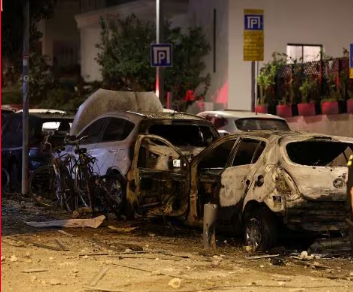
A debris-strewn street in Tel Aviv, after it was hit by a rocket fired by Palestinian terrorists from the Gaza Strip on Oct. 7, 2023. (Getty Images)
Reported by:

Cherry Meigh Timbol
News Content Editor
Published October 7, 2026
Three years after the Hamas-led assault of October 7, 2023, Israel has once again fallen silent to remember the victims of the country’s deadliest day in modern history.
Across Israel on Wednesday, October 7, 2026, families, survivors, soldiers and communities gathered at memorial sites, cemeteries, kibbutzim and the former Nova music festival site to commemorate those killed and abducted in the attack. The anniversary is also unfolding against a highly charged political backdrop, with Israelis preparing for a national election later this month and renewed demands for accountability over the security failures surrounding the attack.
A Nation Remembers
The attack began at approximately 6:29 a.m. on October 7, 2023, when Hamas-led militants crossed from Gaza into southern Israel during the Jewish holiday of Simchat Torah.
About 1,200 people were killed and 251 people were taken hostage, according to widely cited Israeli figures. The attack included massacres at communities near the Gaza border and at the Nova music festival.
This year, memorial ceremonies began at the same time the assault started.
At Kibbutz Kfar Aza and other communities near Gaza, survivors and bereaved families gathered to remember relatives, friends and neighbors who were killed or abducted. A major memorial was also held at the Nova festival site, where hundreds were killed during the attack.
At noon, survivors and bereaved families organized a nationwide minute of silence.
Memorial events were also held at military cemeteries and other locations across the country.
The Memories Remain Deeply Personal
For many Israelis, October 7 is not simply a historical date.
Entire communities were devastated. Families lost multiple relatives. Survivors continue to deal with trauma, displacement and the consequences of captivity.
At Kfar Aza, residents gathered to remember those killed and abducted. Some members of the community have yet to fully return to their homes, underscoring how the consequences of the attack continue three years later.
At the Nova festival site, families gathered at a location that has become one of the most powerful symbols of the massacre.
The commemorations are therefore simultaneously acts of remembrance and attempts to preserve the personal stories of people whose lives ended or changed dramatically that morning.
A Day of Mourning Also Becomes a Day of Protest
Not everyone observing October 7 focused exclusively on remembrance.
Anti-government demonstrators used the anniversary to demand accountability for the failures that allowed Hamas to penetrate Israel’s border and carry out the attack.
Protesters briefly blocked sections of the Ayalon Highway in central Israel for a moment of silence, while demonstrations were also held at junctions around the country and outside the homes of government ministers.
Some activists dyed the fountain at Tel Aviv’s Dizengoff Square red as part of their protest.
The demonstrations reflect a growing argument within Israel over whether the government should establish an independent commission to investigate the events leading up to October 7.
Netanyahu Faces Renewed Pressure
Benjamin Netanyahu has rejected attempts to place sole responsibility for the security failure on his government and has repeatedly emphasized the military and political response that followed the attack.
At memorial ceremonies, Netanyahu renewed his pledge to pursue those responsible for October 7 and prevent Hamas from governing Gaza.
Critics, however, argue that remembering the victims also requires determining why Israel’s extensive intelligence and security apparatus failed to prevent the attack.
The issue has become especially politically important because Israel is approaching elections scheduled for October 27, 2026.
The October 7 anniversary is therefore taking place only weeks before voters decide the country’s political direction.
The Political Battle Over Accountability
For families of victims and some former government supporters, the question is straightforward: how could an attack of such magnitude have happened?
They want an independent investigation into intelligence failures, military preparedness and decisions made in the days and months before the assault.
Supporters of Netanyahu argue that the country must not lose sight of the larger security threat and that Israel’s military campaign has fundamentally changed the regional balance.
The dispute has become one of the central political fault lines surrounding the October 7 legacy.
With elections approaching, the anniversary is inevitably being interpreted through competing political narratives.
Gaza Remains Part of October 7’s Legacy
Israel’s remembrance is taking place alongside a very different reality in Gaza.
The Hamas attack triggered Israel’s massive military campaign in the Gaza Strip. According to Gaza health authorities cited by international news organizations, more than 74,000 Palestinians have been killed since the war began. The figures are maintained by the Hamas-run health ministry and are cited by international organizations, although they do not distinguish in every case between combatants and civilians.
Large parts of Gaza have been destroyed, and much of the population remains displaced.
Although a ceasefire reached last year halted the largest-scale fighting, the situation remains unstable, with continued Israeli military activity and unresolved questions over Gaza’s political future, reconstruction and security arrangements.
For Palestinians, therefore, October 7 is also remembered as the beginning of a devastating Israeli military campaign that transformed life across Gaza.
The same date consequently carries profoundly different meanings on opposite sides of the conflict.
Israel Remains on High Alert
Security has been tightened around this year’s commemorations.
Israeli authorities have warned of potential threats around the anniversary, while military officials have maintained heightened readiness because of concerns about renewed attacks.
The precautions reflect an uncomfortable reality: three years after October 7, Israel’s security environment remains volatile.
The country has faced threats not only from Hamas but from Hezbollah, Iran-aligned groups and other regional actors during the wider conflict.
The consequences of October 7 therefore extend well beyond Gaza and southern Israel.
Reuven Azar Remembers the Victims
Israeli Ambassador Reuven Azar has also joined the commemoration of those killed in the attack, emphasizing the continuing importance of remembering the victims and preserving their stories.
The Economic Times’ coverage of the anniversary highlighted Israel’s national remembrance and the continuing significance of October 7 three years later.
For Israeli officials and many families, remembering the victims is also an argument against allowing the events of that morning to become reduced to statistics.
Each number represents an individual life, family and community.
🧩 Bottom Line:
Three years after Hamas’s October 7 attack, Israel is still living with its consequences.
The anniversary has brought the country together in mourning, but it has also exposed deep political divisions over responsibility, security failures and the future of the Netanyahu government.
For the families of the victims, the day remains about remembering loved ones. For protesters, it is a demand for accountability. For Palestinians, it marks the beginning of a war that devastated Gaza.
As Israel approaches a pivotal election, October 7 has become both a national memorial and a political reckoning—one that will continue shaping Israel’s future long after the anniversary ceremonies end.




