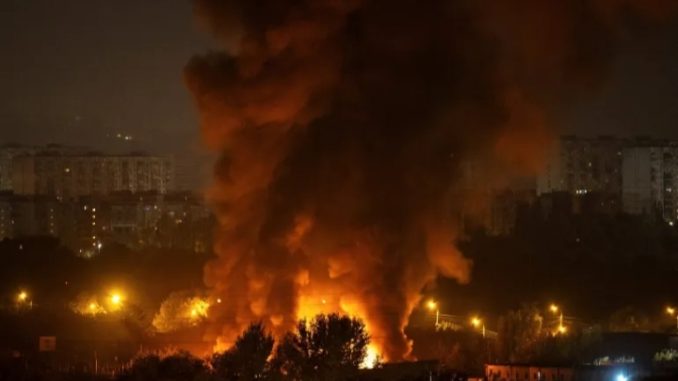
Fire and smoke rise in the capital Kyiv during a Russian missile and drone attack on Ukraine on October 7, 2026 [Vladyslav Sode/Reuters]
Reported by:

Cherry Meigh Timbol
News Content Editor
Published October 7, 2026
KYIV, Ukraine — Russia launched one of its largest aerial assaults on Ukraine in months on Wednesday, firing dozens of missiles and deploying waves of drones against Kyiv and multiple regions, killing civilians, damaging residential buildings and threatening critical energy infrastructure.
The attack came after Ukrainian President Volodymyr Zelenskyy warned Tuesday that intelligence indicated Russia was preparing a major strike. The following night, explosions shook Kyiv as residents rushed into shelters and underground metro stations.
Initial reports from Kyiv said at least two people were killed in the capital’s Darnytskyi district after a fire broke out during the overnight assault. Kyiv Mayor Vitali Klitschko said rescuers recovered the bodies of two victims and rescued two other people from the scene.
However, the overall death toll across Ukraine rose substantially as emergency crews reached other strike locations. Reuters later reported at least 20 deaths nationwide, while Associated Press reported at least 24 civilians killed, including four children. The figures were still developing as rescue operations continued.
Russia fires dozens of missiles
According to Zelenskyy, Russia launched approximately 70 missiles, including ballistic weapons, alongside drones in what he described as one of the most significant attacks of the war.
The Ukrainian president said energy infrastructure was among the principal targets.
“One of the key targets was our energy infrastructure,” Zelenskyy said, according to Reuters.
He warned that Russian ballistic missiles remain particularly difficult for Ukrainian defenses to intercept and renewed calls for additional air-defense systems.
Russia’s Defense Ministry confirmed that its forces had conducted what it called a “massive strike” against Ukrainian targets.
Moscow said the operation involved high-precision weapons launched from land, sea and air, as well as drones. Russian officials claimed the targets included military-industrial facilities in Kyiv and several other regions.
Residential areas hit
The assault caused some of its worst civilian casualties in the northern city of Pryluky, where a Russian missile struck a five-story residential building.
Reuters reported that at least 14 people, including four children, were killed there according to local officials. AP later reported 18 deaths at the apartment building. The discrepancy reflects the rapidly changing casualty figures during rescue operations.
Kyiv also suffered extensive damage.
Residents reported hearing repeated explosions during the night, while authorities urged people to remain in shelters. Metro stations once again became makeshift refuges for residents seeking protection from incoming missiles and drones.
Energy infrastructure under pressure
The attack comes as Ukraine prepares for another difficult winter and faces continuing pressure on its electricity network.
Ukraine’s Energy Ministry began emergency power restrictions in several regions after infrastructure was damaged. The strikes against energy facilities raise concerns that Moscow is again attempting to weaken Ukraine’s electricity supply ahead of the colder months.
The strategy carries echoes of previous Russian winter campaigns, when repeated attacks against power plants, substations and transmission infrastructure left millions of Ukrainians without reliable electricity and heating.
Ukraine’s air defenses face a difficult challenge
Ukraine said it successfully intercepted a large proportion of the drones involved in the latest assault.
Reuters reported that Ukrainian forces shot down just over 80% of 46 jet-powered drones launched during the attack. That represented an improvement over recent weeks, when Ukrainian air defenses had intercepted roughly 50% to 60% of similar drones.
But ballistic missiles remain a major vulnerability.
Zelenskyy has repeatedly appealed for additional U.S.-made Patriot systems, which Ukraine considers essential for protecting major cities and critical infrastructure from advanced missile attacks.
The problem is particularly acute because air-defense resources are increasingly stretched by conflicts and weapons demands around the world.
Russia says it targeted military facilities
Moscow maintains that its strikes were directed at military and defense-related infrastructure rather than deliberately targeting civilians.
Russia said it struck facilities associated with Ukraine’s defense industry, including sites connected to Fire Point, a Ukrainian weapons manufacturer involved in producing cruise missiles and drones. Moscow also said it attacked port and ship-repair infrastructure in the Odesa region.
Ukraine, meanwhile, has accused Russia of deliberately attacking civilian infrastructure and residential areas.
The destruction of apartment buildings and civilian deaths will likely intensify those accusations and increase pressure on Ukraine’s international partners to provide additional air-defense equipment.
Ukraine strikes back
Ukraine has also expanded its long-range attacks against Russian infrastructure.
Zelenskyy said Ukrainian forces had struck several targets inside Russia during the preceding 24 hours, including oil facilities and a military training ground. Kyiv has increasingly targeted Russian energy infrastructure in an attempt to disrupt the economic and logistical machinery supporting Moscow’s war effort.
The escalation illustrates how the war is increasingly becoming an aerial contest extending far beyond the immediate front lines.
🧩 Bottom Line:
Russia’s October 7 assault represents a major escalation in the aerial war over Ukraine. Dozens of missiles and drones struck Kyiv and other regions, with civilian casualties climbing as rescue operations continued. The attacks again exposed Ukraine’s dependence on Western air-defense systems while threatening critical energy infrastructure ahead of winter.
For Kyiv, the immediate priority is survival and protection of its population. For Moscow, the strikes demonstrate that Russia still possesses the capacity to deliver massive coordinated attacks deep inside Ukraine.
And for civilians on both sides, the latest barrage is another reminder that, despite years of fighting and diplomatic efforts, the war remains capable of producing devastating destruction with little warning.