
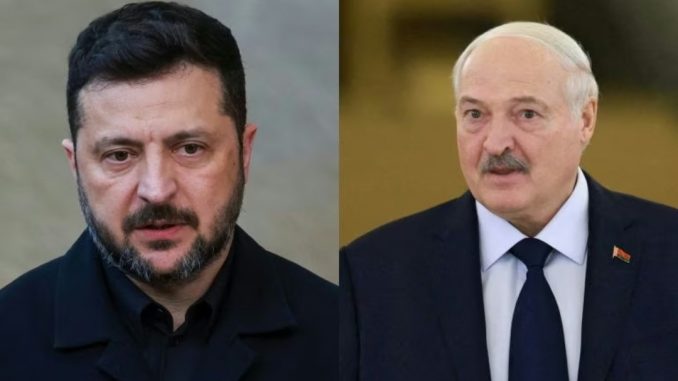
Analysts say Belarusian President Alexander Lukashenko, right, privately conceded to Ukrainian President Volodymyr Zelenskyy’s ultimatum [Reuters]
Published June 30, 2026
MINSK, Belarus — Belarusian President Alexander Lukashenko has noticeably softened his rhetoric toward Ukraine after Kyiv issued an ultimatum demanding the removal of equipment allegedly used to assist Russian drone attacks, highlighting the delicate position Belarus faces as it attempts to balance its alliance with Moscow while avoiding direct involvement in the war.
The shift comes after Ukrainian President Volodymyr Zelenskyy warned that Belarus had one week to dismantle signal relay stations that Ukraine says were helping guide Russian drones targeting Ukrainian cities. Zelenskyy warned that if Minsk failed to act, Ukraine would take matters into its own hands.
Days later, Ukrainian officials announced that intelligence indicated the relay stations had stopped operating, describing the development as a diplomatic success that reduced the immediate risk of direct confrontation between the neighboring countries. While Belarus has not formally confirmed dismantling the equipment, Lukashenko’s subsequent remarks suggested an effort to lower tensions.
Lukashenko Walks a Strategic Tightrope
Lukashenko, one of Russian President Vladimir Putin’s closest allies, has consistently supported Moscow politically and has allowed Russian forces to use Belarusian territory since the full-scale invasion of Ukraine began in 2022.
At the same time, Belarus has avoided sending its own troops into combat against Ukraine.
Speaking publicly after the ultimatum, Lukashenko said Belarus does not want to fight Ukrainians and warned Kyiv not to drag his country into the conflict. He also revealed that Ukrainian representatives had recently visited Minsk for discussions, suggesting that communication channels remain open despite heightened tensions.
Analysts say Lukashenko is attempting to preserve Belarus’ security while avoiding a direct military confrontation that could further destabilize his country.
Ukraine Takes a Firmer Stance
For much of the war, Ukraine avoided directly confronting Belarus despite its support for Russian military operations.
That approach has shifted in recent weeks.
Kyiv has become increasingly vocal over what it describes as Belarus’ role in facilitating Russian drone attacks through communications infrastructure located near the border.
According to Ukrainian officials, disabling those relay systems has reduced Russian drone activity in areas near Belarus, although independent verification remains limited.
Military analysts say the episode reflects Ukraine’s growing confidence in combining military capability with diplomatic pressure to influence developments beyond the battlefield.
Russia’s Closest Ally Faces Difficult Choices
Belarus remains heavily dependent on Russia economically, militarily, and politically.
Moscow continues to rely on Belarusian territory for logistics, military infrastructure, and joint defense cooperation.
However, becoming directly involved in combat could expose Belarus to Ukrainian military retaliation and potentially create additional domestic and international pressure on Lukashenko’s government.
The Kremlin has denied reports that it is forcing Belarus to widen its military role in the conflict, while continuing to emphasize the close alliance between the two countries.
Regional Tensions Remain High
Despite the apparent reduction in immediate tensions between Kyiv and Minsk, Ukrainian officials continue expressing concern over military construction and logistical infrastructure being developed near the Belarusian border.
Security experts caution that while diplomatic communication has temporarily eased one point of friction, Belarus remains a strategic partner of Russia, and the situation could change rapidly depending on developments on the battlefield.
For now, Lukashenko appears intent on maintaining his alliance with Moscow while avoiding becoming a direct participant in a war that has already reshaped the security landscape of Eastern Europe.
 Public / Political Reactions:
🇺🇦 Ukrainian Government Officials
Ukrainian officials portrayed the development as a diplomatic success that demonstrated Kyiv’s willingness to defend its security interests beyond the battlefield.
- President Volodymyr Zelenskyy warned Belarus to remove alleged Russian drone relay stations or face Ukrainian action.
- Ukrainian officials later said the relay systems had stopped operating, describing the outcome as a peaceful but firm assertion of Ukraine’s security interests.
- Kyiv maintains that Belarus must not allow its territory or infrastructure to be used to facilitate Russian military operations against Ukraine.
➡️ Position: Ukraine argues that firm diplomatic pressure helped reduce an immediate security threat without direct military confrontation.
🇧🇾 Belarusian Government Officials
Belarusian President Alexander Lukashenko sought to lower tensions while reaffirming Belarus’ desire to avoid entering the war directly.
- Lukashenko stated that Belarus does not want to fight Ukrainians.
- He revealed that Ukrainian representatives had recently visited Minsk for discussions despite heightened tensions.
- Belarusian officials continue insisting that their country should not be drawn directly into the conflict.
➡️ Position: Belarus is attempting to preserve its alliance with Russia while avoiding direct military involvement against Ukraine.
🇷🇺 Russian Government Officials
The Kremlin has rejected suggestions that Moscow is forcing Belarus to deepen its role in the conflict.
- Russian officials deny reports that they are pressuring Minsk to open another front against Ukraine.
- Moscow continues describing Belarus as a close strategic ally while emphasizing ongoing military cooperation between the two countries.
- Russia has not publicly acknowledged Ukraine’s claims regarding the alleged drone relay stations.
➡️ Position: Russia maintains that its partnership with Belarus remains strong while dismissing claims of coercion.
🌍 International Analysts and Security Experts
Regional analysts view the episode as an example of diplomacy backed by credible military deterrence.
- Experts say Ukraine’s ultimatum reflects a more assertive regional security strategy.
- Analysts believe Lukashenko is carefully balancing his dependence on Moscow with a desire to avoid direct war with Ukraine.
- Observers caution that the situation remains fragile despite the apparent reduction in tensions.
➡️ Position: Analysts believe both Kyiv and Minsk are trying to avoid escalation while protecting their respective strategic interests.
🇨🇳 China
China reaffirmed its support for Belarus amid the heightened regional tensions.
- During a meeting with Lukashenko, Chinese President Xi Jinping pledged continued support for Belarus’ sovereignty and independence.
- Beijing emphasized strengthening bilateral cooperation while avoiding direct involvement in the Russia-Ukraine conflict.
- China’s statements highlighted its interest in maintaining stability among its strategic partners.
➡️ Position: China continues backing Belarus diplomatically while encouraging regional stability.
 Resulting Effects:
Ukraine’s ultimatum to Belarus and the subsequent softening of President Alexander Lukashenko’s rhetoric have underscored the growing role of diplomacy alongside military deterrence in the Russia-Ukraine war. While tensions appear to have eased for now, the episode has significant implications for regional security and Belarus’ strategic position.
1. Reduced Immediate Risk of a Ukraine-Belarus Confrontation
The apparent suspension of the alleged drone relay systems has helped lower the immediate threat of direct conflict.
🕊️ Ukraine and Belarus have avoided a potentially dangerous military escalation.
🤝 Diplomatic communication between Kyiv and Minsk has remained open.
⚠️ Both sides continue monitoring developments along their shared border.
➡️ Result: Diplomatic engagement → reduced risk of immediate confrontation.
2. Increased Diplomatic Leverage for Ukraine
Kyiv views the outcome as evidence that firm diplomacy can produce tangible security gains.
🇺🇦 Ukrainian officials argue that their ultimatum prompted Belarus to reduce activities viewed as supporting Russian drone operations.
📢 The episode may encourage Ukraine to continue combining diplomatic pressure with military preparedness.
🌍 The development strengthens Ukraine’s position in regional security discussions.
➡️ Result: Firm diplomatic stance → increased strategic leverage for Ukraine.
3. Greater Pressure on Belarus’ Balancing Strategy
Belarus continues facing competing pressures from both Russia and Ukraine.
🇧🇾 Minsk must maintain its close alliance with Moscow while avoiding direct involvement in the war.
⚖️ Lukashenko is expected to continue balancing national security concerns with political and economic ties to Russia.
🏛️ Any perceived shift in Belarus’ position will likely receive close international scrutiny.
➡️ Result: Strategic balancing → increased political pressure on Belarus.
4. Continued Regional Military Vigilance
Although rhetoric has softened, military readiness remains high throughout the region.
🛡️ Ukraine is expected to continue monitoring Belarusian military infrastructure near the border.
🚀 Russia and Belarus are likely to maintain close military cooperation.
🌍 NATO members bordering the region will continue observing developments closely.
➡️ Result: Reduced tensions → continued regional security vigilance.
5. Renewed Focus on Hybrid Warfare
The dispute has highlighted the growing importance of communications infrastructure in modern conflict.
📡 Drone guidance systems, electronic warfare, and communications networks remain critical strategic assets.
💻 Governments are expected to invest further in counter-drone and electronic defense capabilities.
⚙️ Future conflicts may increasingly involve technological and cyber components alongside conventional military operations.
➡️ Result: Infrastructure dispute → greater emphasis on electronic and hybrid warfare.
6. Ongoing Uncertainty in Eastern Europe
Despite the apparent diplomatic breakthrough, the broader conflict remains unresolved.
⚠️ Any future military incident could quickly reverse recent progress.
📰 Regional leaders will continue balancing deterrence with diplomatic engagement.
🧭 Analysts warn that lasting stability will ultimately depend on broader progress toward ending the Russia-Ukraine war.
➡️ Result: Temporary de-escalation → continued uncertainty across Eastern Europe.
 Future Outlook:
While the immediate tensions between Ukraine and Belarus appear to have eased, the situation remains highly fluid. The coming weeks will likely determine whether the recent diplomatic progress develops into sustained de-escalation or proves to be only a temporary pause in a broader regional conflict.
1. Ukraine Will Continue Monitoring Belarus Closely
Kyiv is expected to remain vigilant over military activity along its northern border.
🛰️ Ukrainian intelligence will likely continue monitoring Belarusian military infrastructure and communications networks.
📡 Any renewed evidence of Belarusian support for Russian military operations could prompt additional diplomatic or defensive measures.
🛡️ Ukraine is expected to maintain strong border security while avoiding unnecessary escalation.
➡️ Outlook: Continued surveillance → sustained pressure on Belarus to remain neutral.
2. Belarus Will Seek to Avoid Direct Involvement
President Alexander Lukashenko is expected to continue balancing Belarus’ alliance with Russia against the risks of entering the war.
🇧🇾 Minsk will likely maintain close military cooperation with Moscow while attempting to avoid deploying Belarusian forces into combat.
⚖️ Belarus may continue using diplomatic channels to reduce tensions with Kyiv.
🏛️ The government is expected to prioritize domestic stability while avoiding actions that could trigger direct conflict.
➡️ Outlook: Strategic balancing → continued effort to avoid becoming an active battlefield.
3. Russia Will Continue Relying on Belarus as a Strategic Partner
Despite Belarus’ cautious approach, Moscow is expected to preserve its close alliance with Minsk.
🚀 Russia will likely continue using Belarus for logistics, military coordination, and joint defense activities.
🤝 Military cooperation between the two countries is expected to remain strong.
📍 Belarus will continue playing a key strategic role in Russia’s regional security posture.
➡️ Outlook: Ongoing alliance → Belarus remains strategically important to Moscow.
4. Diplomatic Channels May Remain Open
Recent communication between Ukrainian and Belarusian representatives suggests that dialogue remains possible despite the war.
🤝 Additional diplomatic contacts could help prevent misunderstandings along the border.
📄 Regional mediators may encourage continued communication to reduce the risk of accidental escalation.
🕊️ Maintaining dialogue could contribute to preserving stability even as broader hostilities continue.
➡️ Outlook: Continued diplomacy → lower risk of unintended military confrontation.
5. Regional Security Will Remain Fragile
Although rhetoric has softened, the broader Russia-Ukraine conflict remains unresolved.
⚠️ Any missile strike, border incident, or military miscalculation could quickly reignite tensions.
🛡️ Ukraine, Belarus, and neighboring countries are expected to maintain elevated military readiness.
🌍 NATO and European partners will continue closely monitoring developments in the region.
➡️ Outlook: Fragile stability → persistent risk of renewed escalation.
6. The War Will Continue to Shape Belarus’ Foreign Policy
As long as the conflict persists, Belarus is expected to face difficult diplomatic and strategic choices.
🌐 Minsk will likely continue balancing its relationship with Moscow while seeking to avoid deeper international isolation.
📊 Future decisions by Belarus will be closely watched by Ukraine, Russia, and Western governments.
⚖️ The country’s role in the conflict will remain an important factor in regional security calculations.
➡️ Outlook: Ongoing war → continued diplomatic and geopolitical pressure on Belarus.
 Bottom Line:
The latest exchange between Ukraine and Belarus is a reminder that words can be just as powerful as weapons. Without firing a single shot, Ukraine’s firm ultimatum appears to have compelled Belarus to lower the temperature—at least for now. It demonstrated that diplomacy backed by credible deterrence can sometimes achieve what prolonged fighting cannot.
At the same time, Belarus finds itself in an increasingly uncomfortable position. President Alexander Lukashenko remains one of Vladimir Putin’s closest allies, yet he also understands the devastating consequences that direct involvement in the war could bring to his own country. By softening his rhetoric and signaling a desire to avoid conflict with Ukraine, Lukashenko appears to be acknowledging that opening another front would carry enormous military, economic, and political risks.
For the people of Eastern Europe, every successful effort to prevent another escalation is welcome news. Another front in the war would not only threaten Belarus and Ukraine but also further destabilize the region and deepen the humanitarian toll already caused by years of conflict.
Whether this diplomatic breakthrough proves lasting remains uncertain. As long as Russia’s war against Ukraine continues, tensions along the Belarusian border will remain high, and a single miscalculation could quickly undo recent progress. For now, however, both Kyiv and Minsk have shown that even in the midst of war, dialogue and restraint can still play an important role in preventing a wider conflict.
SOURCES: AL JAZEERA – ‘A concession to Zelenskyy’s ultimatum’: Ukraine’s triumph over Belarus
RADIO FREE EUROPE – Belarusian Leader Tempers War Rhetoric After Zelenskyy Ultimatum




