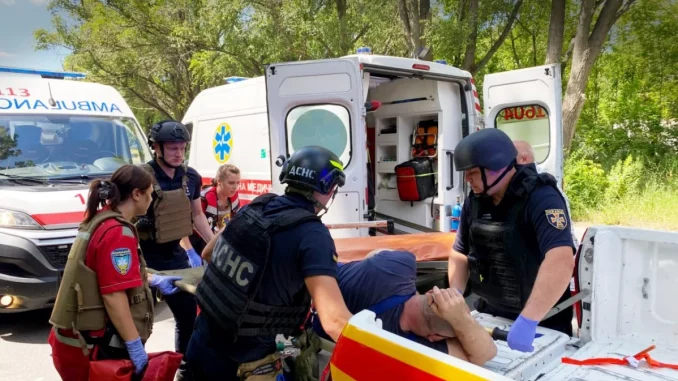
A rescue worker with paramedics move an injured man into an ambulance after a Russian drone strike on passengers minivan in Dnipropetrovsk region, Ukraine
Published June 30, 2026
KYIV, Ukraine — A wave of Russian missile and drone strikes across Ukraine has killed at least a dozen civilians and injured dozens more, underscoring the continued intensity of the war more than two years after Russia launched its full-scale invasion.
The coordinated attacks struck multiple cities including Dnipro, Zaporizhzhia, and Kharkiv, hitting residential areas, transportation vehicles, schools, and commercial buildings in what Ukrainian officials described as one of the latest large-scale aerial assaults on civilian-populated regions.
Widespread Strikes Across Major Cities
According to Ukrainian authorities, the deadliest impact was recorded in Dnipro, where a missile strike killed at least six people and injured nearly 30 others. The blast damaged homes, vehicles, and public infrastructure, leaving emergency crews searching through rubble for survivors.
In Zaporizhzhia, a drone strike targeted a passenger minibus, killing three civilians and injuring several others, including a child. Additional drone explosions in the area caused further injuries and damaged nearby buildings.
In Kharkiv, a glide bomb struck a residential district, killing at least one young woman and injuring multiple civilians. A second bomb reportedly failed to detonate, preventing further casualties but leaving authorities on alert for unexploded ordnance.
Civilian Infrastructure Under Pressure
The attacks also disrupted critical infrastructure across several regions. Ukrainian officials reported power outages in multiple areas following damage to energy systems, adding strain to an already fragile electricity grid that has been repeatedly targeted throughout the war.
Emergency services were deployed across all affected regions, working through destroyed buildings and damaged roads to evacuate civilians and restore basic services.
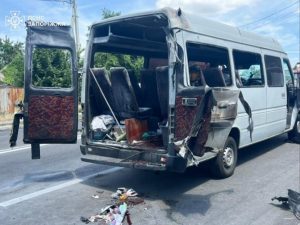


A rescue worker with paramedics move an injured man into an ambulance after a Russian drone strike on passengers minivan in Dnipropetrovsk region, Ukraine
Ukraine Calls for Stronger Air Defenses
Ukrainian President Volodymyr Zelenskyy condemned the attacks, calling them “horrific” and urging Western allies to strengthen Ukraine’s air defense systems.
Officials in Kyiv argue that improved interception systems are essential to counter Russia’s growing reliance on long-range drones and ballistic missiles, which have become central tools in the conflict.
Russia Continues Aerial Campaign Strategy
While Moscow has not issued detailed comments on the latest strikes, Russian forces have consistently maintained aerial bombardments as part of their broader war strategy.
Military analysts note that Russia has increasingly relied on combined missile and drone attacks to overwhelm Ukrainian air defenses, targeting both military and civilian infrastructure in sustained waves.
At the same time, Ukraine has expanded its own long-range drone operations, striking targets inside Russian territory and in occupied regions, signaling a growing symmetry in aerial warfare tactics.
Escalating War of Attrition
The conflict, now in its fifth year, has evolved into a war of attrition, characterized by slow-moving frontlines, heavy artillery exchanges, and intensified drone warfare.
Both sides continue to claim tactical gains while suffering significant losses, with no decisive breakthrough on the battlefield. Civilian populations on both sides remain exposed to periodic strikes that have reshaped daily life in affected regions.
Growing Humanitarian Strain
Humanitarian organizations continue to warn that repeated attacks on urban centers are increasing civilian casualties and straining emergency response systems.
Displacement, infrastructure damage, and energy shortages remain persistent challenges as winter and summer extremes further stress Ukraine’s damaged utilities network.
Outlook
With no peace agreement in sight, analysts say the war is likely to remain defined by aerial strikes, drone warfare, and localized ground battles, rather than large-scale territorial advances.
For civilians across Ukraine, each new wave of attacks reinforces the ongoing uncertainty of a conflict that shows little sign of slowing.
 Public / Political Reactions:
🇺🇦 Ukrainian Government Officials
Ukrainian leaders strongly condemned the latest wave of Russian missile and drone attacks, calling them deliberate strikes on civilian areas.
- President Volodymyr Zelenskyy described the attacks as “horrific” and emphasized that civilians continue to bear the heaviest cost of the war.
- Ukrainian officials reported that multiple cities—including Dnipro, Zaporizhzhia, and Kharkiv—were hit in coordinated strikes targeting residential zones and transport routes.
- Kyiv renewed calls for stronger Western air defense systems to counter increasing Russian drone and missile attacks.
➡️ Position: Ukraine views the strikes as intentional attacks on civilians and is urging expanded international military support.
🇷🇺 Russian Government Officials
The Russian government did not issue detailed public comments on the specific attacks, but has consistently defended its broader military operations.
- Moscow maintains that its strikes target military infrastructure and deny responsibility for civilian casualties.
- Russian officials continue to justify the campaign as part of their stated wartime objectives in Ukraine.
- The Kremlin has previously rejected accusations of targeting civilian populations, despite repeated international condemnation.
➡️ Position: Russia continues to deny intentional targeting of civilians and frames its operations as military necessity.
🇺🇸 United States Officials
U.S. officials have condemned the continued violence and reiterated support for Ukraine’s defense efforts.
- Washington has consistently called Russian missile and drone strikes “unacceptable” and a violation of international norms.
- U.S. policymakers continue advocating for expanded air defense assistance and long-term military aid to Ukraine.
- American officials emphasize that diplomatic pressure and sanctions remain key tools in responding to the conflict.
➡️ Position: The United States condemns the attacks and supports strengthening Ukraine’s defense capabilities.
🇪🇺 European Union Leaders
European leaders expressed concern over the continued targeting of Ukrainian cities.
- EU officials described the strikes as part of an ongoing pattern of attacks on civilian infrastructure.
- Several member states reiterated support for increased air defense systems for Ukraine.
- European leaders continue calling for accountability for violations of international humanitarian law.
➡️ Position: The EU condemns the attacks and supports continued military and humanitarian aid to Ukraine.
🌍 United Nations and International Community
International organizations stressed the humanitarian impact of continued strikes.
- The United Nations has repeatedly warned that attacks on civilians and infrastructure are prohibited under international law.
- Humanitarian agencies continue calling for protection of civilian populations and access for emergency aid.
- Global observers warn that escalating aerial warfare is worsening the humanitarian crisis.
➡️ Position: The international community urges restraint and emphasizes civilian protection under international law.
 Resulting Effects:
The latest wave of Russian missile and drone attacks across multiple Ukrainian cities has intensified both the humanitarian crisis and the military pressure on Ukraine, while also reinforcing the broader stalemate in the ongoing war. The strikes highlight how the conflict has increasingly shifted toward long-range aerial warfare targeting both infrastructure and civilian areas.
1. Rising Civilian Casualties and Humanitarian Strain
The attacks have added to the growing toll on Ukrainian civilians.
💔 Residential areas in cities like Dnipro, Zaporizhzhia, and Kharkiv were directly hit.
🏥 Emergency services are stretched as hospitals treat wounded civilians from multiple strikes.
🚑 Rescue operations continue in damaged neighborhoods, often under ongoing air raid threats.
➡️ Result: Continued strikes → increased civilian casualties and humanitarian pressure.
2. Greater Strain on Ukraine’s Infrastructure
Repeated missile and drone attacks are further damaging essential systems.
⚡ Power disruptions have been reported following strikes on energy infrastructure.
🏚️ Damage to homes, transport, and public buildings disrupts daily life in affected regions.
🔧 Ongoing repairs are difficult due to the frequency of new attacks.
➡️ Result: Infrastructure targeting → worsening disruption of civilian services.
3. Intensified Demand for Air Defense Systems
Ukraine’s leadership is increasing pressure on allies for advanced military support.
🛡️ Kyiv is calling for more air defense systems to intercept missiles and drones.
📦 Western partners are being urged to accelerate weapons deliveries.
📡 Defense analysts emphasize that interception capability is critical to reducing civilian harm.
➡️ Result: Escalating air attacks → stronger demand for air defense support.
4. Continued Military Stalemate on the Ground
Despite heavy aerial warfare, frontlines remain largely static.
⚔️ No major territorial breakthroughs have been reported in recent fighting.
📍 The war continues to resemble a prolonged war of attrition.
🪖 Both sides continue exchanging strikes without decisive gains.
➡️ Result: Ongoing strikes → battlefield stalemate persists.
5. Increased International Condemnation
The strikes have further strengthened global criticism of the war.
🌍 Western governments continue condemning attacks on civilian areas.
⚖️ International organizations stress violations of humanitarian law.
📢 Calls for accountability and investigations into war conduct continue to grow.
➡️ Result: Civilian impact → stronger international pressure and condemnation.
6. Escalation of Drone and Missile Warfare
The conflict is increasingly defined by long-range attacks.
🚀 Both sides are expanding drone operations and missile capabilities.
📡 Electronic warfare and air defense systems are becoming central to strategy.
⚠️ The risk of accidental escalation or miscalculation remains high.
➡️ Result: Technology-driven warfare → more frequent and widespread aerial attacks.
 Future Outlook:
The latest wave of Russian missile and drone attacks suggests that the war in Ukraine is likely to remain a prolonged and high-intensity conflict, with aerial warfare playing an increasingly central role. With no peace agreement in sight, both military strategy and diplomatic efforts are expected to continue evolving under sustained pressure.
1. Continued Reliance on Drone and Missile Warfare
The war is expected to remain dominated by long-range strikes.
🚀 Russia is likely to continue combining missile and drone attacks to overwhelm Ukrainian defenses.
🛡️ Ukraine will keep prioritizing interception systems to reduce civilian and infrastructure damage.
📡 Both sides are expected to expand electronic warfare capabilities.
➡️ Outlook: Aerial warfare → remains the defining feature of the conflict.
2. Persistent Battlefield Stalemate
Despite ongoing attacks, major frontline shifts remain unlikely in the short term.
⚔️ Frontlines in eastern and southern Ukraine are expected to remain largely static.
🪖 Both sides are likely to continue attritional warfare with limited territorial changes.
📍 Military gains will likely remain incremental and costly.
➡️ Outlook: Ground war → continued war of attrition with slow movement.
3. Increased Pressure on Ukraine’s Air Defense Needs
Ukraine’s defense requirements are expected to grow.
🛡️ Kyiv will continue requesting additional Western air defense systems.
📦 Military aid decisions from allies will remain critical to Ukraine’s defensive capacity.
🏭 Defense production in Western countries may become a key factor in sustaining support.
➡️ Outlook: Air defense → central focus of Ukraine’s war strategy.
4. Ongoing Civilian Risk Across Urban Areas
Civilians are expected to remain vulnerable to future strikes.
🏚️ Urban centers will continue facing periodic missile and drone attacks.
🚑 Emergency response systems will remain under strain due to repeated emergencies.
💔 Humanitarian organizations warn of prolonged psychological and physical impact on civilians.
➡️ Outlook: Civilian exposure → continued humanitarian crisis risk.
5. Limited but Ongoing Diplomatic Efforts
Diplomatic resolution remains uncertain.
🤝 International actors continue to encourage negotiations, but trust between parties remains low.
📄 No breakthrough peace framework is currently in place.
🌍 Diplomatic efforts are expected to focus on containment rather than resolution in the near term.
➡️ Outlook: Diplomacy → active but unlikely to produce immediate peace.
6. Long-Term Global Security Implications
The conflict continues to reshape global military and political dynamics.
🌍 Countries are reassessing air defense and drone warfare capabilities.
🛡️ NATO members remain on heightened alert due to regional spillover risks.
📊 The war is influencing global defense spending and security policy.
➡️ Outlook: Ukraine war → long-term impact on global security strategy.
 Bottom Line:
The ongoing Russia–Ukraine war continues to show no clear path toward resolution, with the conflict now defined less by territorial breakthroughs and more by sustained missile, drone, and artillery warfare across multiple fronts.
For Ukraine, each new wave of attacks reinforces the urgent need for stronger air defense systems and continued international military support, as civilian areas remain vulnerable to long-range strikes. For Russia, the continued aerial campaign reflects a strategy aimed at maintaining pressure on Ukraine while avoiding decisive ground offensives that could lead to heavy losses.
Despite intense daily fighting, the frontlines remain largely static, underscoring that the war has evolved into a prolonged conflict of attrition rather than rapid territorial conquest. Civilians continue to bear the heaviest burden, with repeated strikes disrupting infrastructure, homes, and essential services.
At the diplomatic level, meaningful peace negotiations remain distant, as both sides remain entrenched in their positions and trust is extremely limited. International actors continue to call for de-escalation, but no comprehensive framework for ending the war is currently in place.
For now, the reality is clear: the war is still active, still evolving, and still deeply unresolved — with uncertainty remaining the only constant for both soldiers on the frontlines and civilians living under the threat of repeated strikes.
SOURCES: AP NEWS – Zelenskyy condemns ‘horrific attacks’ as Russian strikes kill 12 and wound 40 in Ukraine