Published April 22, 2026
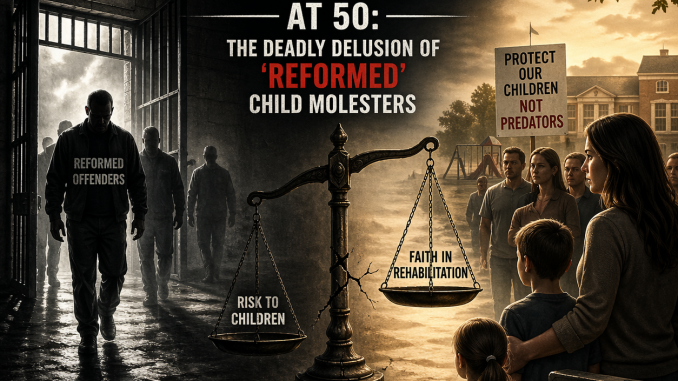
There is growing public concern around policies that allow convicted child sex offenders to be released after serving long sentences—sometimes around age 50 or earlier—based on the belief that they have been “rehabilitated” and are no longer a threat. Critics of this approach argue that this assumption is not supported by real-world risk patterns and could put communities in danger.
At the center of the debate is a difficult question: can someone convicted of sexually abusing children ever be safely considered “low risk” again after release?
The Policy Tension: Justice vs. Safety
At the center of this debate is a difficult balance between two goals that do not always align: giving people a second chance after they have served their sentence, and making sure the public—especially children—is protected from potential harm.
On one side, the justice system is built on the idea that sentences are meant to be served and that, over time, people can change. Supporters of release policies argue that if someone has completed their punishment, participated in treatment, and shown long-term compliance in custody, there should be a path back into society under supervision. From this view, rehabilitation is part of a fair system.
On the other side, critics argue that some crimes carry risks that do not simply disappear once a sentence is completed. They believe that when it comes to serious offenses involving children, the priority should shift more heavily toward prevention than reintegration. In simple terms, they see safety as something that cannot be compromised once trust has already been broken in a severe way.
Another tension is how decisions are made. Courts and parole boards rely on assessments, reports, and structured evaluations to decide whether someone is ready for release. Critics argue that these tools, while useful, are still predictions—not guarantees. And when the potential consequences involve vulnerable victims, they say predictions may not be enough.
There is also the emotional side of the issue. For families and communities, justice is not only about legal completion of a sentence—it is also about feeling secure afterward. Critics argue that even if a system considers a case “resolved,” the public may still feel the impact and worry about what happens next when someone is released.
At the same time, policymakers face pressure to manage prison populations and reduce long-term incarceration costs, which adds another layer to the decision-making process. Critics say this can sometimes influence release decisions in ways that compete with pure safety concerns.
🏁 The Final Word:
In simple terms, this debate comes down to how much risk a society is willing to accept when it lets someone with a serious history of harming children back into everyday life. Supporters of release policies may talk about rehabilitation, time served, and second chances—but critics focus on something more immediate and personal: what happens if the assessment is wrong?
For many families, this is not an abstract policy discussion. It becomes real when they think about children walking to school, playing outside, or living in neighborhoods where they assume safety is already guaranteed. The worry is not about punishment or revenge—it is about uncertainty. Once someone is released, the consequences of a mistake in judgment are not reversible.
Critics argue that the system is asking the public to trust predictions about human behavior that are inherently difficult to guarantee. Even with therapy, monitoring, and good behavior in prison, there is still a fear that risk assessments can miss something important. And when the offense involves children, even a small margin of error feels too large for many people to accept.
In personal terms, the concern is simple: most people are willing to believe in change, but they are not willing to gamble with the safety of children on that belief. For them, the question is not whether someone might be different after decades in custody, but whether society can afford to be wrong—even once.
-DCZ