
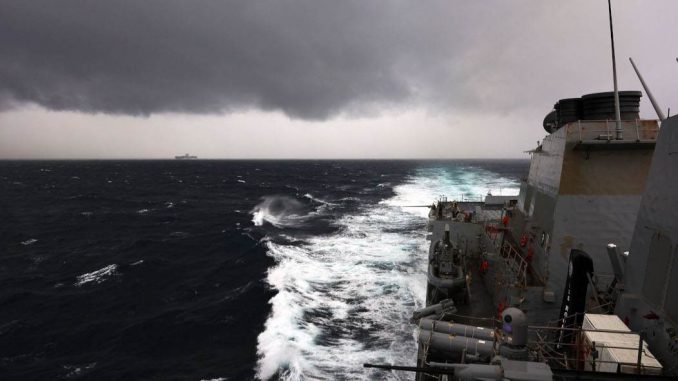
CREDIT: U.S. Navy photo by Mass Communication Specialist 1st Class Indra Beaufort
Published April 18, 2026
The already volatile situation in the Strait of Hormuz escalated sharply again Friday after Iranian officials announced the strategic waterway was closed once more, blaming the United States for allegedly violating a fragile ceasefire-style arrangement tied to maritime access.
The reversal comes just days after Tehran signaled a limited reopening of the Strait under strict conditions, a move that briefly calmed energy markets before fresh accusations and military tensions re-emerged.
The conflicting claims between Iran, Washington, and regional observers have now created a fast-moving geopolitical dispute where even the operational status of one of the world’s most important shipping lanes is being openly contested.
Iran: U.S. “Violation” Triggered Immediate Closure
Iranian officials said the decision to shut the Strait again was a direct response to what they described as continued U.S. naval enforcement actions and a failure to uphold the terms of the understanding governing maritime movement.
Tehran claimed the arrangement had been conditional from the beginning, arguing that limited access was contingent on reciprocal de-escalation steps — including reduced military pressure in the Gulf and a pause in what Iran characterizes as coercive enforcement measures.
Iranian statements further accused Washington of distorting the agreement, with officials insisting that the U.S. narrative of an “open Strait” did not reflect the actual operational conditions on the ground.
U.S. Response: Strait Remains Open, Pressure Will Continue
The Trump administration rejected Iran’s assertion that the waterway has been closed, maintaining that commercial shipping continues to move through the Strait under international navigation rules.
However, U.S. officials also confirmed that naval assets remain deployed in the region, citing the need to protect commercial shipping lanes and deter any disruption of global energy flows.
President Donald Trump reiterated that pressure on Iran would not be lifted, framing the U.S. posture as essential to maintaining stability and preventing strategic exploitation of the waterway.
At the same time, administration messaging has emphasized that Iran’s claims are part of a broader pattern of shifting interpretations designed to gain leverage during negotiations.
Competing Narratives Deepen Confusion
Live regional reporting, including updates from international broadcasters, has highlighted a growing divide in how the Strait’s status is being described.
Depending on the source, the Strait is being characterized as:
- Fully open to commercial shipping
- Partially restricted under security conditions
- Or effectively closed due to military and enforcement risks
This divergence has created uncertainty not only in diplomatic circles but also among shipping operators and insurance firms, who rely on stable and predictable access conditions.
Industry analysts note that perception alone is now influencing shipping decisions as much as physical access, given the risk of rapid escalation.
Regional Reporting: Blockade Pressure Still Central
Regional coverage indicates that despite alternating announcements, the underlying reality has not fundamentally changed: U.S. naval presence and enforcement operations remain a key factor shaping maritime behavior in the Strait.
Even when passage is technically permitted, commercial vessels reportedly face:
- Heightened security screening
- Route restrictions or advisories
- Insurance premium spikes
- Risk-based rerouting decisions
This has led some analysts to describe the situation as a “conditional access environment” rather than full normalization of shipping lanes.
Europe and Global Markets Watching Closely
European governments and international energy stakeholders are closely monitoring developments, particularly after earlier diplomatic efforts in Paris aimed at stabilizing maritime conditions.
Officials have expressed concern that repeated reversals — opening, partial reopening, and closure claims — risk undermining confidence in global supply chains.
Oil markets remain highly sensitive to each announcement, with prices reacting sharply to perceived changes in risk even when physical shipping volumes remain relatively stable.
Broader Stakes: Control, Credibility, and Escalation Risk
Beyond the immediate dispute, the crisis underscores several broader strategic tensions:
- Control over chokepoints: The Strait of Hormuz remains one of the most important leverage points in global energy trade.
- Credibility of agreements: Rapid reversals raise questions about how durable any maritime understanding can be under current conditions.
- Speed of escalation: Military and political signals are moving faster than diplomatic verification mechanisms.
- Information conflict: Competing official narratives are now shaping perception as much as physical reality.
🧩 Reading Between the Lines: Strait of Hormuz Crisis
What’s happening around the Strait of Hormuz isn’t just about ships, oil, or headlines saying “open” or “closed.” It’s really about control, leverage, and who gets to influence global energy flow when things get tense.
1. This Isn’t Just a Shipping Lane — It’s a Global Pressure Point
The Strait of Hormuz is one of the most important oil routes in the world. A huge portion of global oil passes through it. That means:
- If it slows down, oil prices go up fast
- If it gets blocked or “uncertain,” global trade feels it immediately
- Countries far away still get affected through fuel and inflation
So when you hear “open” or “closed,” it’s not just geography — it’s about global economic stability.
2. “Open” Doesn’t Always Mean Normal
Even when officials say the Strait is open, it doesn’t always mean everything is back to normal.
In simple terms:
- Ships may still need permission or follow strict routes
- There may still be military presence nearby
- Insurance companies still treat it as risky
So “open” can sometimes mean allowed, but not fully safe or stable.
3. The Real Issue: Who Controls the Rules
The deeper issue isn’t just whether ships can pass. It’s who sets the conditions.
If one country can:
- Turn access on or off
- Set rules for passage
- Influence shipping safety decisions
Then it holds a strong form of leverage over global trade without firing a shot.
That’s why every announcement around the Strait causes immediate global reaction.
4. Allies React, But Often After the Fact
European leaders and other partners often meet after major announcements to respond or coordinate.
But the pattern is:
- Something changes quickly in the region
- Markets react immediately
- Diplomatic meetings happen afterward
This creates the impression that events move faster than responses, especially in crises involving energy and shipping routes.
5. Leadership Messaging Becomes Part of the Conflict
When major leaders criticize alliances or question whether partners are doing enough, it becomes more than politics — it affects perception.
In simple terms:
- Strong words signal frustration with coordination speed
- Allies interpret it differently depending on perspective
- Adversaries watch for any sign of division or delay
So even statements about alliances become part of the strategic picture.
🔗 The Stakes: What’s Really at Risk
At first glance, the Strait of Hormuz situation looks like another round of political arguments and shifting announcements. But underneath all the headlines, the stakes are very straightforward: energy, stability, and control over one of the most important shipping routes in the world.
1. Energy Supply for the Whole World
A large share of the world’s oil moves through the Strait of Hormuz. That means:
- If traffic slows down, fuel prices can jump quickly
- If shipping becomes risky, everything from transport to goods becomes more expensive
- Even countries far away feel the impact through inflation
In simple terms: what happens there affects prices everywhere else.
2. A Narrow Waterway With Huge Power
The Strait is not wide or easy to replace. There are no simple alternatives that can handle the same volume of oil.
That creates a reality where:
- A single chokepoint carries global importance
- Any disruption creates immediate worldwide concern
- Control or influence over it becomes a major advantage
This is why even small changes in access or security cause big reactions.
3. “Open” Doesn’t Mean Risk-Free
Even when officials say the Strait is open, shipping companies still look at:
- Security risks
- Military activity in the area
- Insurance costs
- Sudden policy changes
So in practical terms, “open” can still mean uncertain and cautious movement, not normal business as usual.
4. Speed of Action Matters More Than Statements
One of the biggest issues in situations like this is timing.
- Events on the ground can change quickly
- Markets react instantly
- Governments and alliances often respond later
That gap between action and response creates uncertainty, and uncertainty itself becomes part of the problem.
5. Bigger Question: Stability vs. Pressure
At the core of everything is a simple question:
- Is the situation becoming more stable over time?
- Or is it being managed through pressure, warnings, and shifting conditions?
When stability depends on constant negotiations and changing rules, it becomes harder for businesses, markets, and governments to plan ahead.
🏁 The Final Word:
In simple terms, the Strait of Hormuz situation shows how much the world still depends on a single, narrow waterway to keep energy and trade moving. When that route becomes uncertain—whether through political disputes, military presence, or shifting announcements—everything from fuel prices to global shipping stability feels the impact quickly. The bigger concern is not just who says it is open or closed, but whether access is truly stable, predictable, and backed by real security on the ground. When that stability is in question, markets react, countries adjust, and everyday costs can rise, showing how a small chokepoint can create big worldwide consequences.
SOURCES: REDSTATE – Iranian Official Says Strait of Hormuz Is Closed Again Because Trump Violated the Deal
AL JAZEERA – Hormuz Strait shut down again over US ‘piracy’, says Tehran
DAILY SABAH – Iran says closed Hormuz again over US naval blockade



The IRGC’s Hormuz blunder will go down in history
Mahdism: The Religious Cult of Iran’s Rulers
US Prepares To Board Iran-Linked Ships Globally Following Iranian Gunboat Attack On Tanker In Hormuz
“No More Mr. Nice Guy”: Trump Sends Witkoff To Pakistan For U.S.-Iran Talks As Hormuz Traffic Freezes
Iran’s dire Strait of Hormuz