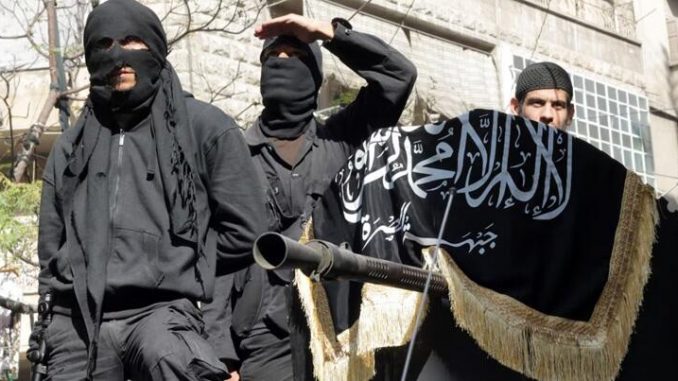
The precursor to Jolani’s Hay’at Tahrir al-Sham was the Syrian AQ group Al-Nusrah Front, via CBC
Published December 7, 2025
On December 5, 2025, the Canadian government announced it had officially removed Syria from its list of foreign states that support terrorism and rescinded the terrorist designation of Hay’at Tahrir al-Sham (HTS).
In a joint statement, Canada’s Foreign Affairs and Public Safety ministries said the decision followed an “extensive review” and noted that it aligns with similar moves by key allies, including the United Kingdom and the United States. Ottawa cited what it described as “positive steps” by Syria’s transitional government toward political stability and international cooperation.
HTS, once a dominant rebel group in Syria’s civil war, has a long history of links to extremist networks. Since the collapse of the previous Syrian regime in late 2024, the group has reportedly become the de facto ruling authority in Damascus. In recent months, the new leadership has taken steps to restructure militias, claim political transition, and promote what it calls a more moderate and inclusive government.
Canada’s decision to delist HTS follows a similar path taken by other Western nations, which have recognized that the political reality on the ground in Syria has shifted. Official statements highlight that the group’s role in Syria’s governance was a key factor in reassessing its designation.
The move has drawn attention from both media and analysts, with some describing it as “very belated” given HTS’s prominent role in the Syrian government. Critics point to the group’s extremist origins, while supporters frame the delisting as a recognition of the changing political landscape in Syria.
 Implications
1. Diplomatic and Geopolitical Implications
-
Western Engagement with Syria: Canada aligning with the U.S. and U.K. signals a willingness to re-engage diplomatically and potentially economically with Syria’s new leadership, opening doors for reconstruction aid and international cooperation.
-
Legitimacy for HTS: Delisting implicitly acknowledges HTS as Syria’s de facto ruling authority, giving the group political legitimacy on the international stage despite its extremist history.
-
Shift in Alliances: This move may encourage other Western or regional powers to reconsider their stance toward Syria, potentially isolating nations that continue to treat HTS as a terrorist organization.
2. Security Implications
-
Counterterrorism Risks: Critics argue that removing HTS from the list may reduce legal and financial tools available to monitor or sanction the group, creating loopholes for extremist activities.
-
Precedent for Other Groups: This action could set a precedent where militant groups rebrand themselves to gain legitimacy, complicating global counterterrorism efforts.
-
Intelligence Challenges: Governments will need enhanced intelligence efforts to ensure that the rebranding is genuine and not a cover for continued extremist operations.
3. Economic Implications
-
Sanctions and Aid: Lifting terror designations allows for normalized trade, investment, and aid flows into Syria, which could accelerate reconstruction and humanitarian support.
-
Foreign Investment: Companies may now feel safer engaging with Syria without fear of violating terrorism-related laws, though reputational risks remain.
4. Legal and Domestic Implications
-
Canadian Legal Adjustments: Canada must revise laws and regulations that relied on HTS’s terrorist designation, affecting law enforcement and financial compliance frameworks.
-
Public Perception: Domestic critics may view this as politically expedient but morally questionable, potentially raising public concern about prioritizing geopolitics over counterterrorism principles.
5. Regional Implications
-
Middle East Dynamics: Neighboring countries, particularly those previously affected by HTS or Syrian instability, may feel threatened by the legitimization of a formerly extremist group.
-
Proxy Conflicts: Regional actors could adjust their strategies, either engaging with Syria’s new leadership or bolstering opposition to it, influencing proxy conflicts.
6. Humanitarian Implications
-
Access for Aid Groups: Reduced designation restrictions may allow NGOs and UN agencies greater access to provide aid in HTS-controlled areas.
-
Civilians at Risk: If the group fails to maintain a genuine moderation path, civilians may continue to face instability or exploitation by armed actors.
 Overall Takeaway:
Canada’s belated decision to remove HTS from its terrorist list is a stark reminder that Western governments often prioritize political expediency over principle. By effectively legitimizing a group with a long history of extremist violence, Ottawa risks sending a dangerous message: that rebranding alone can erase decades of terror.
While proponents may argue this opens doors for diplomacy and reconstruction, the reality is that security and common-sense foreign policy should come first. HTS’s past actions cannot be ignored, and normalizing their rule without robust safeguards invites both domestic and international risks. Canada’s move may be viewed as a weak concession to geopolitical pressures rather than a principled stand against terrorism — a cautionary tale in a world where strength and moral clarity often matter more than bureaucratic reassessments.
SOURCES: THE ZEROHEDGE – Embarrassing: Canada Very Belatedly Removes Syria’s Ruling HTS From Terror List
MIDDLE EAST MONITOR – Canada removes Syria from state sponsors of terrorism list