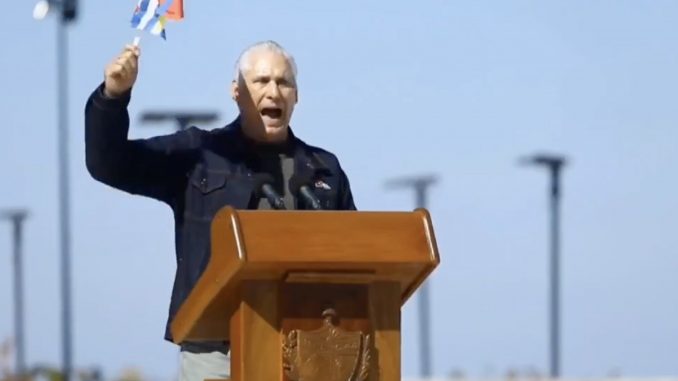
Cuban dictator Miguel Díaz-Canel rants just steps from the U.S. Embassy in Havana in January
Published March 18, 2025
Cuban President Miguel Díaz-Canel has issued a strong warning that Cuba will resist any form of external aggression, as tensions between Cuba and the United States continue to escalate in 2026.
In recent statements, Díaz-Canel emphasized that any attempt to interfere with Cuba’s sovereignty would be met with what he described as “impregnable resistance.” This message comes amid increasingly aggressive rhetoric from U.S. leadership and ongoing economic pressure on the island.
Escalating U.S.–Cuba Tensions
The situation has intensified following remarks by U.S. President Donald Trump, who suggested the possibility of major action against Cuba and even hinted at taking control of the country in some form.
At the same time, U.S. policies—including sanctions and an oil blockade—have significantly impacted Cuba’s already fragile economy. These measures have contributed to widespread blackouts, fuel shortages, and growing hardship among the Cuban population.
Cuba’s Response: Sovereignty and Defiance
Díaz-Canel has consistently rejected U.S. pressure, insisting that Cuba will not accept foreign dictates. His government frames the crisis as the result of long-standing U.S. economic restrictions rather than internal policy failures.
He has also stressed that Cuba is prepared to defend itself if necessary, echoing earlier statements that the country would fight “to the last drop of blood” against foreign intervention.
Ongoing Crisis Inside Cuba
The geopolitical tensions are unfolding alongside a deep domestic crisis. Cuba is currently facing:
- Severe energy shortages and nationwide blackouts
- Food scarcity and inflation
- Growing public unrest and protests
Recent demonstrations have been driven largely by power outages and economic hardship, highlighting the strain on everyday life in the country.
Diplomatic Efforts Continue
Despite the heated rhetoric, there are signs of limited diplomatic engagement. Cuban officials have confirmed that discussions with the United States are taking place, aimed at addressing the energy crisis and broader tensions—though progress remains uncertain.
 Implications Cuba’s Defiance Against U.S. Pressure
Cuba’s recent statements, with President Miguel Díaz‑Canel pledging “impregnable resistance” if the United States attempts to interfere, carry several important consequences:
1. National Security Concerns
Any aggressive rhetoric from Cuba highlights the risk of a direct confrontation in the Caribbean. Policymakers in Washington and U.S. allies in the region may need to prepare for scenarios that could escalate rapidly, ranging from cyber disruptions to maritime incidents.
2. Geopolitical Signaling
Díaz‑Canel’s strong language signals that Cuba intends to remain aligned with partners who oppose U.S. influence. This could embolden other authoritarian regimes to resist diplomatic pressure, weakening U.S. leverage in global negotiations and emboldening adversaries.
3. Energy and Economic Vulnerabilities
Cuba’s economy is already fragile due to sanctions, blackouts, and food shortages. A hardline stance risks worsening humanitarian conditions, but also serves as a warning to external actors that any attempt to impose change will have costs—both economic and political—on those involved.
4. Impact on Regional Stability
Heightened tensions in Cuba can ripple across the Western Hemisphere. Neighboring nations may face increased refugee flows or political friction if U.S.–Cuba relations deteriorate further. The stance signals that Cuba may resist compromise, complicating diplomatic solutions.
5. Domestic Messaging and Regime Survival
By framing the U.S. as an external threat, the Cuban government strengthens internal cohesion and legitimizes strict control measures. This strategy is often aimed at preventing domestic unrest from undermining the regime, even while the population suffers shortages and economic hardship.
6. U.S. Strategic Calculations
For policymakers and security planners, Cuba’s defiance suggests that any attempt to pressure or influence the island will require careful weighing of costs versus outcomes. Military intervention is framed as extremely risky, while sanctions or negotiations remain the primary levers of influence.
 Overall Takeaway:
Cuba’s declaration of “impregnable resistance” underscores the high stakes in the region. The United States faces a complex challenge: applying pressure without triggering a direct confrontation, while navigating the humanitarian and economic fallout on the island. Díaz‑Canel’s rhetoric reinforces the need for measured, strategic approaches that protect national interests, uphold stability in the Western Hemisphere, and deter further authoritarian assertiveness. The situation serves as a reminder that firm resolve and clear policy planning are essential when dealing with regimes that prioritize defiance over dialogue.
SOURCES: THE GATEWAY PUNDIT – Cuban Communist Dictator Miguel Dias-Canal Vows to Resist US Pressure with “Impregnable Resistance” if US Announces Plans to Seize the Country
THE NEW YORK POST – Cuba will fight to ‘the last drop of blood’ after Trump’s warning to make a deal: ‘No one dictates what we do’
APA – Cuban president promises ‘impregnable resistance’ to any US attempt to control island