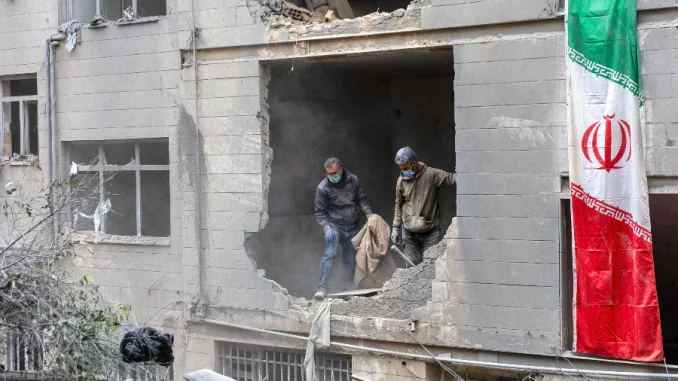
People clear rubble in a house in the Beryanak District of Tehran this month after it was damaged by missile attacks. (Getty)
Published March 24, 2026
The Middle East conflict involving the United States, Israel, and Iran took a dramatic turn this week as Iran launched new waves of missile strikes against Israel, even as the U.S. insisted it was making diplomatic progress toward ending the war — a claim that Tehran has formally denied.
New Missile Attacks Intensify Conflict
On Tuesday, Iranian forces fired multiple ballistic missiles and drones into Israeli territory, targeting major urban centers including Tel Aviv and prompting air raid warnings across the country. While some missiles were intercepted, others caused reported damage and injuries, underscoring the ongoing severity of the conflict.
Israeli defense forces responded with airstrikes on Iranian-backed positions, particularly in Lebanon against Hezbollah, as part of a broader regional engagement that shows little sign of de-escalation.
Trump Says Talks Are Underway
At the White House, U.S. President Donald Trump asserted that Washington was making headway in trying to end hostilities with Tehran, saying the U.S. was in “negotiations right now” with influential Iranian contacts and that Iran had made an important concession related to energy and the strategic Strait of Hormuz. He framed this as progress toward a broader settlement plan aimed at halting the wider regional war.
According to U.S. officials and media reports, Washington has reportedly shared a 15-point peace proposal with Iran, which may be discussed under a proposed 30‑day ceasefire window. The plan — not publicly released but widely reported — is said to include demands to dismantle Iran’s nuclear program, curb support for regional proxy militias, and reopen the vital shipping route through the Strait of Hormuz.
Iran Officially Rejects Negotiation Claims
In stark contrast to the U.S. narrative, Iran’s leadership has vehemently denied that any formal negotiations are taking place. Tehran’s parliament speaker, Mohammad Baqer Qalibaf, dismissed talk of direct U.S.–Iran talks as “fake news” intended to influence global markets and obscure ongoing military actions. Iran states that it has not engaged in genuine diplomatic contacts and has continued its military posture.
Additional reporting confirms Iran’s rejection of negotiation claims, with Iranian officials demanding guarantees regarding an end to conflict, reparations, and security guarantees before any substantive talks could begin — a high bar that has left mediation efforts fragile and highly uncertain.
Regional Mediation Efforts
Despite these denials, several regional actors — including Pakistan, Turkey, and Egypt — have offered to act as intermediaries and host potential talks, reflecting broader international concern over the widening conflict. Islamabad, in particular, has publicly stated it is ready to host peace discussions if both sides agree.
However, most analysts view the likelihood of direct, substantive negotiations as remote given the deep mistrust between the parties and Iran’s firm rejection of U.S. demands. Israeli officials have also expressed skepticism, arguing that U.S. and Iran positions remain far apart.
Global and Economic Impact
The ongoing conflict and uncertainty over peace prospects have sent oil prices surging and shaken global markets, while supply disruptions through the Strait of Hormuz continue to alarm energy analysts and national governments alike.
🔍 Analyst Insight:
Analysts see the current situation as a complex interplay of diplomatic outreach and battlefield realities:
- Diplomatic Gesture vs. Military Reality: The U.S. peace plan aims to offer Tehran a negotiated way out of the conflict, but Iran’s missile attacks suggest that hardline elements within the Iranian leadership remain focused on leveraging military pressure rather than bargaining.
- Mixed Signals Under Stress: Tehran’s public denial of negotiations—contrasted with reports of backchannel mediation—reflects internal political pressures and a negotiating posture designed to preserve strategic autonomy.
- Strategic Leverage: Iran’s continued missile launches keep pressure on both Israel and the United States, complicating diplomatic efforts even as global demand grows for a cessation of hostilities.
👥 Human Element:
The ongoing conflict has serious consequences for civilians and military personnel alike:
- Israeli civilians in major cities such as Tel Aviv and Jerusalem have faced missile barrages and air‑raid alerts, leading to injuries and disruptions in daily life.
- Iranian citizens have endured retaliatory U.S. and Israeli strikes on military infrastructure, continuing fears of escalation and domestic instability.
- Regional populations, including in neighboring countries, face displacement, economic hardship, and heightened insecurity amid sustained hostilities.
🎯 Conclusion:
The United States’ effort to propose a structured peace plan represents a strategic attempt to end a costly and destabilizing conflict through diplomacy paired with pressure on Iran’s nuclear and missile ambitions. Yet Tehran’s public dismissal of negotiation reports and its continued missile attacks on Israel highlight the significant obstacles to achieving a negotiated end to the war. The dual tracks of military engagement and diplomatic outreach underscore the profound mistrust between the parties and the difficulty of navigating a path to peace that addresses security concerns on all sides. As the world watches, the success or failure of these diplomatic efforts will shape not only the future of Middle East hostilities but also broader global priorities, from economic stability to strategic alliances.
SOURCES: NEWSMAX – US Has Sent Iran a Peace Plan Via Mediators, Sources Say
REUTERS – Trump cites progress with Iran, US reported to propose plan to end war
AL JAZEERA – Pakistan ‘ready to host US-Iran talks’: Can latest peace push work?
ECONOMIC TIMES – Iran dismisses Trump’s claim of talks on total resolution as ‘fake news’, accuses market manipulation