
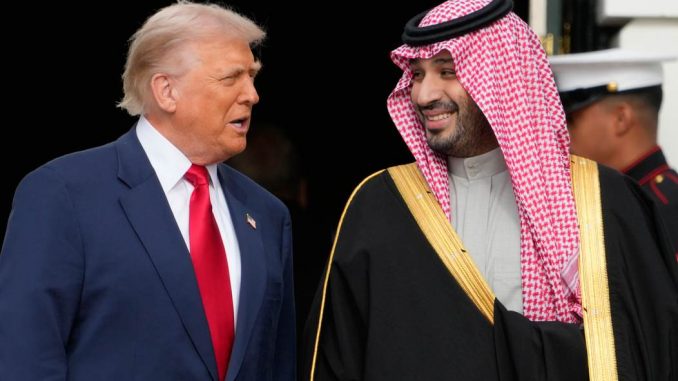
US President Donald Trump with Saudi Crown Prince Mohammed bin Salman. Photo Credit: The White House, X
Published March 24, 2026
Amid the ongoing Middle East conflict triggered by the U.S.–Israeli military campaign against Iran, Saudi Arabia’s Crown Prince Mohammed bin Salman has reportedly been pressing former U.S. President Donald Trump to maintain and even intensify the military offensive — known as Operation Epic Fury — against Tehran.
Push for Continued Military Action
Sources familiar with private discussions between the two leaders say that the Saudi Crown Prince views the U.S.‑led campaign not merely as a defensive response, but as a “historic opportunity” to reshape the balance of power in the Middle East. According to Townhall, bin Salman told Trump that the war provides a chance to decisively weaken — or even topple — Iran’s hard‑line government, which Riyadh has long regarded as a destabilizing force in the region.
Similarly, Eurasia Review reported that the crown prince has privately urged Trump to intensify strikes on Iranian targets as part of this effort — a stance that underscores Saudi Arabia’s anxiety over Iran’s strategic ambitions and its ongoing missile and drone attacks across the Gulf.
Saudi Position and Official Denials
Despite these reports, Saudi officials have publicly denied that bin Salman has pushed Trump to escalate the campaign. Riyadh maintains that its priority remains defense and stability, emphasizing diplomatic engagement and the protection of Gulf civilian infrastructure against Iranian strikes. According to a statement cited by Townhall, Saudi Arabia insists that it has consistently supported peaceful resolution efforts, even as it coordinates with the U.S. regarding defense cooperation.
Context: Operation Epic Fury
Operation Epic Fury — launched by U.S. and Israeli forces on February 28, 2026 — began with a series of intense aerial strikes on Iranian military infrastructure and leadership targets, reportedly including the killing of Supreme Leader Ayatollah Ali Khamenei early in the campaign. This offensive has drawn Iran into a broader conflict involving multiple fronts across the region.
Iran has responded with waves of missile and drone strikes into Israel, Iraq, Kuwait and other Gulf states, including Saudi Arabia — which has seen missile and drone attacks against cities and critical infrastructure. This retaliation has intensified concerns in Gulf capitals and has raised questions about the potential for the war to widen further.
Regional & Geopolitical Stakes
Saudi Arabia’s reported encouragement for the U.S. to persist in Operation Epic Fury reflects deep, long‑standing rivalries with Iran. Riyadh views the Iranian regime as a strategic threat — both militarily and ideologically — and believes that weakening Tehran’s influence could reinforce Saudi security and regional stability in the long run.
However, continued escalation carries significant risks. Gulf leaders have publicly expressed concerns about retaliation and broader regional destabilization, including threats to energy infrastructure and global oil markets if the conflict intensifies. Moreover, diplomatic efforts and mediation efforts by countries like Turkey, Egypt, and Pakistan are still being explored in hopes of limiting further bloodshed and economic disruption.
U.S. Internal Dynamics & Trump’s Messaging
While Trump has continued to voice support for strong military action against Iran — at times declaring progress toward conflict objectives — his statements have been mixed in tone, sometimes suggesting diplomatic openings even as military operations proceed. Analysts note this dual messaging reflects broader debate within U.S. policy circles about the goals and endgame of Operation Epic Fury.
🔍 Analyst Insight:
The call by the Saudi Crown Prince reflects a calculated strategy in a high-stakes geopolitical environment. Experts argue that sustaining military pressure on Iran is a strategic necessity, not an option.
Key Points:
- Decisive action strengthens deterrence: Analysts note that Tehran is unlikely to curb aggressive behavior without clear consequences. Continuing Operation Epic Fury signals resolve to both allies and adversaries.
- Maintaining credibility: U.S. commitment to Saudi and Israeli security underlines a willingness to act on threats, reinforcing long-term strategic influence in the Gulf.
- Reducing future risk: By keeping Iran on the defensive, leadership potentially shortens the overall conflict, minimizing the chances of broader escalation or regional destabilization.
👥 Human Element:
Beyond strategic calculations, the ongoing conflict has profound human consequences. Civilians in Israel, Saudi Arabia, and neighboring Gulf states face direct threats from missiles, drones, and disrupted infrastructure. Understanding this human dimension highlights why firm action is seen as necessary.
Key Points:
- Protecting civilians: Escalation is framed as a means to safeguard lives by deterring further attacks and weakening Iran’s operational capabilities.
- Stability in daily life: Strong military pressure helps secure energy, food, and medical supplies by keeping critical infrastructure protected.
- Shortening the conflict: Advocates argue that a decisive approach now could reduce long-term casualties and disruption, rather than prolonging uncertainty with stalled diplomacy.
🎯 Conclusion:
The Crown Prince’s urging illustrates a broader principle: in regions where adversaries actively threaten allies, decisive measures are often the most effective safeguard. By intensifying Operation Epic Fury, leadership prioritizes the protection of key partners, the security of vital infrastructure, and the message that aggression carries consequences. While diplomacy remains part of the long-term solution, firm military pressure reflects a pragmatic approach to defending national interests and ensuring regional stability in the face of continued threats.
SOURCES: TOWNHALL – The Crown Prince of Saudi Arabia Urges Trump to Continue Operation Epic Fury
EURASIA REVIEW – Saudi Crown Prince Reportedly Urges Trump To Intensify Strikes On Iran




