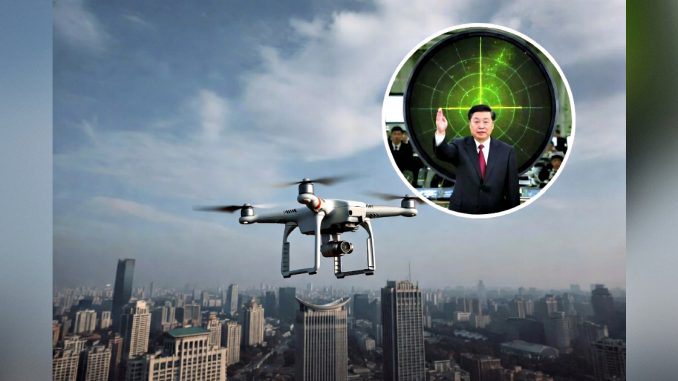
AI-Generated image by Grok
Published April 6, 2026
China is tightening its grip on unmanned aerial vehicles across the country — even as its drone industry has grown into one of the largest in the world. In recent weeks, authorities in the Chinese capital and across major cities have moved to sharply restrict drone operations, placing strict limits on sales, storage, transport, and flight without prior approval amid rising low‑altitude security concerns. Critics say the moves reflect Beijing’s desire for control rather than a genuine public safety threat.
According to recent reporting, Beijing’s new regulations prohibit the sale or lease of drones and 17 “core components” within large swaths of the city’s airspace unless operators receive public security authorization. Individuals may not store more than a small number of drones or parts at a single location, and unapproved devices are barred from entering the city altogether. These limits take effect May 1 and cover an area roughly three times the size of Singapore. Lawmakers justified the changes by citing “low‑altitude security” concerns as unmanned aircraft use expands.
From Industry Powerhouse to Controlled Skies
China is already home to major drone manufacturers and a booming unmanned aerial vehicle (UAV) sector. These systems are used in myriad roles, from deliveries to surveillance and even military applications. But as the technology proliferates, Beijing appears increasingly intent on controlling how drones are used and by whom.
Recent rules require real‑name registration and permits, and some jurisdictions — including Beijing — have effectively made the city a no‑fly zone for recreational or unauthorized drones. Operators must link their devices to official identification, and real‑time flight data may be transmitted to authorities. This has chilled flying activity by hobbyists and small operators, even as larger economic plans seek to harness drone technology for logistics and services.
At the same time, China overhauled its Civil Aviation Law late last year to formally bring UAVs under the national aviation framework, requiring certification and identification codes for certain classes of drones. This marks a significant shift in how unmanned systems are regulated as part of a rapidly developing “low‑altitude economy.”
“The Ministry of Public Security said that tighter regulations were necessary to protect public safety, noting the risks of drone information systems being hacked as well as incidents in which drones had flown at a high altitude, even threatening civil aviation safety. It cited a case in which it said an operator had flown a drone within 800 meters, or about 2,600 feet, of a civil aircraft, and another in which it said a user had flown a drone into a no-fly zone near an airport to film planes’ landing paths. Last year, two drones collided midair and crashed onto a Shanghai skyscraper.”
Security or Control? Debate on the Ground
Government officials argue the clampdown is necessary to maintain safety and order in increasingly crowded skies over cities and transportation hubs. But many observers see a broader motive — one where control and surveillance take precedence over innovation and freedom of use. Critics point to detentions and fines for what would be minor infractions elsewhere, and reports that some urban centers have effectively become no‑fly zones for civilian drones.
This shift comes as drone technology plays a role in military posture in the region — including surveillance flights and aerial exercises — even as Beijing tightens regulatory controls at home.
🔍 Critical View: Innovation Constrained by Control
China’s sweeping new drone regulations highlight a tension between technological progress and state control. Once celebrated as a global leader in unmanned aerial systems, the country is now actively restricting how drones can be sold, flown, and even stored. The question is whether these measures truly serve public safety — or whether they reflect a preference for surveillance and centralized authority over innovation.
When Safety Becomes Control
Beijing cites “low-altitude security” as the justification for banning unregistered drones and limiting civilian access. On the surface, concerns about airspace safety and urban congestion are valid. But the scope of restrictions — prohibiting sales of core components and limiting storage — goes far beyond standard safety measures. It effectively places the airspace under complete state control.
Impact on Innovation and the Market
China’s domestic drone industry, once a symbol of technological prowess, now faces limitations that stifle competition and experimentation. Hobbyists, entrepreneurs, and smaller businesses are caught in a web of bureaucratic requirements, while state-aligned enterprises retain relative freedom. This centralization risks slowing innovation and redirecting resources toward projects favored by the government rather than the market or public demand.
Military and Strategic Implications
The crackdown also raises strategic questions. While civilian drones are restricted, the military and security sectors retain access to advanced technology. Critics argue that this creates a dual system: public innovation is constrained, while the state can expand its surveillance and tactical capabilities with fewer limits.
👥 On the Ground: Flying Under Strict Rules
On the streets and rooftops of Beijing, the new drone regulations are already reshaping daily life for hobbyists, businesses, and delivery operators. What was once an open and expanding space for innovation is now tightly controlled, with airspace effectively monitored and restricted by the state.
Every Flight Requires Permission
Operators must now register drones to their real identities, obtain permits for even short flights, and ensure every component is approved. For hobbyists, a simple recreational flight can trigger fines or confiscation. For businesses, delivery and survey operations face bureaucratic hurdles that slow deployment and limit growth.
Innovation Meets Red Tape
Local entrepreneurs and tech enthusiasts report frustration as regulations restrict experimentation and small-scale innovation. New drone models and prototypes are subject to government scrutiny, reducing the ability to test or operate freely. What was once a vibrant low-altitude economy is increasingly a space where only authorized entities can act.
Safety or Surveillance?
While authorities cite low-altitude safety as the justification, many observers note that the measures also serve as a tool for centralized control. Surveillance, monitoring, and limitation of independent operation suggest that the skies are as much about state oversight as public safety.
🎯 The Final Word:
China’s crackdown on drones illustrates a stark trade-off between technological advancement and centralized control. What was once a thriving sector — driving innovation, business, and practical applications — is now restricted by strict rules and heavy oversight.
The real impact is clear on the ground: hobbyists, entrepreneurs, and small businesses face hurdles that slow progress, while the state retains almost total control over who can operate in the skies.
This situation highlights a broader lesson: when security and control are prioritized over freedom and innovation, even a leading technology sector can become constrained, limiting opportunities and shaping the environment according to the state’s priorities rather than the public’s potential.
SOURCES: THE GATEWAY PUNDIT – NO-FLY ZONE: China is Dominant in Today’s Drone Industry – But It’s Tightening Penalties for Civilian Operators To Include Prison Time
SOUTH CHINA MORNING POST – Beijing tightens drone rules, citing ‘low-altitude security’ concerns