
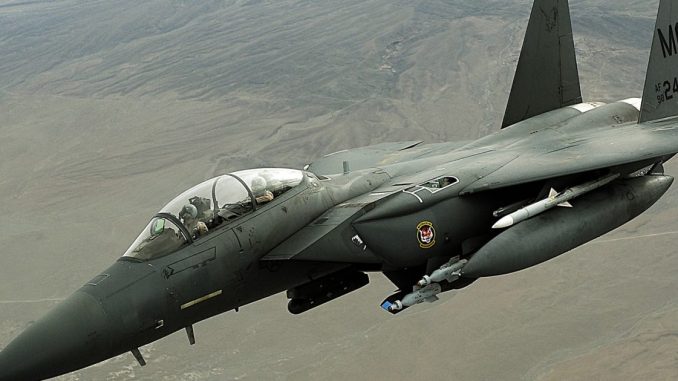
An F-15E Strike Eagle flying over Afghanistan. Credit: U.S. Air Force/Wikimedia Commons
Published April 5, 2026
New details are emerging about the condition and status of the U.S. airman rescued from deep inside Iran following one of the most high-risk military operations in recent history.
The airman — a weapons systems officer aboard a downed F-15 fighter jet — has now been safely evacuated from hostile territory and is receiving medical treatment after surviving days behind enemy lines.
Injured but Expected to Recover
According to U.S. officials, the airman sustained injuries during the crash and subsequent evasion but is expected to recover. After being extracted from Iran, he was transported to a secure location in the region — widely reported to be Kuwait — where he is now under medical care.
President Donald Trump confirmed the rescue and reassured the public that the airman “will be just fine,” describing the mission as one of the most daring in U.S. military history.

The daring raid involved hundreds of special ops forces.
Survival Against the Odds
Before the rescue, the airman endured nearly two days hiding in mountainous terrain while evading Iranian forces and local groups reportedly incentivized to capture him. He relied on elite survival training, limited equipment, and constant movement to avoid detection.
At times, Iranian search teams were closing in, prompting urgent action from U.S. forces. Intelligence and deception tactics were used to mislead pursuers and buy critical time for the rescue operation.

Wreckage shown at the apparent site of the downed American transport plane and two helicopters involved in a rescue operation, in Isfahan province, Iran, April, 2026.
Massive Rescue Operation
The recovery effort involved dozens of aircraft, special operations forces, and intelligence assets working in coordination. U.S. forces engaged hostile elements during the mission, with helicopters taking fire and aircraft providing cover from above.
To prevent sensitive technology from falling into enemy hands, some U.S. equipment used during the mission was destroyed after the extraction was complete.
Despite the intense conditions, the operation was completed without American fatalities.

Map detaining the rescue plan to save the lost airman.
A Strategic and Symbolic Victory
The successful rescue is being seen as both a military and political win amid a broader and escalating conflict with Iran. It avoided what could have become a major crisis had the airman been captured and demonstrates the U.S. military’s commitment to recovering its personnel.
Both crew members from the downed aircraft have now been safely recovered, marking a rare instance of two separate rescues conducted deep inside hostile territory.
🔍 Critical View: A Successful Rescue — But a Risk That Shouldn’t Be Routine
The successful recovery of the downed F-15 airman is being rightfully celebrated as a remarkable achievement. It showcased precision, coordination, and the unmatched capability of U.S. forces to bring their own home under extreme pressure. But beyond the success lies a deeper concern: why are such high-risk recoveries becoming necessary in the first place?
Heroism Cannot Replace Strategy
There is no question the airman’s survival was extraordinary. Hiding in mountainous terrain, evading search teams, and enduring injury while awaiting rescue speaks to the highest level of training and discipline. The rescue operation itself — involving multiple assets and forces — demonstrated elite execution.
But relying on heroism and last-minute precision should not become the standard operating condition. When missions place personnel deep inside hostile territory, the margin for error disappears, and the consequences become immediate and severe.
An Expanding Threat Landscape
What makes this incident particularly troubling is the environment in which it unfolded. Reports that local groups were incentivized to capture the airman highlight a shift in how conflicts are fought. The battlefield is no longer confined to military forces; it now includes irregular actors, making evasion far more difficult and recovery operations far more dangerous.
This kind of environment amplifies risk in ways that cannot always be controlled, even with superior technology and training.
Operational Strength vs. Strategic Exposure
The U.S. military proved it can execute under pressure. But execution alone cannot offset exposure. Each mission that pushes deeper into contested territory increases the likelihood of incidents like this — where a single setback triggers a chain of high-risk responses.
The issue is not capability; it is the level of risk being accepted. Success in recovery should not overshadow the conditions that made recovery necessary.
👥 On the Ground: Survival, Evasion, and Extraction in Hostile Terrain
On the ground in Iran, the reality for the downed F-15 airman was immediate and unforgiving. Injured, isolated, and deep inside hostile territory, he had only minutes to disappear before search teams began closing in. The mountains became his only cover — a harsh environment where survival depended on instinct, training, and constant movement.
Hiding in Plain Sight
Using rugged terrain to his advantage, the airman reportedly sheltered in crevices and high-altitude areas, staying out of sight while Iranian forces and armed groups combed the region. With limited supplies and no guarantee of immediate rescue, every decision carried weight — when to move, when to stay hidden, and how to avoid detection.
This was not just a matter of waiting to be found. It was an active effort to remain invisible in a landscape filled with threats from multiple directions.
A Growing Threat Environment
What made the situation more dangerous was the nature of the search. Reports indicated that local militias and civilians were encouraged to assist in locating the airman, turning the surrounding area into a wide and unpredictable network of potential pursuers.
This type of environment leaves no clear front line. The threat is constant, and the margin for error is almost nonexistent.
The Race to Extraction
As time passed, the risk of capture increased. U.S. forces had to act quickly, launching a complex rescue mission under pressure. Helicopters and special operations units moved in while providing cover against potential enemy engagement.
Every moment mattered. A delay could have meant the difference between rescue and capture.
🎯 The Final Word:
The rescue of the F-15 airman is a clear demonstration of capability, coordination, and the unwavering commitment to bring every service member home. It highlights the strength of training, the precision of execution, and the resolve of those on the front lines.
But beyond the success lies a broader reality: when missions unfold deep inside hostile territory, even the best forces operate with little margin for error. The need for such high-risk recoveries is itself a signal that the stakes — and the exposure — are increasing.
The airman is safe, and that is a victory. But the circumstances that led to his ordeal serve as a reminder that true strength lies not only in responding to danger, but in limiting how often that danger becomes unavoidable.
SOURCES: THE NEW YORK POST – How US used SEAL Team 6, a CIA ruse and death from above to rescue missing F-15 airman in Iran: ‘They’ve been schwackin’ dudes chasing him’
REUTERS – High-stakes US special forces mission rescues airman from Iran after F-15 crash
THE GATEWAY PUNDIT – BREAKING: “Tuesday, 8:00 P.M. Eastern Time!” — Trump Drops FINAL STRIKE DEADLINE as Iran Faces ‘Power Plant Day’ Reckoning


