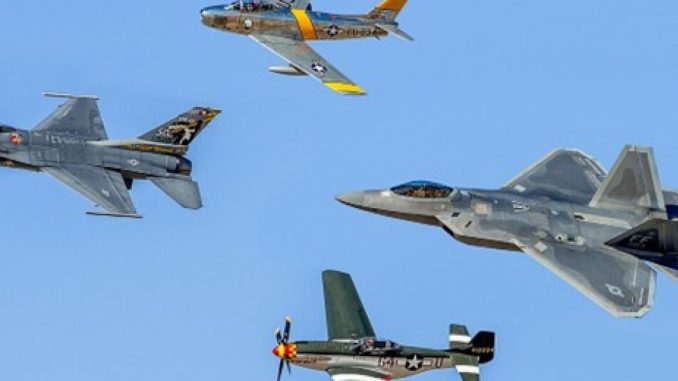
Military planes in flight. Credit: Wikimedia Commons
Published April 5, 2026
A dramatic U.S. military rescue operation deep inside Iran has captured global attention after a downed American airman was successfully extracted following a tense, multi-day manhunt in hostile territory.
The airman, part of a crew aboard a downed F-15 fighter jet, survived by hiding in mountainous terrain while evading Iranian forces and armed groups reportedly offered rewards to capture him. His eventual rescue marks one of the most complex and high-risk operations in recent U.S. military history.
Hiding in the Mountains, Evading Capture
After ejecting from the aircraft, the injured airman found himself alone in rugged terrain, forced to rely on elite survival training. Reports indicate he hid in a mountain crevice and remote high-altitude areas, remaining undetected even as Iranian search teams closed in.
Despite being wounded, he managed to move through difficult terrain and avoid capture for more than a day, drawing on Survival, Evasion, Resistance, and Escape (SERE) training designed for exactly this kind of scenario.
At one point, intelligence sources say he was nearly surrounded, with Iranian forces and local militias converging on his location.
A Race Against Time
The search for the missing airman quickly became a high-stakes race. Iranian authorities reportedly encouraged civilians to assist in locating the American, adding urgency to the rescue effort.
In response, the U.S. launched a massive recovery operation involving:
- Special Operations Forces
- Dozens of aircraft
- Intelligence support, including a deception campaign to mislead Iranian search teams
The CIA reportedly played a critical role by spreading false information suggesting the airman had already been rescued, buying valuable time.
The Rescue Mission
The extraction itself was a high-risk operation carried out under enemy pressure. U.S. forces deployed helicopters and elite units into Iranian territory while providing air cover to hold off approaching forces.
Gunfire was exchanged, and some U.S. aircraft reportedly sustained damage during the mission. Despite this, the operation succeeded without American fatalities.
In a final measure to protect sensitive technology, U.S. forces reportedly destroyed aircraft that could not be recovered.
The rescued airman was then flown out of Iran and transported to a secure location for medical treatment.
A Defining Moment in the Conflict
The incident marks a major escalation in the ongoing conflict between the United States and Iran. The downing of the F-15 — and the subsequent rescue — highlights both the risks faced by U.S. forces and the evolving nature of modern warfare.
It also underscores a key reality: even with advanced technology and air superiority, missions over hostile territory carry unpredictable and life-threatening consequences.
🔍 Critical View: Heroism on the Ground, Questions at the Top
The dramatic rescue of a U.S. airman hiding in the mountains of Iran is being hailed as a triumph of courage, training, and precision. And it is. Against overwhelming odds — hunted, injured, and isolated — that airman survived long enough for U.S. forces to bring him home. But behind the celebration lies a harder question: how did an American service member end up in that position in the first place?
Elite Forces, Extreme Risk
There is no doubt about the capability of U.S. forces. From Survival, Evasion, Resistance, and Escape (SERE) training to the rapid deployment of elite rescue teams, this operation showcased the very best of American military strength. The coordination, speed, and execution were extraordinary.
But the success of the rescue should not overshadow the reality that the mission itself placed personnel deep inside hostile territory, where even a minor setback could turn into a life-or-death crisis. When a jet goes down in enemy territory, the margin for error disappears instantly.
A Battlefield That Has Changed
What makes this situation even more dangerous is the nature of the environment. Reports of bounties offered to civilians and militias to capture the airman show how modern conflict has evolved. This is no longer just a fight between uniformed forces — it is a landscape where anyone can become a threat.
That raises serious concerns about the level of risk being accepted. When adversaries can mobilize both military and civilian actors, the danger multiplies, and recovery operations become exponentially more complex.
Strategic Decisions Under Scrutiny
This incident highlights a broader issue: operational excellence cannot compensate for flawed or overly aggressive strategic decisions. The U.S. military can execute complex rescues under fire, but it should not be placed in situations where such rescues become necessary in the first place.
The question is not whether the military can respond — it clearly can. The question is whether enough was done to minimize the need for such a response. Every mission carries risk, but not every risk is unavoidable.
👥 On the Ground: Survival, Pursuit, and a Race Against Time
On the ground in Iran, the reality was brutal and immediate. A downed U.S. airman, injured and alone, found himself in rugged mountain terrain with hostile forces closing in. Reports indicate he took cover in remote high-altitude areas, using the terrain to stay hidden while Iranian units and armed groups intensified their search — some reportedly motivated by financial rewards for his capture.
Survival in Hostile Territory
This was not just evasion — it was survival under extreme pressure. With limited supplies and no guarantee of immediate rescue, the airman relied on elite training to remain undetected. Every movement had to be calculated. Every decision could mean the difference between escape and capture.
The terrain itself became both ally and obstacle. Mountain crevices and elevation provided concealment, but also made communication and extraction far more difficult.
A Hunt Unlike Conventional Warfare
What unfolded on the ground reflects a shift in modern conflict. The airman was not just evading a structured military search — he was being pursued in an environment where irregular forces and civilians could join the hunt. This blurred battlefield creates unpredictable threats, where danger can come from any direction at any time.
Rescue Under Pressure
As the search intensified, U.S. forces launched a high-risk recovery operation. Timing was critical. The longer the airman remained exposed, the greater the chance of detection. Rescue teams had to navigate hostile airspace, uncertain intelligence, and the constant risk of engagement.
The successful extraction was not just a demonstration of capability — it was a race against a tightening window, where delay could have changed the outcome entirely.
🎯 The Final Word:
The rescue of the U.S. airman from the mountains of Iran stands as a powerful example of skill, coordination, and determination under extreme pressure. It proves that when everything is on the line, American forces have the capability to respond swiftly and bring their people home. But it also exposes the razor-thin margin between mission success and disaster when operations unfold deep inside hostile territory.
This incident is more than a story of survival — it is a reminder that strength is measured not only by how effectively crises are handled, but by how carefully they are avoided. The airman is home, and that is a victory. But the circumstances that led to his ordeal highlight the need for sharper judgment, clearer strategy, and a constant focus on minimizing unnecessary risk.
SOURCES: DAILYMAIL ONLINE – How US AirForce Colonel trekked a 7,000ft high ridge to evade Iranian forces with only a handgun while Trump dispatched rescue mission
THE GATEWAY PUNDIT – Several INCREDIBLE New Details Emerge on the Legendary Rescue of 2nd F-15 Pilot in Iran, Including a Clever Trick the CIA Pulled on the Iranians and a Final Twist