Published April 5, 2026
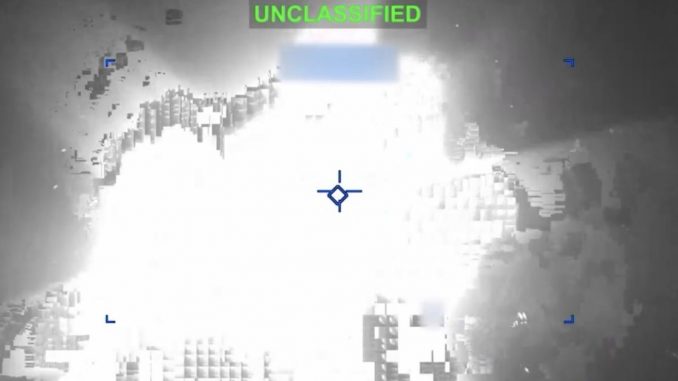
The U.S. military has released striking new footage showing an Iranian “suicide drone” being intercepted and destroyed, offering a rare glimpse into the fast-moving and increasingly dangerous air war unfolding across the Middle East.
According to U.S. Central Command (CENTCOM), the video captures the moment an Iranian one-way attack drone — often referred to as a “kamikaze drone” — was taken out before it could reach its intended target. These drones are designed to crash into targets and detonate, making them a growing threat across the region.
A New Kind of Battlefield Threat
The footage underscores how modern warfare is shifting. Unlike traditional aircraft, Iranian drones are often low-cost, hard to detect, and capable of flying at low altitudes, making interception more difficult.
This is not a theoretical threat. Earlier in the conflict, similar one-way attack drones were used in a deadly strike on a U.S. military position in Kuwait, killing American personnel and injuring dozens.
The ability of these drones to evade defenses — even briefly — has made them one of the most dangerous tools in Iran’s arsenal.
Part of a Wider Escalation
The release of the video comes as tensions between the United States and Iran continue to escalate. CENTCOM has increasingly published footage of strikes and interceptions, signaling both operational success and a message of deterrence.
Recent developments show that the conflict is expanding across multiple fronts — from airspace over Iran to key maritime routes and regional bases. Iranian drone and missile activity has already targeted infrastructure and military assets across the region, raising fears of a broader confrontation.
Air Superiority Still Tested
While the U.S. maintains significant technological and operational advantages, recent incidents — including the downing of a U.S. fighter jet — highlight that the threat environment remains highly contested.
The drone interception video serves as both reassurance and warning: American forces are capable of neutralizing threats, but those threats are becoming more frequent, more advanced, and more unpredictable.
🔍 Critical View: A Warning Shot in the Drone Age
The release of footage showing a U.S. interception of an Iranian suicide drone is being framed as a tactical success — and it is. The threat was neutralized, the system worked, and lives were likely saved. But the bigger picture raises a more serious concern: how often are these threats getting through, and how prepared are we for what comes next?
A Low-Cost Threat with High Impact
Iran’s use of one-way attack drones highlights a growing imbalance in modern warfare. These systems are relatively cheap, easy to deploy, and difficult to detect — yet they can inflict significant damage on high-value targets. This creates a dangerous equation where adversaries can overwhelm defenses not with sophistication, but with volume and persistence.
Reactive Defense vs. Strategic Prevention
Intercepting a drone mid-air is a success, but it is also a sign that the threat has already reached a critical stage. Each interception represents a moment where defenses are tested under pressure. The question is whether current strategy is too focused on reacting to attacks rather than preventing them at the source.
As drone warfare becomes more frequent, relying solely on interception risks turning defense into a constant game of catch-up.
Escalation in Plain Sight
The fact that such footage is being released publicly sends a message — but not just to domestic audiences. It signals that the conflict is intensifying and that drone activity is becoming a routine part of the battlefield. This normalization of constant aerial threats should raise concerns about long-term stability and the potential for miscalculation.
The Real Concern
This incident underscores a broader issue: technological advantage alone does not guarantee security. As adversaries adapt and exploit lower-cost tools, the gap between offense and defense narrows.
The successful interception is proof of capability. But the growing frequency of these threats is a warning. Strength is not just measured by the ability to stop attacks — it is measured by the ability to prevent them from becoming routine in the first place.
👥 On the Ground: Intercepting a Threat in Real Time
On the ground — and in the skies above the Middle East — the interception of an Iranian suicide drone was a split-second engagement with potentially devastating consequences. The footage released by U.S. Central Command shows just how quickly these threats emerge and how little margin for error exists once they are in motion.
Seconds to Respond
Operators tracking the drone had only moments to identify, confirm, and neutralize the target. Unlike traditional aircraft, these one-way attack drones are small, fast, and often fly at low altitudes, making detection difficult and response windows extremely tight.
The interception itself required precision — one miscalculation could have allowed the drone to reach its target, putting lives and critical infrastructure at risk.
A Persistent and Unpredictable Threat
What makes these encounters especially dangerous is their unpredictability. These drones can be launched with little warning, from multiple locations, and sometimes in coordinated waves. On the ground, this translates into constant alert status for personnel, where every unidentified object in the sky must be treated as a potential threat.
This is no longer occasional engagement — it is a continuous defensive posture.
Pressure on Frontline Defenses
Air defense teams are now operating in an environment where threats are frequent and evolving. Each interception demands coordination between radar systems, command units, and response teams, all working in real time under pressure.
Even a successful shootdown does not eliminate the broader risk. It only confirms that the threat has reached the point where immediate action is required.
🎯 The Final Word:
The successful interception of an Iranian suicide drone highlights both the strength and the strain of modern defense systems. It proves that U.S. forces can respond with speed and precision when threats emerge — but it also underscores how frequently those threats are now reaching critical stages.
This is no longer an occasional challenge; it is an ongoing test of readiness in an environment where low-cost weapons can create high-stakes consequences. Each interception is a win, but also a signal that the battlefield is shifting in ways that demand more than reactive defense.
The real measure of strength going forward will not just be stopping attacks in mid-air, but ensuring they are fewer, less frequent, and less capable of reaching the point where split-second decisions determine the outcome.
SOURCES: THE GATEWAY PUNDIT – WATCH: CENTCOM Posts Video of Iranian Suicide Drone Being Obliterated