by Diana Zapata • News Writer /Editorial Specialist
Published August 24, 2026
WASHINGTON — President Donald Trump has dramatically escalated his trade confrontation with Canada, announcing plans for 50% tariffs on Canadian cars, trucks, automotive parts and steel beginning Jan. 1, 2027, after negotiations between Washington and Ottawa broke down.
Trump announced the move Monday, accusing Canada of pursuing trade policies that have disadvantaged American workers and businesses. He also signaled that Canadian companies would not receive special treatment simply because the two nations have traditionally been close allies.
The announcement marks another major escalation in an increasingly bitter economic confrontation between the United States and its northern neighbor.
Trump Turns Up the Heat
Trump’s latest threat focuses heavily on Canada’s automotive and steel industries — sectors deeply integrated with the U.S. economy.
Under the proposed policy, vehicles and automotive parts imported from Canada would face a 50% tariff, while Canadian steel would also be subjected to the same rate.
The president has argued that companies producing inside the United States would have an advantage under his tariff strategy.
Trump’s move came after trade negotiations failed to produce a broader agreement between Washington and Ottawa. Reuters reported that the president announced the new auto and steel tariffs after talks with Canada broke down.
The White House’s strategy is clear: raise the economic cost of doing business with Canada in an effort to force Ottawa toward a more favorable trade arrangement.
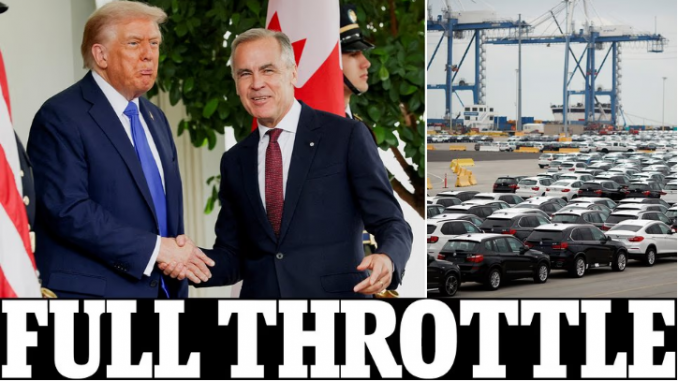
 President Donald Trump released a furious statement on Monday morning accusing Canada of ‘ripping off the United States of America for years.’ On Saturday, the US imposted a new 50 percent tariff on some Canadian goods after negotiations on a trade deal fell through
Carney Fires Back
Canadian Prime Minister Mark Carney is refusing to back down.
Carney has promised a “dollar-for-dollar” response to U.S. tariffs, with Canada’s retaliatory measures expected to target selected American products beginning Sept. 8.
Canadian officials have indicated that sectors including steel, dairy, appliances, agricultural equipment, paper and electronics could face retaliatory duties.
Carney has portrayed the confrontation as more than a routine trade dispute, arguing that Washington’s demands threaten Canada’s economic sovereignty.
“We’re the partner of choice in many respects for countries around the world,” Carney said, criticizing U.S. efforts to influence Canada’s future trade relationships.

‘Canada will match those tariffs dollar for dollar to protect our workers and businesses,’ Canadian Prime Minister Mark Carney said in a statement on Saturday shortly after the new rates went into effect
The Auto Industry Is Ground Zero
The automotive sector may become one of the biggest casualties of the escalating dispute.
The North American auto industry operates through a highly interconnected supply chain. Vehicles can cross the U.S.-Canada border multiple times during production, with engines, components, steel and other materials moving between factories on both sides.
That means a 50% tariff could potentially affect not only Canadian manufacturers but also American companies that depend on Canadian suppliers.
Carney has specifically criticized proposed U.S. treatment of Canadian-made vehicles and parts, saying Washington’s negotiating position would make some production less economically viable.
Canadian officials have also pointed to planned production at major facilities as an example of how tariff rules could disrupt investment and manufacturing decisions.
 ‘Tariffs on all Cars, Trucks, both large and small, Automotive Parts, and Steel, will be increased to 50%,’ Trump said on Monday. Above, a Toyota assembly plany in Ontario is shown
Canada Threatens a Broader Response
Ottawa’s response could extend well beyond automobiles.
Canada has already signaled that it intends to retaliate against selected American exports rather than simply absorb the additional costs.
The country’s government says the objective is to protect Canadian workers and businesses while maintaining leverage in future negotiations.
The dispute could therefore develop into a classic tit-for-tat trade war, with each government increasing tariffs in response to the other’s actions.
The latest U.S. measures already cover roughly $20 billion worth of Canadian goods, according to multiple reports.

Trump has long railed against automaker factories in Mexico and Canada. He has made it a priority to brink automotive manufcaturing back to the US
A Dangerous Moment for North American Trade
The economic stakes are enormous.
The United States and Canada maintain one of the world’s largest trading relationships, with hundreds of billions of dollars in goods and services moving between the two countries.
Axios reported that bilateral trade totaled approximately $376 billion during the first half of 2026 alone.
That means a prolonged trade war could create consequences far beyond Ottawa and Washington.
American manufacturers could face higher input costs.
Canadian exporters could lose access to their largest market.
Consumers on both sides of the border could eventually see higher prices.
And companies could begin reconsidering where they manufacture products.
 The fresh tariffs will impact Canadian hockey equipment in addition to the automotive sector
Trump Bets on Pressure
Trump has repeatedly embraced tariffs as a negotiating weapon, arguing that foreign governments have taken advantage of the United States for too long.
His approach is built around a simple proposition: make access to the American market expensive enough and trading partners will eventually agree to better terms.
Supporters say the strategy gives Washington leverage that traditional diplomatic negotiations lack.
Critics warn that tariffs can also become a tax on American businesses and consumers if companies pass higher import costs down the supply chain.
The Canada dispute will put that theory to a major test.
No Easy Way Out
Both governments now face a difficult choice.
Trump can continue escalating pressure and risk further damaging one of America’s most important trading relationships.
Carney can retaliate and demonstrate that Canada will not simply accept Washington’s demands — but potentially at the cost of greater economic disruption for Canadian businesses.
Neither side appears eager to blink first.
And that could make a negotiated settlement increasingly difficult.
What Happens Next?
The immediate question is whether the threatened January 1 auto and steel tariffs will actually take effect as announced or become another bargaining chip in negotiations.
Recent events show just how quickly the situation can change.
Earlier this month, Trump temporarily paused threatened Canadian tariffs after saying the two countries had reached a deal, only for negotiations to subsequently collapse.
That history suggests the current confrontation may still have several twists ahead.
But the rhetoric has become considerably more aggressive.
Carney has already promised retaliation.
Trump has demonstrated a willingness to escalate.
And businesses on both sides of the border are now being forced to plan for a much more uncertain trading environment.
💬 Overall Takeaway:
This is no longer a routine disagreement over tariffs.
Trump is betting that economic pressure will force Canada back to the negotiating table with a willingness to make deeper concessions. Carney is betting that Canada can withstand the pressure and respond without surrendering its economic independence.
The danger is that both sides could underestimate the damage of escalation.
A 50% tariff may be designed to protect American manufacturing and force better trade terms, but Canada can retaliate — and American manufacturers that depend on Canadian materials could feel the pain as well.
For consumers and workers, the question is ultimately much simpler than the politics:
Who pays the price if the world’s closest trading partners decide that neither side is willing to blink?
SOURCES: DAILYMAIL ONLINE – Trump explodes at Mark Carney as he announces 50 percent tariff on cars in trade war with Canada
THE HILL – Trump threatens 50 percent New Year’s Day tariffs on more Canadian goods
THE NEWS INTERNATIONALE – Carney vows action as Canada prepares response to Trump’s 50 percent tariffs