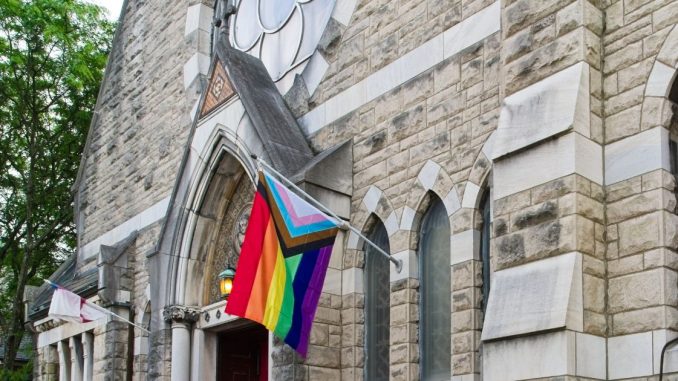
Saint Paul’s Episcopal Church in downtown Evansville, Indiana, with a rainbow flag out front on May 13, 2025. (Peter Blottman Photography / Getty Images)
by Diana Zapata • News Writer /Editorial Specialist
Published August 25, 2026
As reports continue to emerge of Christians being massacred by Islamist extremists in parts of Africa and the Middle East, an entirely different conversation is unfolding in American politics. The contrast has left many believers asking a difficult question: How did Christianity become portrayed as threatening in a nation founded on religious liberty while Christians remain among the world’s most persecuted faith communities?
The latest flashpoint comes from Iowa, where Democratic congressional candidate and Lutheran minister Sarah Trone Garriott is facing scrutiny over resurfaced remarks in which she said that the collision of faith and political power has made Christians feel “very threatening” to her. The comments, originally delivered during a 2023 church event, have reignited debate over whether political criticism of Christian nationalism is increasingly being interpreted as criticism of Christianity itself.
Two realities, one uncomfortable contrast

Yet in the United States, the political conversation often centers on a different concern: the rise of Christian nationalism—the belief, held by some activists and political movements, that America should explicitly prioritize Christian identity in government and public life. Critics argue this ideology can threaten pluralism and the separation of church and state, while supporters insist it is frequently used as a catch-all label to discredit ordinary Christians with conservative beliefs.
That distinction matters.
Opposing Christian nationalism is not inherently the same as opposing Christianity. But in today’s hyper-polarized political climate, the line between criticizing an ideology and condemning a religious community is becoming increasingly blurred.
A minister’s words under the microscope
Garriott’s remarks have drawn particular attention because she is not merely a politician—she is also an ordained Lutheran minister. Her critics argue that describing Christians as “threatening” sends a damaging message to millions of believers who view their faith as a force for compassion, charity, and service.
Supporters counter that the clip has been stripped of context. They maintain she was specifically warning about the fusion of religious authority with political power, not expressing fear of Christians as individuals. That distinction may satisfy some voters, but others see the wording itself as revealing how faith is increasingly framed through a political lens.
The danger of broad labels

Most Christians are neither militants nor theocrats. Most Muslims reject terrorism. Most people of faith simply want the freedom to worship without being treated as political caricatures. When public figures describe entire religious groups in language associated with danger or extremism, they risk reinforcing exactly the kind of division they claim to oppose.
America’s greatest strength has never been religious uniformity—it has been the constitutional promise that people of every faith, or none at all, may participate equally in public life.
Why this debate matters
The controversy arrives at a moment when faith is becoming increasingly central to electoral politics. From school prayer and parental rights to abortion and religious liberty, both major parties are appealing to voters through deeply moral and spiritual arguments. That makes precision in language more important than ever.
There is a legitimate debate over the influence of religion in government. There is also a legitimate concern about the global persecution of Christians. Both conversations deserve honesty rather than slogans, and neither should require portraying ordinary believers as enemies.
💬 Overall Takeaway:
For me, the most important issue in this controversy is not whether someone is a Democrat, Republican, conservative, or progressive. It is whether we can still have an honest conversation about faith without turning ordinary Christians into a political threat.
There is a legitimate and necessary debate about Christian nationalism, the separation of church and state, and the proper role of religion in government. Those issues should be discussed openly and critically. But that discussion should never require treating Christianity itself—or the millions of Americans who peacefully practice it—as something inherently dangerous.
That distinction becomes even more important when Christians in other parts of the world are facing persecution and, in some cases, deadly attacks because of their faith. Their suffering deserves to be acknowledged without turning it into a political weapon.
As I see it, political leaders have a responsibility to choose their words carefully, particularly when they are also religious leaders. Criticize an ideology when criticism is warranted, but do not allow that criticism to become a blanket judgment against the people who practice the faith.
America’s strength has always been its promise of religious freedom. Protecting that principle means making room for disagreement while refusing to demonize an entire faith community. That is the standard I believe political leaders—regardless of party—should be held to.