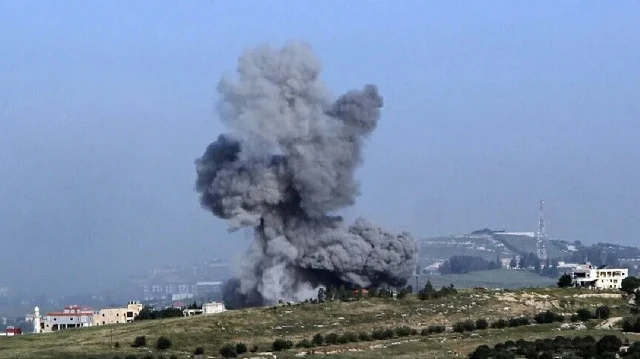
FILE: Israeli attack targets southern Lebanon despite ceasefire deal. / AA
by Diana Zapata • News Writer /Editorial Specialist
Published August 25, 2026
BEIRUT — Israeli forces carried out fresh airstrikes and artillery attacks across southern Lebanon this week, according to Lebanese state media, raising tensions along the Israel-Lebanon border despite a U.S.-mediated framework intended to reduce hostilities.
The latest reported strikes came Tuesday, when Israeli warplanes struck an area along the Litani River near the Deir Mar Mima monastery in Deir Mimas, according to Lebanon’s National News Agency. Artillery fire was also reported around Markaba in the Marjayoun district.
The developments underscore how fragile the current security arrangement remains as Israel and Lebanon attempt to prevent the conflict from spiraling into another major confrontation.
Israeli strikes hit southern Lebanon
Lebanese authorities reported several forms of Israeli military activity in southern Lebanon, including airstrikes, artillery shelling and movements of Israeli military vehicles.
New earth barriers were reportedly erected near the Deir Mimas-Burj al-Muluk-Kfar Kila junction, with one reported barrier located roughly 150 meters from inhabited homes.
Separate reports described additional attacks around Mays al-Jabal and Ainatha, illustrating the continuing military pressure across the southern border region.
Tensions persist despite U.S.-mediated deal
The latest attacks are particularly significant because they come amid a U.S.-mediated framework intended to stabilize the Israel-Lebanon front.
Lebanese officials and media have described Israeli military activity as a violation of the framework, while Israel has repeatedly maintained that its operations are aimed at threats and military infrastructure associated with Hezbollah.
The dispute highlights one of the biggest challenges facing any ceasefire arrangement: Israel says it must retain the ability to prevent Hezbollah from rebuilding its military capabilities, while Lebanese officials have demanded an end to Israeli military operations and greater respect for Lebanon’s sovereignty.
Southern Lebanon remains a flashpoint
Southern Lebanon remains one of the most dangerous areas in the region despite diplomatic efforts to reduce the intensity of the fighting.
Earlier this month, Israeli attacks reportedly killed at least 11 people in a single day, according to regional reports, in one of the most serious escalations since the latest ceasefire extension.
The continued military activity has also raised concerns about civilians attempting to return to communities near the border.
Is another confrontation with Hezbollah possible?
The immediate question is whether the latest Israeli strikes will remain limited military operations or become the beginning of another major confrontation with Hezbollah.
Israel has repeatedly said Hezbollah’s military infrastructure and weapons capabilities cannot be allowed to re-establish themselves near the Israeli border.
Hezbollah, meanwhile, remains a powerful armed organization inside Lebanon, creating a difficult situation for the Lebanese government as it attempts to strengthen the authority of the Lebanese state and its military.
The result is an increasingly complicated three-way pressure point involving Israel, Hezbollah and the Lebanese government.
Regional implications
Any major escalation in Lebanon could quickly become a broader Middle Eastern crisis.
The Israel-Hezbollah confrontation is closely connected to the wider regional struggle involving Iran and its network of allied militant groups. A significant escalation could therefore draw in additional actors and undermine diplomatic efforts aimed at stabilizing the region.
For Washington, the challenge is particularly serious. The United States has been involved in diplomatic efforts to maintain the Israel-Lebanon framework, but continued military activity demonstrates how difficult it is to translate a political agreement into lasting security on the ground.
What happens next?
1. Israel is likely to continue monitoring Hezbollah activity.
Israeli officials have consistently argued that military action is necessary to prevent Hezbollah from rebuilding offensive capabilities.
2. Lebanon will face pressure to strengthen state control.
The Lebanese government is attempting to increase the authority of its own military in southern Lebanon while dealing with Hezbollah’s continued influence.
3. U.S. diplomacy will be tested.
Continued strikes could put additional pressure on Washington to enforce or renegotiate the existing security framework.
4. Civilian concerns will remain at the center of the dispute.
Communities along the border remain vulnerable to renewed fighting, displacement and damage to homes and infrastructure.
💬 Overall Takeaway:
The latest Israeli strikes in southern Lebanon are another warning that the Israel-Lebanon conflict remains far from settled. The existence of a U.S.-mediated framework may have reduced some of the pressure, but it has not resolved the fundamental dispute over Hezbollah’s military capabilities, Israel’s security demands and Lebanon’s sovereignty.
The greatest danger now is not simply another isolated airstrike. It is miscalculation. A strike that produces significant casualties, a Hezbollah retaliation or an incident involving Lebanese forces could rapidly create pressure for both sides to escalate.
For civilians living in southern Lebanon, these geopolitical disputes are not abstract. They mean homes under threat, communities struggling to recover and families uncertain whether the next period of relative calm will actually last.
The coming days will be critical. If the latest strikes remain limited, diplomacy may still have room to prevent a wider conflict. But if Israeli operations intensify or Hezbollah responds militarily, the fragile security framework could face its most serious test yet.