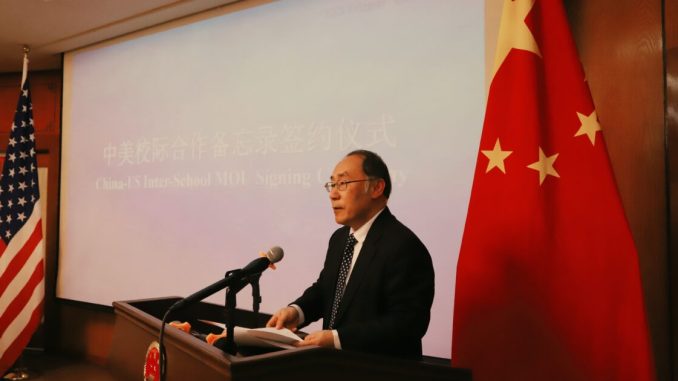
Consul General Wang Baodong attends a YES Friends Club event and a China-US interschool memorandum-signing ceremony with Chicago Public Schools. Photo courtesy of the Consulate General of the People’s Republic of China in Chicago.
Reported by:

Cherry Meigh Timbol
News Content Editor
Published September 12, 2026
Concerns over Chinese influence in American education are gaining renewed attention as reports examine Chinese-linked investment in U.S. private schools and other programs that provide access to American students.
The issue was highlighted by The Gateway Pundit in a September report examining claims that Chinese Communist Party-linked interests are gaining access to American high schools and other educational institutions.
The controversy goes beyond traditional Chinese-language and cultural exchange programs. Critics are increasingly focused on ownership, investment and institutional relationships that could give China-linked organizations a long-term presence inside the American education system.
One company receiving particular scrutiny is Spring Education Group, a large private-school network whose ownership structure has been linked to Hong Kong-based Primavera Holdings.
According to reporting by Texas Scorecard, Primavera and Spring have connections to businessman Fred Hu, who has served as an economic adviser to the Chinese government. The organizations have disputed allegations concerning Hu’s alleged Communist Party membership.
Spring Education Group operates numerous private schools in the United States. Texas Scorecard reported that the company owned 13 schools in Texas, operating under brands including Xplor Preschool & School Age Care, Honor Roll School and Paragon Prep.
The concern is not simply that Chinese investors may have an interest in American education. Rather, critics argue that ownership or financial relationships involving entities connected to China could create potential avenues for foreign influence, access to student information and ideological pressure.
Florida previously raised concerns
The issue has already prompted government action.
According to Texas Scorecard, the Florida Department of Education suspended four schools owned by Spring Education Group from receiving school-choice funds in 2023 after an investigation identified what the department described as direct ties between Spring and the Chinese Communist Party through Primavera.
Florida officials subsequently raised concerns about allowing taxpayer dollars to support schools connected to a foreign adversary.
The controversy illustrates why the question of foreign ownership of educational institutions has become a national-security issue rather than simply a business matter.
Exchange programs also under scrutiny
The concerns extend beyond ownership.
A separate report examined a China-linked exchange initiative involving American K-12 schools and universities.
According to that reporting, researchers identified connections between the initiative and schools and universities across 30 states, including 83 universities. Critics cited the program’s stated ideological connections to Marxism-Leninism and Xi Jinping Thought as reasons for increased scrutiny.
Erika Sanzi of Defending Education argued that the concern is not with international educational exchanges generally, but with programs involving organizations connected to the Chinese Communist Party.
She called for greater transparency concerning foreign-linked partnerships involving American schools.
That distinction is important. International educational exchange is common and can provide legitimate cultural and academic benefits. The question being raised by critics is whether American institutions are adequately examining the organizations funding or facilitating those exchanges.
Congress has already taken action
The issue has also reached Capitol Hill.
The House Select Committee on the Chinese Communist Party has announced legislation aimed at restricting Chinese Communist Party influence in American schools, describing foreign influence over U.S. education as a national-security concern.
The broader concern is consistent with warnings from U.S. intelligence and law-enforcement officials.
The FBI has previously warned that the Chinese government seeks to influence American lawmakers and public opinion and has described Chinese efforts to obtain economic, technological and political advantages inside the United States.
The FBI has also warned that American academic institutions can be targets for Chinese intelligence and influence operations, while emphasizing that legitimate international scholarship and collaboration remain valuable.
Why schools matter
American schools occupy a uniquely sensitive position because they provide access to young people, families, educators and communities.
Critics argue that foreign-linked organizations operating within education can potentially gain influence over curriculum, cultural programming, student exchanges and institutional decision-making.
There is also concern about student information. Texas lawmakers previously warned that foreign-linked ownership within K-12 education could create potential pathways for data exploitation and long-term ideological influence.
China’s own education system provides additional context for the debate. Chinese authorities have increasingly emphasized Communist Party oversight and Xi Jinping Thought throughout the country’s education system.
That does not establish that Chinese-linked investment in an American school automatically means the school is controlled by Beijing. It does, however, provide context for why policymakers are examining the issue more closely.
The bigger question
The central issue is not whether American students should learn about China, study Mandarin or participate in international exchange programs.
The question is who controls the organizations providing those opportunities, where their funding originates, what access they receive, and whether American parents and government officials have enough transparency to evaluate potential conflicts of interest.
As Chinese-linked investments and partnerships continue to receive scrutiny, lawmakers and parents are likely to demand greater disclosure from schools receiving foreign investment or participating in foreign-sponsored programs.
For American education, the debate is increasingly moving beyond the classroom and into the realm of foreign influence, data security and national security.
🧩 Bottom Line:
The available evidence supports growing scrutiny of Chinese-linked investment and partnerships involving American schools, but claims that the Chinese Communist Party is directly controlling every institution mentioned should not be presented as established fact without additional evidence.
What is clear is that federal and state officials are increasingly treating foreign influence in American education as a legitimate national-security concern. The question now is whether existing disclosure and oversight rules are strong enough to ensure that American schools remain accountable to American students, parents and communities.
SOURCES: THE GATEWAY PUNDIT – China’s Communist Party Buying Access to US High Schools
VISION TIMES – Chicago Public Schools’ China Partnerships Draw New Scrutiny