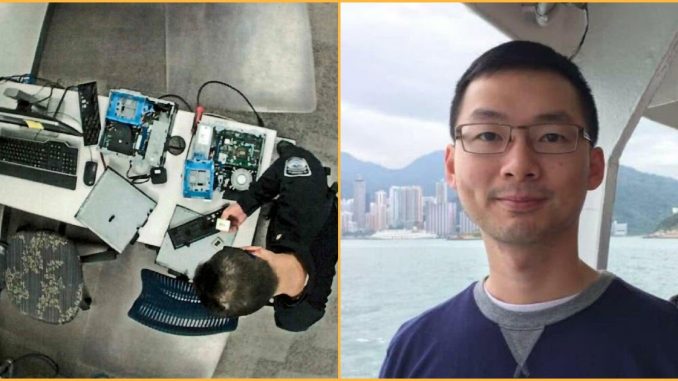
A Customs and Border Protection supervisor assigned to the Maine-Canada border has been arrested and charged after FBI agents say he was caught on hidden camera tearing apart government computers, ripping out processors and memory, stuffing in cheaper parts, and plugging the machines back into CBP’s network.
Reported by:

Cherry Meigh Timbol
News Content Editor
Published September 12, 2026
CALais, Maine — A Customs and Border Protection supervisor assigned to the Maine-Canada border has been arrested after federal investigators accused him of secretly removing components from government computers, replacing them with older or lower-quality hardware, and returning the machines to the federal network.
Terry “Jiajia” Liu, 39, a Chinese national originally from Guangzhou, was arrested in Maine and charged with theft and damage to government property. According to an FBI affidavit cited in federal court records, investigators identified 46 CBP computers at three Maine border facilities that had allegedly been modified without authorization.
The case has raised serious questions about security and oversight inside a federal agency responsible for protecting the nation’s borders.
Liu was assigned as a CBP supervisor at the Calais Port of Entry, with responsibilities extending to the Ferry Point and Milltown facilities. Although his position reportedly included limited information-technology responsibilities, investigators say he had no authorization to open, alter or replace components inside CBP computers.
The allegations are particularly notable because CBP officials had reportedly warned Liu directly about handling government computer equipment.
In March 2025, Calais Port Director Theodore Cummings sent Liu a written instruction telling him not to move computers or computer parts and directing equipment problems through the agency’s established information-technology work-ticket system.
Months later, CBP personnel reportedly discovered that approximately 23 computers had been altered. A subsequent inventory expanded the number to 46 machines — 38 at Calais, six at Ferry Point and two at Milltown.
According to the FBI affidavit, investigators found that processors, memory modules and hard drives had been removed from government computers and replaced with components that did not meet the agency’s original specifications.
Some machines originally equipped with 14th-generation Intel processors allegedly received older processors or Intel Pentium chips. Other computers reportedly had less memory or storage than they originally contained.
Government Parts Allegedly Traded for Credit
Investigators also allegedly uncovered evidence connecting missing computer components to an electronics trade-in program.
According to the affidavit, Liu sent emails from a personal account to his official CBP email address containing shipping labels and trade-in information for processors matching components missing from government computers.
Federal investigators reportedly obtained records showing Liu received credit for trading in 14th-generation Intel Core i7 processors on multiple occasions between May 2025 and July 2026. The FBI also identified Newegg credits in his American Express records.
The criminal complaint alleges that Liu stole 10 Intel processors valued at more than $1,000 between approximately May 2025 and January 2026. A second count alleges that he damaged or attempted to damage CBP computers between January and March 2026, resulting in more than $1,000 in damage or attempted damage.
The government estimates that restoring the altered components would cost approximately $20,460. Replacing all 46 computers was estimated at roughly $105,800, not including additional configuration costs.
Hidden Cameras Captured Alleged Modifications
The investigation escalated after federal agents installed surveillance cameras at the facility.
The FBI affidavit describes footage allegedly showing Liu opening government computers during overnight shifts, removing components and installing replacements.
In one incident on January 9, investigators reportedly observed Liu carrying computers into a training room shortly after midnight. He allegedly removed their side panels, worked on internal components and replaced a processor.
Investigators also said he moved components between machines and connected computers to monitors, keyboards and network cables to test them.
In another incident, a camera allegedly captured Liu removing a memory module from a computer and placing it inside his desk drawer before taking the computer into a server room and reconnecting it to a monitor and network equipment.
The allegations become particularly significant because some of the modified computers were subsequently connected to the CBP network.
FBI Says Espionage Has Not Been Alleged
Despite the national-security implications of the case, the FBI affidavit reportedly does not allege that Liu installed malware, conducted espionage or transmitted government information to a foreign government or outside party.
That distinction is important.
The current allegations center on unauthorized modification and theft of government property rather than a proven Chinese espionage operation.
Nevertheless, the circumstances have prompted questions about how a foreign-born individual working in a supervisory position at a sensitive federal facility was able to access government computers and allegedly alter their hardware repeatedly.
According to the FBI account, Liu acknowledged during a September 9 interview that he replaced CBP components with older parts purchased from Amazon and Newegg and used government components for trade-in credit.
Investigators say his explanation changed during questioning. He allegedly first claimed that he was attempting to improve computer efficiency but later acknowledged that he knew the replacement components reduced performance. According to the affidavit, Liu said he was frustrated with the length of time required to repair CBP computers.
Prosecutors Seek Detention
Federal prosecutors have argued that Liu presents a flight risk.
Assistant U.S. Attorney Chris Ruge reportedly cited Liu’s recent and frequent international travel, financial resources and foreign connections in seeking continued detention.
His residence near the Canadian border was also cited as a concern, with prosecutors arguing that even electronic monitoring might not prevent him from leaving the United States.
Liu appeared before U.S. Magistrate Judge John C. Nivison in Bangor and was temporarily held without bail pending a detention hearing. He waived a preliminary hearing but requested a hearing concerning the government’s detention request.
A separate report cited by The Maine Wire says Liu was apprehended at Bangor International Airport while allegedly attempting to board a flight to China, although the court records reviewed by the publication did not independently confirm the circumstances of his apprehension.
A Border-Security Question Beyond One Employee
The allegations against Liu remain accusations, and he is entitled to the presumption of innocence unless proven guilty in court.
But the case nevertheless exposes a troubling vulnerability: federal computers located inside facilities responsible for securing America’s international border were allegedly opened and altered by an employee who had specifically been instructed not to handle the equipment.
The FBI investigation indicates that the alleged modifications continued over an extended period and involved dozens of machines across multiple facilities.
Whether the case ultimately proves to be a straightforward theft scheme motivated by frustration and financial gain, or whether investigators uncover additional information, remains to be seen.
For now, federal authorities have not alleged that Liu conducted espionage or placed malware on CBP systems. The central accusations are that he illegally removed government components, replaced them with inferior hardware and returned altered machines to government use.
The incident is likely to fuel renewed scrutiny of employee screening, access controls and internal cybersecurity procedures at sensitive federal facilities — particularly those operating along the nation’s international borders.
Liu remains accused, not convicted, and the allegations will be tested in federal court.
Terry Liu remains in federal custody after prosecutors argued his travel history, resources and home near Canada made him too risky to release while the case moves forward. pic.twitter.com/iTxb0QlUu2
— The Maine Wire (@TheMaineWire) September 11, 2026
🧩 Bottom Line:
The allegations against Terry “Jiajia” Liu raise serious questions about security and oversight at a sensitive U.S.-Canada border facility. Federal investigators allege that Liu repeatedly removed and replaced components from CBP computers and used government hardware for trade-in credit.
However, there is currently no allegation in the FBI affidavit that Liu engaged in espionage, installed malware, or transmitted government information to China. He remains presumed innocent unless and until proven guilty in federal court.
The case now moves forward as authorities determine the full scope of the alleged computer modifications and whether additional charges or findings will emerge.
SOURCES: THE GATEWAY PUNDIT – Chinese National Working as CBP Supervisor at Maine-Canada Border Caught on Camera Swapping Hardware Inside Homeland Security Computers — Then Putting Them Back on the Government Network
THE MAINE WIRE – Chinese National Accused of Illegally Modifying Homeland Security Computers at Maine-Canada Border Station
PRESS HERALD – Border Patrol supervisor in Maine accused of modifying government computers