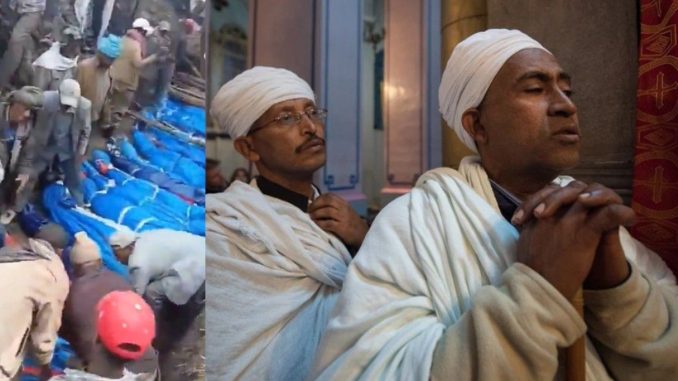
Christians remain under attack in Ethiopia, where gunmen killed at least 34 Orthodox Christians in Endato on November 5, 2026. This file photo shows funeral services at Abu Aregawi Church for victims of the earlier Mai Kadra massacre. Photos via social media
Reported by:

Cherry Meigh Timbol
News Content Editor
Published November 10, 2026
At least 34 Ethiopian Orthodox Christians were killed in an armed attack in the village of Endato, in Ethiopia’s Oromia region, on November 5, according to reports from local media and international news organizations. The incident represents another deadly episode in a series of attacks against Orthodox Christian communities in the country’s Arsi Zone.
The latest attack occurred in Robe district, East Arsi Zone, where armed assailants reportedly targeted residents, destroyed homes and businesses, and left several people injured. Community members gathered the bodies of victims at Endato Debre Mitmaq St. Mary Church.
The reported death toll remains subject to verification. Some local accounts cited higher figures, while the widely reported minimum stands at 34. No organization has publicly claimed responsibility for the November 5 assault.
A Series of Deadly Attacks
The Endato killings followed two earlier attacks in October that left at least 60 Orthodox Christians dead, according to the Ethiopian Orthodox Tewahedo Church.
On October 20, gunmen reportedly killed 14 people in Gora Silingo, in Merti district. Four days later, another attack in the villages of Tereta, Chole and Birbo, in Shirka district, killed at least 46 people, according to the Church’s Holy Synod.
The attacks also resulted in burned homes and numerous injuries. The World Council of Churches expressed concern over the repeated violence, noting that Orthodox Christian communities in the region include people of both Amhara and Oromo backgrounds.
With the additional 34 reported deaths in Endato, the minimum reported toll from the three October and November attacks reached at least 94 people.
The Ethiopian Human Rights Commission previously confirmed 48 deaths in connection with the October 24 violence, including local security personnel. It attributed the attack to the Oromo Liberation Army (OLA), an armed group fighting the Ethiopian government.
However, responsibility for the November 5 attack has not been established, and the circumstances surrounding the separate incidents should not be treated as conclusively identical.
Ethiopian Authorities Face Questions Over Security
The violence has intensified scrutiny of the Ethiopian government’s ability to protect civilians in Oromia, a region that has experienced prolonged armed conflict.
The Ethiopian Human Rights Commission has previously identified the Oromo Liberation Army as responsible for the October 24 attack. The armed group has denied targeting civilians in previous incidents.
Meanwhile, the Oromia regional government announced that dozens of people had been detained following the October attacks.
The World Council of Churches has called on Ethiopian federal and regional authorities to strengthen security measures, protect vulnerable communities and conduct impartial investigations.
The organization also emphasized that Orthodox Christians from different ethnic backgrounds have suffered from the violence, warning against allowing religious and ethnic divisions to deepen.
Democrats’ Congressional Victory and the Nigeria Controversy
The latest Ethiopian killings have also drawn attention because they occurred shortly after Democrats secured control of both chambers of the U.S. Congress in the November 3, 2026, midterm elections, according to the Associated Press.
The political connection highlighted in the original report involves Representatives Gregory Meeks and Sara Jacobs, two Democratic lawmakers who previously challenged President Donald Trump’s approach to violence against Christians in Nigeria.
In a November 3, 2025, statement, Meeks and Jacobs argued that violence involving farmers and herders in Nigeria was driven by several factors, including resource scarcity and land competition, rather than religion alone.
They also warned that Trump’s threats of military intervention could involve the United States in another conflict.
Their statement acknowledged that terrorist organizations had killed both Christians and Muslims and stressed the importance of protecting all Nigerian communities.
However, the lawmakers’ comments concerned Nigeria, not Ethiopia. There is no established evidence that their position on Nigeria influenced the Ethiopian government’s response to the attacks or the security situation in Oromia.
The Associated Press confirmed that Democrats won control of both the House and Senate in the 2026 midterm elections, marking a significant political shift in Washington.
International Concern Over Religious Freedom
The repeated attacks have raised broader concerns about the safety of religious minorities and the protection of civilians in Ethiopia.
The Ethiopian Orthodox Tewahedo Church has called for stronger government intervention and accountability for those responsible. International religious organizations have also urged authorities to prevent further attacks and ensure that victims receive humanitarian assistance.
The November 5 killings underscore the continuing challenges facing communities in Oromia, where armed conflict, ethnic tensions and religious divisions have contributed to prolonged insecurity.
Investigators still face the task of establishing who carried out the latest attack and whether the victims were specifically targeted because of their religious identity.
For affected families, the immediate priorities remain justice, protection and the ability to live and worship without fear of further violence.
The Bottom Line
The reported killing of at least 34 Orthodox Christians in Endato brings the minimum reported death toll from three attacks in Ethiopia’s Arsi Zone to at least 94 in less than three weeks.
While the attacks have raised serious questions about religious persecution and civilian protection, responsibility for the latest killings remains unconfirmed.
The political debate in Washington over the treatment of Christians in Nigeria is a separate issue. Nevertheless, the developments highlight the importance of consistent international attention to religious freedom and the protection of civilians, regardless of their faith or nationality.