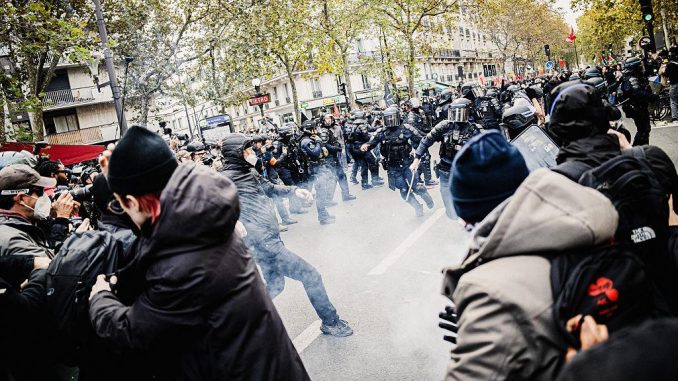
Thousands of students, teachers, and labor union members take to the streets of Paris, France, during nationwide demonstrations on November 10, 2026. Protesters march with banners, placards, and union flags, demanding better education funding, higher wages, improved working conditions, and stronger public services amid growing social and economic tensions.
Reported by:

Cherry Meigh Timbol
News Content Editor
Published November 11, 2026
PARIS – Several of France’s largest trade unions have called a new interprofessional strike for Tuesday, Nov. 17. Student protests, now in their third month, are continuing alongside them.
The CGT, UNSA, FSU, Solidaires, CFE-CGC and FA-FP announced the strike after meeting the government on Monday, Nov. 9. They are asking private- and public-sector workers to strike, and retirees, pupils, university students and yellow-vest protesters to join marches.
More unions may back the call before the date. CGT leader Sophie Binet urged workers to decide in general assemblies whether to walk out. Retirees are due to demonstrate on Thursday, Nov. 19. As of Monday, no strike notice had been filed for the RATP or SNCF transport networks.
The call follows the Nov. 5 strike. The Interior Ministry’s preliminary estimate was about 600,000 demonstrators, while the CGT reported nearly 1.6 million. The ministry deployed 70,000 police and gendarmes. Government figures put participation at 16% of teachers and 9.89% of civil servants. Prime Minister Sébastien Lecornu then convened unions and employers at Matignon. The unions left unconvinced.
The wider movement began with high-school pupils. Their protests have continued for nearly two months despite the government’s concessions. Two weeks ago the government promised to overhaul the Parcoursup university-placement platform from 2027 and replace it in 2028, along with more money for school buildings and extra resources for the most deprived schools.
Most pupil and student groups and education unions walked out of a meeting on the reform to protest the presence of far-right and business representatives.
Figures on school blockades are disputed. On Nov. 3, authorities said 48 of France’s 3,700 high schools were blocked, while the Union syndicale lycéenne said 500. Student and education unions called new action on Nov. 10, with further protests announced for Nov. 14, 17 and 19.
Most protests have been peaceful, but there have been isolated incidents. On Monday, firework mortars were set off inside two schools in Seine-et-Marne, and two pupils were injured at one of them. Police arrested five people after trouble outside schools in Le Havre and Rouen.
After Nov. 5, authorities reported 448 arrests and 53 police officers injured. Some weekend marches have drawn smaller crowds. The Interior Ministry reported about 7,000 participants by 2 p.m. at a recent Saturday protest.